

Would You Stop at the Store? A Sales Lesson in Consistency
Salespeople often ask me, “What’s the most powerful principle of influence when it comes to sales?”
While every sales situation is different, I believe the principle of consistency is often the most powerful influence principle in the sales process.
Why? Because the best salespeople talk less.
That may sound strange, especially if your experience with sales involves someone talking nonstop about features, benefits, and special offers. But after more than 20 years studying sales and reading countless books, articles, and research studies, one theme consistently emerges: top salespeople spend far more time asking questions and listening than talking.
Many sales experts suggest that effective salespeople talk only 25% to 30% of the time. The rest is spent uncovering what matters most to the customer.
That’s where consistency comes in. Dr. Robert Cialdini’s principle of consistency teaches that people feel both internal psychological pressure and external social pressure to act consistently with what they’ve previously said and done. We like to see ourselves as people who follow through on our commitments, and others tend to view us more favorably when we do.
In other words, people are naturally motivated to align their actions with their own words and that has enormous implications for sales.
Good salespeople don’t use questions merely to gather information. They use questions to help customers clarify what they truly want and need. Once those needs are clearly stated, the salesperson can demonstrate how their solution aligns with what the customer has already identified as important.
As I often tell participants in my workshops: “People don’t resist their own values.”
Let me illustrate with a simple example.
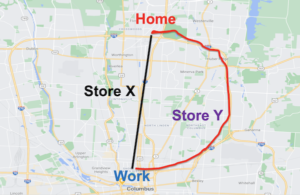
Imagine you work about 15 miles from home and drive the same route every day.
Now suppose someone at home calls and asks: “Would you stop at the store on your way home and pick up batteries and bug spray?”
If the items are available at Store X, which sits just a minute or two off your normal route, the answer is probably an easy yes.
Why? Because the store is already aligned with where you’re going.
But what if the items are only available at Store Y, several miles out of your way, possibly adding 20 minutes or more to your trip?
You might hesitate. Not because you don’t want to help, but because it’s inconvenient. It takes you off the easy, convenient path you take every day.
Unfortunately, that’s exactly what happens in many sales conversations.
When salespeople ask thoughtful questions early in the process, customers articulate their goals, challenges, priorities, and desired outcomes. The salesperson then demonstrates how their offering fits those stated needs… creating a more “direct route” toward a solution.
The purchase becomes the equivalent of stopping at Store X—it’s already on the customer’s route.
However, when salespeople shortchange the discovery process, they often find themselves trying to persuade customers to take a completely different path. They spend their time explaining, convincing, defending, and overcoming objections because they never established where the customer wanted to go in the first place.
That’s Store Y. It’s harder. It takes longer. And it often feels like selling.
Jeffrey Gitomer famously said: “People don’t like to be sold, but they love to buy.”
The best sales conversations don’t push people toward a destination they never chose. They help people move toward outcomes they’ve already identified as important.
That’s why consistency is such a powerful principle. When customers tell you what matters most, and you can genuinely connect your solution to those priorities, saying “yes” feels natural because it’s consistent with what they’ve already said they want.
So here’s a question worth considering: Are your sales questions leading customers toward Store X or forcing them toward Store Y?
The answer may reveal why some sales conversations feel effortless while others feel like an uphill battle.
Know your product. Know your competition. But most importantly, know the right questions to ask because the shortest path to a sale is often helping customers follow the path they already chose.
Edited with ChatGPT
Brian Ahearn
 Brian Ahearn is the Chief Influence Officer at Influence PEOPLE and a faculty member at the Cialdini Institute. An author, TEDx presenter, international speaker, coach, and consultant, Brian helps clients apply influence in everyday situations to boost results.
As one of only a dozen Cialdini Method Certified Trainers in the world, Brian was personally trained and endorsed by Robert Cialdini, Ph.D., the most cited living social psychologist on the science of ethical influence.
Brian’s first book, Influence PEOPLE, was named one of the 100 Best Influence Books of All Time by Book Authority. Persuasive Selling and Influenced from Above were Amazon new release bestsellers. His LinkedIn courses on persuasive selling and coaching have been viewed by over 850,000 people around the world and his TEDx Talk on pre-suasion has more than a million views!


Great example on using consistency. Even if the the customer does buy what they didn’t want, they will be more apt to complain, not give a good reference or possibly return the product.
Good observation Pete. Thanks for chiming in.