
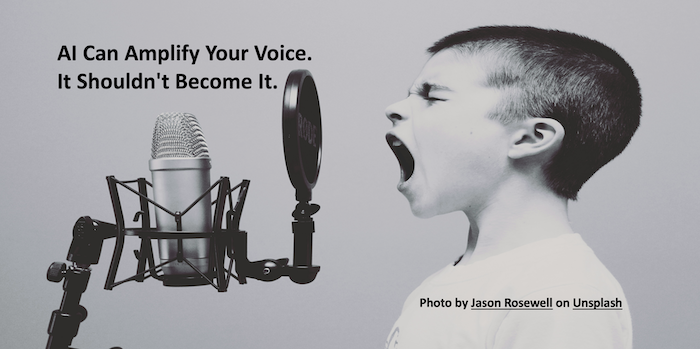
AI Can Amplify Your Voice. It Shouldn’t Become It.
A little over a month ago, I wrote an article titled “Is AI Making Us Lazy Influencers?“ The topic is top of mind again after reading a LinkedIn post that began with this attention-grabbing statement: “I don’t use AI to write my content.”
The author quickly explained that statement wasn’t a badge of honor. His point was this—what matters isn’t who writes the content—it’s whether the content provides value.
I agree…to a point.
Great ideas are great ideas, whether they were polished with AI or not. I use AI regularly. It helps me organize my thoughts, challenges my assumptions, improves my clarity, and edits my writing.
But I think there’s an important distinction that often gets overlooked. There’s a difference between using AI to improve your thinking and using AI to replace your thinking. That difference matters.
Imagine you’ve read all four of my books. You’ve watched my LinkedIn Learning courses, followed my videos, and regularly read my LinkedIn posts.
Then we meet and within five minutes you realize something doesn’t add up. The person standing in front of you doesn’t sound anything like the person whose content you’ve been consuming. The words, ideas, and knowledge don’t align.
Eventually you discover the truth. I didn’t write the books. I didn’t write the articles. I didn’t develop the ideas. AI—or someone else—did. (That’s not the case!)
Would you feel disappointed? I know I would.
There’s an old example that perfectly illustrates the point. Back in the late 1980s, Milli Vanilli became one of the biggest acts in music. They won awards, sold millions of albums, and built an enormous following.
Then people discovered they hadn’t actually sung the songs. Their careers collapsed immediately. The issue wasn’t that the music suddenly became bad. The issue was authenticity. People believed they were admiring one thing when, in reality, they were getting something else.
I wonder if we’re creating a modern version of that with AI-generated content.
Suppose I discovered that some of my favorite authors—Dallas Willard, C.S. Lewis, or others—hadn’t actually written the books that shaped my thinking. Those books wouldn’t suddenly become less insightful. But my respect for those individuals would disappear.
Why? Because I wasn’t simply buying information. I was investing my trust in the person behind the ideas. That’s where influence comes in.
One of Dr. Robert Cialdini’s principles of influence is Authority. We naturally place greater trust in people who possess genuine expertise. But genuine expertise has to be genuine.
If AI is generating your ideas, your examples, your stories, and your conclusions, what expertise are you actually demonstrating? Eventually you’re no longer showcasing your thinking. You’re showcasing your prompting. Those aren’t the same thing.
Don’t misunderstand me. I’m a fan of AI. I use it almost every day. Sometimes I use it to help me process thoughts, much like I’d talk through an idea with a trusted friend. Other times I use it to edit articles, improve flow, or point out blind spots in my reasoning.
It’s an outstanding collaborator but it’s a poor substitute for your own experience. The stories you’ve lived, the mistakes you’ve made, the lessons you’ve learned, and the convictions you’ve developed cannot be replaced by AI because it never lived them. Those are the very things that make your voice unique!
Ironically, I think the people who will benefit most from AI over the next decade won’t be those who rely on it the most. They’ll be the people who have spent years developing real expertise and then use AI to communicate that expertise more effectively.
AI can amplify your voice. It should never become your voice.
A question to ponder: Where do you draw the line between using AI as a tool and allowing it to become the author of your expertise?
Edited by ChatGPT
Brian Ahearn
 Brian Ahearn is the Chief Influence Officer at Influence PEOPLE and a faculty member at the Cialdini Institute. An author, TEDx presenter, international speaker, coach, and consultant, Brian helps clients apply influence in everyday situations to boost results.
As one of only a dozen Cialdini Method Certified Trainers in the world, Brian was personally trained and endorsed by Robert Cialdini, Ph.D., the most cited living social psychologist on the science of ethical influence.
Brian’s first book, Influence PEOPLE, was named one of the 100 Best Influence Books of All Time by Book Authority. Persuasive Selling and Influenced from Above were Amazon new release bestsellers. His LinkedIn courses on persuasive selling and coaching have been viewed by over 850,000 people around the world and his TEDx Talk on pre-suasion has more than a million views!


Leave a Reply
Want to join the discussion?Feel free to contribute!