Tag Archive for: Politics

Some Problems with American Politics

I spent a good bit of time before New Year’s
flipping between CNN, MSNBC and Fox News to find out about the progress being
made on the “fiscal cliff” talks. The more I thought about that fiasco the more
I decided to share my view of the problems in American politics.
The average American seems to understand much
more than our elected officials. Married people know if you want a marriage to
work you need to learn to compromise. For the most part the ability to
compromise is seen as a good thing in life – except with our politicians.
In order to get out of the primaries,
representatives have to pander to the extreme elements in their party. That
means politicians take a hard line on many issues. They soften only slightly in
the general election with a goal of winning over as many undecided voters as
possible because neither party has such a stronghold that they can rely solely
on their base to get them elected.
Once the elected officials get to Washington
they’re beholden to those who elected them and the extreme positions they
espoused. The principle of consistency, the psychological
trait that tells us people want to be consistent in word and deed, makes it
difficult for politicians to move from their original positions even if new
data dictates that doing so would be best for the majority of Americans.
Despite what we learned about democracies and
majority rule it’s never that simple because of procedural rules that allow
each party to bring things to a halt or a snail’s pace. While there are good
reasons for these rules, they seem to be abused by both sides and the result is
the gridlock we’ve seen in Washington for far too long.
Another issue is the mentality politicians
seem to have about re-election. It’s almost the same mentality American businesses
now have about quarterly earnings. Businesses can be so focused on the
short-term that they make bad long-term decisions. For example, too often
companies don’t make needed investments in things like technology in order to keep
expenses low and boost quarterly earnings which makes the stock price look good.
In the same way politicians seem to do what’s best for them in the short-term
(i.e., get re-elected) as opposed to the long-term good of the country.
Personally I think term limits would help alleviate
this to some degree.
Lastly, I’ll share what I call “the law of the
gym.” When I was just out of college I was competing in bodybuilding contests.
My weight was around 225 lbs. and I would diet down to about 195 lbs. for
competitions. I quickly learned I could not burn enough calories through
exercise alone to lose those 30 lbs. In fact, exercising too much would
eventually be counter-productive to my goal. To put this in perspective,
consider this – running two miles burns approximately 250 calories or the
equivalent of a Snickers bar. Which is easier to do, run two miles or skip the
candy bar? It was obvious I needed to restrict my diet in certain ways. The
good news was, between the exercise and dieting I was always able to reach my
goal weight.
Let’s apply “the law of the gym” to politics
and our current debt situation. Tax revenues are like exercise; we can’t raise
them enough to get out of debt and raising them too much could actually hurt us
if jobs are lost. Our nation needs to go on a diet – spending cuts – in addition
to our exercise – recent tax increases. To go on spending as we are will only
cause the debt to grow. Hopefully our politicians can reach some compromise and
start reducing government spending so the debt begins to come down.
And speaking of the debt, we’ve become desensitized
to how large it’s become. Hundreds of millions, billions and trillions are
figures that no longer cause us to bat an eye. Only when you compare and contrast the debt to something
can you begin to wrap your mind around it, so here’s a comparison point for
you.  If you spent $1 million a day since
the time of the Egyptian empire you would only pay off a trillion dollars of our
debt. More than 2,700 years at a million dollars a day hardly makes a dent!
Now consider our national debt at roughly $16
trillion. If we could pay it down by $1 million a day it would take us more than 48,000 years to pay it off!
When politicians talk about it being immoral to pass on our debt to the next
generation that’s not as big a problem as passing our debt on to  thousands of generations! How would you feel if we were still paying down the
debt of the ancient Egyptians or Romans?
I no longer consider myself an affiliate of
either party because neither represents my views any longer. There are elements
of each that I agree with but there’s so much with both that I disagree with
that I can’t consider myself a Republican or a Democrat. It’s my hope that
sometime during my lifetime we get a third or fourth alternative to choose from
because right now most of us find ourselves choosing between the lesser of two
evils.
Brian, CMCT®
influencepeople 
Helping You Learn to Hear “Yes”.

How is the Wealth Pie Divided?

I read an article in The Atlantic recently that was a bit shocking and eye-opening, titled “Americans Want to Live in a Much More Equal Country (They Just Don’t Realize It).”  The article focused on people’s ideal, actual estimate, and the reality of how American wealth is divided up amongst the population.
Let’s suppose there are 100 people in a fictitious society and the average “wealth” per person is $50,000, for a total of $5 million in wealth for the whole society. Of course that $5 million would not be divided evenly because some people do better than others whether through luck, perseverance, or a little of both. On the opposite end, some don’t do well for a host of reasons.
Speaking of how well people do, let’s divide the 100 people into five groups of 20, so we have the bottom 20%, the next 20%, the middle 20%, another 20%, and finally, the top 20%. My question for you would be this: how would you divide the wealth pie between the five groups? In other words, how much of the $5 million should each group get?
In the article referenced above, people were asked a similar question without referring to actual dollars. According to their answers, in an ideal society, the top 20% would get 32% of the wealth. That would translate into $1.6 million, or 60% more than everyone would get in an “even” split. Then they were then asked to estimate how much total wealth the top 20% actually had, and they guessed almost 60%, which would translate into $3 million of our $5 million pie.
So what was the actual split in America? The top 20% in our society have 84% of the wealth, or $4.2 million of the $5 million pie! More shocking than that, is what the bottom 40% have to split – a whopping .3%. That means in our fictitious society the bottom 40% would have $15,000 of the $5 million wealth to share among 40 people. You read that right, $15,000 to share among 40 people.
In the field of influence, we talk about the contrast phenomenon which tells us what is presented first, i.e., how things are ordered, can make all the difference in how people assimilate the information. On this subject, in an article I posted last year, I wrote:
“We would do well to always ask ourselves what we’re comparing to and whether or not it’s a valid comparison or the best comparison. For example, I heard on a conservative news channel the Illinois state legislature was considering a 66% increase in the state income tax. Wow, that should be cause for revolt in this economy! But here’s the perspective from the other side; the state income tax would only go up 2 percentage points. And here’s where both comparisons come from; the tax will go from 3 percent to 5 percent. That’s 2 percentage points, a 66% increase. I’m sure those opposed to the tax talked about a 66% increase whereas those in favor focused on the 2 percent change. Both are valid and both will elicit completely different responses! Compared to what?”
As people see the inequity in our country more clearly it’s a sure recipe for discontent and that discontent will manifest itself somehow. We saw the beginnings of that with the “We are the 99%” and “Occupy Wall Street” movements. I don’t think people expect everyone will get the same slice of the pie but many feel they have very little opportunity to better themselves because of the obstacles they face. On the other end there’s the old saying, “the rich get richer,” because wealth reinvested usually creates income without the obstacles so many people have to overcome.
With the presidential election coming up, both sides are talking about the same issues but in very different ways. How each candidate presents his case will impact how Americans think about the issues and ultimately vote. As we struggle with record deficits, there is quite a bit of talk about how to rein the deficit in. In the most basic terms we can collect more money through taxes, reduce government spending, or have some combination of the two. My encouragement to you is simply this; during the election season pay very close attention to what is presented and how it’s presented so you can make the most informed choice.
Brian, CMCT
influencepeople 
Helping You Learn to Hear “Yes”.

Why the “We are the 99%” Movement?

Earlier this year a movement began in the United States known as “We are the 99%.” If you live in America it’s hard to believe you would not have heard about it because of the considerable media coverage the Occupy Wall Street protesters have received in major cities across the country. It’s a good bet most of my foreign readers have heard about it too because of the world-wide economic depression we find ourselves in, and of some similar protests internationally.

Why such dissatisfaction in the land of opportunity, the country where almost everyone wants to live? Certainly the financial crisis that led to the economic downturn in 2008 helped start the movement as many unemployed and underemployed Americans looked at what they perceive to be injustice caused by Wall Street and other large financial institutions.
I believe one psychological reason for the movement is rooted in a phenomenon Robert Cialdini, PhD., likes to call “compare and contrast.” This phenomenon tells us we experience things as being more different than they actually are depending on how they are presented.
According to the Congressional Budget Office, between 1979 and 2007 Americans known as “the middle class,” approximately 60% of wage earners, saw their income increase by 40%. Most people would say that’s not bad, until they compare it to the top 1% of American wage earners who saw their income increase an average of 275% during the same period. To make matters worse, when you group the bottom 90% together that group actually saw their incomes go down by $900. While the reasons for these gaps are many, the bottom line is this; it’s human nature to compare and contrast and the widening gap is a cause of discontent.
Is a person good looking? You can only make that determination by comparing that person to other people. Do you make a lot of money? Again, that’s a relative term and can only be answered by comparing your income to someone else’s. Many people are happy with their salary…until they find out they make significantly less than some coworkers. When it comes to compare and contrast, we all do it to one extent or another.
We live in a time of unprecedented wealth and even people who don’t earn much live far better than their relatives from decades ago. Indeed, it’s rare when Americans don’t have cable television, a computer in their home and a cell phone – hardly necessities of life. Yet there’s a tremendous amount of dissatisfaction because of the perceived income gaps and that they only seem to be growing larger as time goes by.
How did we get here? One statistic I share in my Principles of Persuasion workshop has to do with CEO pay. In 1980 a typical CEO made about 42 times more than the average American worker. By 1990 that figure had grown to 109 times. In 1993, the Fed mandated full disclosure of CEO compensation in an effort to help curb this trend but unfortunately their plan backfired big time. I bet you didn’t know this; by 2005 the difference between the typical CEO and average American worker’s pay had ballooned to 525 times! You read that right. In all fairness, in more recent years the gap has shrunk to a mere 269 times.

How could this have happened? After all, some of the thinking behind the full disclosure of compensation was to let everyone see how much CEOs and other top executives were earning so stockholders could put the brakes on the incredible income growth. It failed because of consensus.

Consensus, sometimes referred to as social proof, is the principle of influence that tells us we look to the actions of others when making decisions and this is heightened when we’re not completely sure what to do. Prior to the federal mandate about compensation disclosure it was an educated guess as to what the market was paying other CEOs in a given industry. Once it because public knowledge it wasn’t unlike what we see with star athletes in sports. Salaries for those athletes have skyrocketed because once an athlete knows what other top performers make their sports agent begins to negotiate an even bigger deal for the athlete. It’s a keep up with the Jones’ mentality and so it’s been with CEO compensation.
Perhaps we’ve now reached the point the Feds thought we would back in the early 1990s when they implemented the full disclosure rule. The Fed thought people would say “enough is enough” back then but it seems to have taken a worldwide economic depression to wake up the voice of the majority of Americans. Where it goes is yet to be seen because there will be a tug of war between the average American comparing their income to the top earners and the power of consensus as companies vie for the best CEO talent they can find.

Brian, CMCT
influencepeople 
Helping You Learn to Hear “Yes”.
Do We Need Term Limits for a Better America?

In November many Americans went to the polls to vote on various issues. In less than a year we’ll go back to vote in the Presidential election so the rhetoric will heat up with each passing month until November 2012. Knowing this I thought it would be a good time to look at a political issue – term limits – through the lens of influence.

Precedence was set with American presidents when George
Washington declined to run for a third term and based on his actions no president ran for a third term in office until Franklin Roosevelt did so in 1944. The unusual circumstance of a world war in two major theatres was a big reason for FDR’s decision. However, not long afterwards the American people passed the 22 Amendment which limited a United States president to a maximum of two terms in office.
For some reason Americans have not done the same thing when it comes to term limits for congressman and senators. While some states enacted laws to limit the terms of their particular representatives in Washington in an effort to move away from “career politicians” the U.S. Supreme court overturned those laws saying states could not limit the term of national offices.
I’m not going to argue if term limits are good or bad. Like just about anything in life there are positives and negatives to each side of the argument. What is concerning is whether or not the best people get elected and whether or not we’re getting fresh political ideas simply because of how voters make decisions.
I remember my pastor saying, “People will remain the same until the pain of being the same is greater than the perceived pain of change.” That’s akin to, “If it ain’t broke don’t fix it.” Americans saw voter revolts in 1994 when republicans swept into power in the house and senate and again in 2010 because of our economic woes. Both times there was so much dissatisfaction with the status quo that people kicked out many incumbents. My question is, why do we have to wait for things to get so bad before we act? “If it ain’t broke, don’t fix it,” sounds good until you consider Steve Jobs and his iPhone. We didn’t need the iPhone because nothing was broken but we’re better off for it. Perhaps we could have the same fresh ideas and change in Washington if we routinely had new people in office.
Politicians are famous for saying things like, “We have term limits because voters can always vote someone out of office if they want to,” and, “Why do we need to restrict voter freedom?” Of course both arguments could be used against term limits for the president and yet as a country we thought it was good to limit the terms for the highest office in the land. I suspect career politicians are thinking first and foremost about self-preservation, not the good of the country.
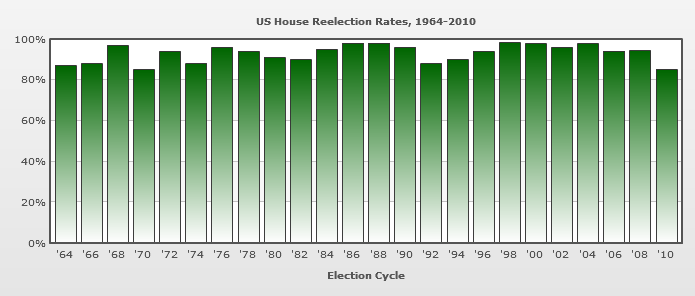
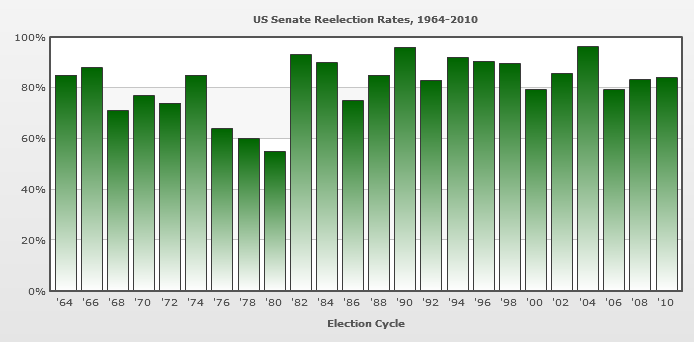
But I digress and you’re wondering how influence ties into this. It will come as no surprise to readers when I state the obvious; nearly every sitting politician wins re-election the vast majority of the time. In fact, it’s staggering how often they win. Take a look at the charts below showing reelection rates for U.S. congressman and senators from the Center for Responsive Politics.


Are incumbents winning so often because they’re the best candidates? Hardly. It’s simply a function of familiarity. People go to the polls and tend to vote for the person they’re most familiar with and the farther you go down in terms of elected offices the worse it is because quite often people vote for the incumbent simply because they know nothing about the other person running. When you’ve seen or heard about your congressman for the past four years or your senator for the last six years that’s a lot of familiarity for a challenger to overcome.
On this subject, in his book Influence Science and Practice, Dr. Cialdini wrote, “Often we don’t realize that our attitude toward something has been influenced by the number of times we have been exposed to it in the past.” And it’s not just how often we hear a name it’s how much we see the face. Sitting politicians are routinely seen in the news and that helps unless their face is connected to a scandal. I can tell you from firsthand experience that I get much better response to my emails when I include my picture at the bottom of the email because familiarity helps.
While there many other things that come into play during an election we can’t underestimate the importance of simply being more familiar with one candidate vs. another. It’s the way we’re wired.
To be sure we – the typical American voter – are partly to blame because we’re notoriously disengaged when it comes to knowing the candidates, their positions, and understanding the issues. If anyone didn’t need term limits it would be presidents because I’d venture to guess we know presidential candidates better and understand the presidential issues more because of how much they’re in the media vs. lower offices and more localized issues.
In a sense terms limits save us from ourselves and how our decision making might be working against us. My boss likes to say, “If you always do what you’ve always done, you’ll always get what you’ve always got.” In other words, how can we expect anything different from Washington when we keep electing the same people for the most part? Yes, we can make a concerted effort to become more informed voters but with less than 60% of people of voting age voting in every presidential election since 1968 do we really think that will happen? I certainly don’t. Sometimes we need laws to protect ourselves from ourselves and I’d say term limits would be one such law.
Brian, CMCT
influencepeople 
Helping You Learn to Hear “Yes”.
Consistency in American Politics

I know conventional wisdom says we should not talk about sex, religion or politics but I’m going to go against that wisdom this week to talk about something I observe in American politics that hurts all Americans. The genesis of this post is seeing yet another story about the political fight going on regarding America’s growing debt and the debate on how to handle the debt ceiling crisis.

I’m not big on politics and offer no solutions to our problems. We elect people to solve those problems just like we hire accountants to help us with taxes and lawyers to help answer legal questions. We share our goals with those professionals so they can come up with solutions that best suit us and we essentially do the same with elected representatives.

A big problem with politics stems from the principle of influence known as consistency. This principle tells us people feel internal psychological pressure to remain consistent in word and deed. Normally this is very good because it motivates people to do what they said and adhere to their word. When people don’t follow through we usually look down on them. When I lead a Principles of Persuasion workshop I usually ask participants to describe people who are not consistent and a few words I typically hear include: unreliable, flaky, wishy-washy, and inconsistent. Occasionally someone will go against the tide and say “flexible.”

Rigidly adhering to your word can come back to haunt you if it’s proven your original stance was wrong or circumstance require a change. I’m sure President George Bush Sr. wishes he never uttered, “Read my lips – no new taxes.” When it became clear taxes had to go up he lost all credibility with the American public.

Unfortunately, most American politicians pander to the faithful of their party in order to get elected and in doing so they make public statements in no uncertain terms about what they will or won’t do. They leave no room for change lest they get branded by an opponent as unreliable, flaky, wishy-washy, and inconsistent.

To be sure politicians should have convictions and share those with the public so we can make the best informed decision on who we want to represent us. However, when they dig themselves into positions so deeply that there’s no room for real dialog with the other side and potential compromise for the good of the country then we get what we have now – political gridlock.

Of course each person will tell us they’re just carrying out the wishes of their constituents back home and simply doing what they were sent to Washington to do. As far as I’m concerned that’s a meaningless bunch of drivel! Anyone can use that line to justify nearly any vote they make. It’s analogous to the defense lawyers declaring “the system works” because Casey Anthony got off. The same thing could have been uttered by prosecutors if she had been convicted. If the system works no matter what the verdict then the phrase is meaningless…or maybe the process is!

The following is my opinion only so you can take it or leave it but I still get to write it because it’s my blog. I want elected officials who have one overriding goal, the good of the country. If that means setting aside some ideology so compromise can be reached then so be it. Or perhaps they can start by telling voters what they stand for but that they’re willing to change if necessary for the good of the country.

Next week we’ll get back to the series I’m doing on influence tips for restaurant owners. Until then, thanks for faithfully reading and for allowing me to rant a little this week.

Brian, CMCT
influencepeople
Helping You Learn to Hear “Yes”.