
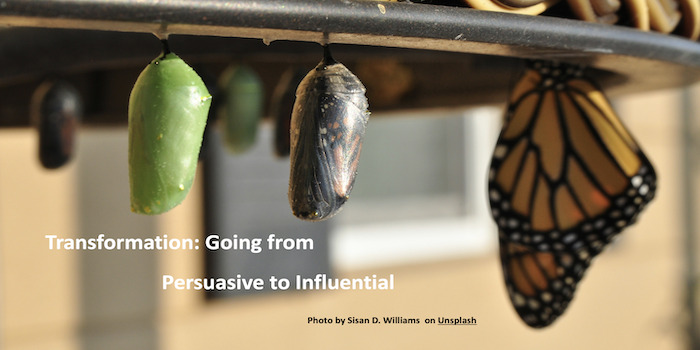
Transformation: Going from Persuasive to Influential
You can learn what to say to become more persuasive. But who are you becoming as you learn to say it?
That question gets at the difference between applying influence principles and allowing them to change us on the inside, and as a result, how we relate to people.
I experienced something similar when I became a runner. For years, I lifted weights and competed in powerlifting and bodybuilding. At that time, if you’d asked me about running, my response would have been, “I hate it!” Why burn precious calories that could be put to better use in the gym?
About a decade after I stopped competing, a friend convinced about a dozen of us that we could run the Columbus Marathon. With some prompting from my wife, I decided to give it a shot.
Much to my surprise, I began to enjoy running, especially how I felt afterward. Eventually, I fell in love with it and somewhere along the way, my identity changed. I no longer saw myself as a weightlifter, I was runner!
Getting up early to run in the dark became a natural part of my life. I didn’t have to debate the decision every morning. Runners run, and I was a runner.
That didn’t mean running became effortless. My lungs burned during speed work. My legs ached during long weekend runs. Marathon training still demanded discipline and effort, but the willingness came more naturally.
That distinction was highlighted this weekend while listening to a Dallas Willard podcast about the transformed life.
When Doing Flows from Becoming
Some of the things Jesus calls us to do can seem incredibly difficult.
- Love your enemies.
- Turn the other cheek.
- Embrace meekness in a world that rewards displays of power.
If I’m filled with resentment, loving an enemy will feel like a battle. If I’m determined to prove I’m right, responding gently may feel almost impossible. I can try to force the right behavior but something deeper needs to change.
In the Christian life, that ongoing transformation is called sanctification. As we learn to trust Christ and become more like Him, our responses can begin to flow from the inside, from a changed heart.
Loving a difficult person may still be costly. Responding with patience will still require effort. But the willingness to take those steps gradually becomes easier because those actions increasingly reflect who we are becoming.
Just as becoming a runner changed my relationship with running, inner transformation changes our relationship with what Jesus calls us to do.
What Does This Have to Do with Influence?
When I teach influence, people learn practical ways to communicate more effectively. Those skills matter. Knowing how to make a clear request, establish credibility, or find common ground can make a meaningful difference. But there’s another question to consider:
Are we only becoming better at gaining agreement, or are we becoming people others have good reason to trust and follow?
In Influenced from Above, I explore connections between Dr. Robert Cialdini’s principles of influence and faith.
Consider liking. Finding similarities and offering sincere praise can strengthen a relationship. As we become more interested in others, those practices grow out of genuine curiosity and appreciation. This can become a first step towards brotherly love for another.
With unity, recognizing a shared identity can make agreement easier. That connection also invites us to care about another person’s well-being because we see ourselves as belonging together. This exemplifies agape love.
Commitment and consistency remind us of the importance of keeping our word. Letting our yes be yes and our no be no builds trust through everyday faithfulness.
And reciprocity helps explain why generosity often invites generosity in return. The Golden Rule takes our attention beyond the return: How would I want to be treated if I were in this person’s circumstances?
These principles help us understand influence. Inner transformation shapes the reasons we use them to serve other. It all but removes the need to consider the difference between manipulation and ethical influence. After all, I wouldn’t manipulate a friend and I’m sure you wouldn’t either.
Practice with a Deeper Purpose
We don’t have to wait until we’re transformed to begin. Practice matters because doing often leads to becoming. I became a runner by running, and we can grow in generosity, honesty, and care by practicing them.
But the goal reaches beyond mastering an influence approach. It’s becoming someone whose words and actions consistently express a sincere concern for others. Someone who can accept a “no” without abandoning the relationship. That’s when ethical influence begins to flow from who we are.
Something for you to consider: What began as a skill you practiced that eventually became part of who you are?
Edited by ChatGPT
Brian Ahearn

Brian Ahearn is the Chief Influence Officer at Influence PEOPLE and a faculty member at the Cialdini Institute. An author, TEDx presenter, international speaker, coach, and consultant, Brian helps clients apply influence in everyday situations to boost results.
As one of only a dozen Cialdini Method Certified Trainers in the world, Brian was personally trained and endorsed by Robert Cialdini, Ph.D., the most cited living social psychologist on the science of ethical influence.
Brian’s first book, Influence PEOPLE, was named one of the 100 Best Influence Books of All Time by Book Authority. Persuasive Selling and Influenced from Above were Amazon new release bestsellers. His LinkedIn courseson persuasive selling and coaching have been viewed by over 850,000 people around the world and his TEDx Talk on pre-suasion has more than a million views!


Leave a Reply
Want to join the discussion?Feel free to contribute!