Tag Archive for: consensus

Helping Teens Balance Peer Pressure and Authority Figures

A week ago, Abigail graduated from the 8th grade. To most people, that’s not a big deal—unless you happen to be a parent. Like most things kids do—sports, school plays, and moving on to the next grade—they’re not terribly significant events in and of themselves, but they help shape who we are and who we become.

What’s significant about Abigail’s situation is that entering high school next year will be a HUGE change—much more than for the typical kid. You see, she’s gone to the same school her whole life, Polaris Christian Academy, with basically the same group of friends. There were only a dozen kids in her class and just four girls, including Abigail.

In the fall, she’ll attend Westerville South High School, which means she goes from the small, private Christian school environment to a huge public school—from a tiny class to one that will have more than 400 students! And did I mention that none of the kids she knows will go to her new school? It could make for a lonely, difficult time.

In early May, she posted on Facebook, “Another awards chapel were im the only one left in my row, 9 yrs of that, hmm getting kinda tired of it :/” As a parent, seeing something like that breaks my heart.

Consensus—that desire to be part of the crowd—is an incredibly strong psychological force, especially for kids. Not being part of the group is tough because they’re fighting physical pain when they’re excluded. That’s right: being excluded from a group registers in the brain as physical pain! Watch this short video of Dr. Robert Cialdini as he explains this interesting scientific finding.

So how’s a parent to deal with this?

I believe there’s potentially good and bad in everything. Some “good” things become bad when we abuse them, and some “bad” things turn out to be good for us if we deal with them the right way. As a parent, one of my responsibilities is to help Abigail learn this truth so she can overcome obstacles and enjoy life to the fullest.

All of this started me thinking, and I noticed something about her personality. While all her friends were doing things together when they were younger, Abigail worked for four years to earn her black belt in taekwondo. When her girlfriends all went out for cheerleading, she didn’t—because it wasn’t for her. When they all played basketball over the winter, she passed to play club volleyball, where she didn’t know anyone. While her friends were all on stage for the plays the last few years, Abigail decided she’d rather be backstage working the lights.

After thinking about this, I told Abigail I was proud of her. She didn’t quite get it, but I explained that she showed strength of character to be okay with not being a part of everything everyone else did. If she can deal with not partaking in the fun activities her friends were doing, and if she can deal with the feelings of being singled out because she didn’t get awards when most other kids were recognized, then I have confidence she’ll be her own person as she takes this big step in life and moves into a totally foreign environment in high school.

On a similar note: several years ago, while at camp, Abigail didn’t finish all her food, so the camp counselor said she’d have to sing in front of the other campers. She doesn’t like to sing, so she dug her heels in and said she wouldn’t. And despite the fact that her mom was sitting there watching—embarrassed, I might add—Abigail didn’t give in.

Again, I saw this as a learning opportunity. After that incident, I told Abigail that her mom had shared the story with me, and that I was proud of her. She had a hard time understanding that one, too. I explained that she shouldn’t just do what everyone asks her to—or tells her to—and that the camp incident was good training. I followed that up by telling her she’d have to accept the consequences that come with saying “no” to people, and that there would certainly be consequences for saying no to an authority figure like a teacher.

I hope you see where I’m going with this.

As I wrote earlier, consensus can be a powerful psychological force, and sometimes it can lead us to do things we ought not to. By the same token, authority is a powerful influence as well. Sometimes we do things simply because someone we perceive to be an authority tells us to. Part of learning to navigate life as an independent adult is knowing whom to say “yes” to—and whom to say “no” to.

So here’s my encouragement to those of you who are parents:
Understanding how the principles of influence can be used against you or your kids is just as important as learning how to ethically use them. Talk to your kids about this, because it will give them the tools necessary to make better, more informed choices.

You’ll be glad you did.

Brian
influencepeople
Helping You Learn to Hear “Yes”.

Swept Along on the Highway of Life

I was driving into work not long ago and came across what I thought was a metaphor for life. I hit the road early, shortly before 7 a.m. on a beautiful spring morning to get a head start on my day. There was not a cloud in the sky, but there was a little chill in the air, and as I made my way east on the outer-belt I was struck by the fact that there were very few cars on the road. Seeing that made me glad I’d decided to head to the office early. Unlike some major cities, Columbus traffic isn’t bad at all if you leave a little earlier than normal. When I do that, I can make it from my driveway to the State Auto parking lot, nearly a 15-mile journey; in 20 minutes or less if there are no accidents or road construction.

As I enjoyed my coffee, alone with my thoughts, I noticed there were cars well behind me and some a good distance in front. Like most people I don’t quite adhere to the speed limit, so I was going about 70 mph in a 65 mph zone. The further I drove the more I noticed the cars behind me continuing to gain on me until all of a sudden, I was surrounded by cars.

I don’t know about you, but I tend to keep pace with traffic almost unconsciously. In this case, before I realized it, I was actually going 80 mph! As I shared, like most people I flirt with speeds just above the speed limit but usually not 15 mph so once I recognized what I was doing I slowed down and boy was I glad I did because a few moments later I saw a highway patrol car join us on the drive.

After giving quick thanks for slowing down and avoiding a possible ticket I began to analyze the situation. Only after the fact did I realize how I was being swept along on the highway of life. The principle of influence that was at work on me is known as consensus, sometimes called social proof. This psychological principle describes the human tendency to look towards many other people, or people we see as similar to ourselves, for clues about how to act in certain situations.

Despite knowing the speed limit many of us don’t adhere to it and a big reason we don’t is because we observe so many others not obeying the law. And, sometimes in doing so we find ourselves doing things we might not do in the absence of other people. Case in point, I was perfectly content with my 70 mph speed until other cars surrounded me traveling much faster. It wasn’t even a conscious choice to speed up but before I knew it, I had.

This applies to much more than just the highway. You might be reading this feeling a bit of pride because you don’t change your driving habits based on the habits of other drivers but there are many ways consensus might be at work on you:

  • Do you stand during standing ovations…even when you didn’t like the performance? Most people do.
  • Does your dress conform to those around you? If you doubt it just loo
    k at some old photos and you might be hit with this thought, “What was I thinking when I wore that outfit?”
  • Have you ever tried a restaurant dish because, “It’s our most popular menu item”? Part of reason the dish remains so popular is that little phrase used by the server.
  • If you’ve had a question, have you ever held it until a few others asked questions first? It’s amazing how group dynamics change after one person breaks the ice.

These are all simple ways we’re influenced by the actions of others, the power of the crowd. Some people call it good etiquette; others call it being polite or good manners. However, you label it it’s still the same because we’re unconsciously driven to do things and act in ways because of how we observe others.

This isn’t a bad thing. In fact, most of the time following the actions of others has very good consequences for us. We feel a sense of belonging, we are more readily accepted into groups, and we avoid conflict. However, there are times when it can lead us astray and have very bad consequences.

  • Excessive speeding can be dangerous to us and others.
  • For teens, wanting to fit in can lead to bad choices when it comes to drinking, drugs and sex.
  • Following the crowd at work because “everybody does it” can cost you your job.

Most of the time I’m trying to get you to see ways to ethically use influence and persuasion to hear “Yes!” This week I encourage you to take time and reflect on why you’re doing some of the things you’re doing. Do you really want to do them or are you feeling internal pressure to conform? Are the choices you’re making in your best interests or are they to please some group? There are people out there who understand influence and persuasion, but their intent isn’t ethical, it’s one sided for their benefit. If you’ll pay attention as you’re swept along on the highway of life, you’ll retain control of where you go, when you want to go and the path you’ll take to get there.

Brian
Helping You Hear “Yes!”

Influence Approaches for Different Personality Styles

Last year I started holding bi-monthly lunch ‘n learn sessions for people who’d been through my Principles of Persuasion workshops. During our time together we discuss different aspects of influence and people participate in interactive exercises to help keep their influence skills sharp. The group is usually 30-40 managers and supervisors from different departments at State Auto. A couple of weeks ago I co-lead a session along with Mike Rau, a State Auto manager, where we talked about strategies for influencing different personality types.

Now I have to tell you up-front; to my knowledge there are no scientific studies on which principles of influence have the most impact on different personality styles. What I’m going to share is my personal opinion based on experience, my understanding of the principles of influence and more than 15 years in sales training.

The chart below, or something similar, might be familiar to those of you who’ve taken different personality tests over the years. It’s a simple way to categorize people based on their orientation. It looks at whether individuals are more task-oriented vs. people-oriented on the vertical axis. The horizontal axis determines whether people are more oriented towards taking fast action, telling people what to do and controlling others vs. people who are inclined to be slower to act, and ask more questions rather than directing people.

Ask – Slower
Control Self
Task-Oriented
Tell –
Faster
Control Others
Thinker
Analytical
Pragmatic
Driver
Facilitator
Amiable
Influencer
Expressive

People-Oriented
Across the population spectrum about 25% of people fall into each category. Below are the different personality styles, some traits associated with each and bullet points for the principles of influence that should be most impacting. The goal here is to give you a quick reference to fall back on when it’s obvious someone has a strong orientation in one of these four personality areas.

Pragmatic/Driver: Example – Jack Welch former CEO of GE. The pragmatic wants quick results, gets to the point, task-oriented, more controlling of others, acts first then thinks, assertive, risk taker. The best principles of influence when dealing with this personality type would be:

  • Authority – They may not care what the crowd says but prove your point with the opinion or experience of an expert or someone they respect or admire, and they’ll listen.
  • Scarcity – Drivers are successful because they win! Show them what they might lose if they don’t do what you’re asking and you’ll grab their attention.
  • Consistency – Their self-confidence makes them believe they’re right so they might seem like they stubbornly hold to an opinion. If you can tie your request to what they’ve said or done in the past your odds of success will go up.

Influencer/Expressive: Example – Oprah Winfrey. The influencer is focused on social groups and events, more in tune with people than tasks, imaginative, usually sway others, and likes innovation. The best way to engage these individuals would be using the following principles of influence:

  • Sarcity – Influencers don’t want to lose out on opportunities to move people to action. Talk about how they might lose an opportunity and you’ll have a good chance of hearing “Yes!”
  • Reciprocity – They understand how engaging with favors helps because they frequently use that tactic when they persuade. Do something for them and they’ll try to return the favor to build their network.
  • Liking – Expressive people are talkers and quite often like to talk about themselves. Pay a genuine compliment or ask about something they’re into and they appreciate you for taking interest.

Facilitator/Amiable: Example – Sandra Bullock. Facilitators like stable relationships, focus on feelings, less assertive, more people-focused, slow to change, and wants product support. The psychology of persuasion to utilize for this group would be:

  • Consensus – Because they’re so likable and want everyone to get along showing them what many others are already doing will help your case.
  • Liking – They naturally like others and want to be liked so use liking to come to know them and like them and you’ll increase your chance to influence.
  • Reciprocity – Giving small gifts, time, effort, etc. conveys thoughtfulness to the facilitator and will likely be returned in kind.

Thinker/Analytical: Example – Albert Einstein. Thinkers are task-oriented, slower to act, exert self-control, less assertive, data-oriented, prudent, systematic, logical, look to track records/trends. When dealing with this type of person you should look to use the following principles of influence:

  • Authority – Because they think long and hard about things they place a high premium on expert advice.
  • Consistency – Again, because they think before they act they take their words and actions seriously. Tap into what they’ve said or done in the past to make your point.
  • Consensus – The thinker will play the odds and find safety in numbers. Tell them what many others are doing when building your case.

As I wrote earlier, none of this is scientifically proven but I believe it make lots of sense and is fairly easy to remember. Too often people learn about personality styles but do nothing with that knowledge so I encourage you to give it a try next time you find yourself in a situation where it’s very clear the type of person you’re dealing with. Do so and I think you’ll find it a little easier to persuade them and ultimately hear “Yes!”
Brian
influencepeople
Helping You Learn to Hear “Yes”.

Copyblogger Uses Social Proof to Build Readership

Last month my friend Mike Figliuolo of thoughtLEADERS sent me a blog post he thought I’d enjoy. It was on the heels of my first anniversary writing Influence PEOPLE. The blog post was called, “The 8 Habits of Highly Effective Bloggers.” If you’re into blogging you might want to check it out.

As I read the post I felt good about how I’d approached writing this blog. But the real take way for me had to do with something other than Copyblogger’s content; it was their effective use of a principle of influence that caught my eye. Take a look at the picture below and see if you pick up on what I saw.

Depending on how good your eyesight is you might have been able to pick out three things that effectively tapped into the principle of consensus. This psychological principle tells us people are often swayed by the crowd. When we see many others doing something we take that as a clue that it might be the right thing to do. So how did Copyblogger effectively use the psychology of persuasion to their advantage?

First, near the upper left of the website there’s a section where you can sign up for email updates. No big deal, that’s pretty standard. Where they leveraged consensus was by letting you know there are 109,922 subscribers. My frame of reference; more people read Copyblogger each week than attend an Ohio State football game!
Second, just below the email area there’s the little blue Twitter bird. There you’ll see 51,917 people follow Copyblogger on Twitter. More praise for Copyblogger because that large number will motivate more people to become followers on Twitter.

Third was something that might not have stood out quite as much. On the right hand side of the page is a section with popular articles. Knowing those are some of the more popular posts will get people to read them just like more people order the most popular dishes at restaurants. In addition, immediately after the two articles you can see the numbers 174 and 120. If more than 100 people are commenting on these articles doesn’t that make you just a little curious why they’re commenting and what they’re saying? I’d say that’s subtle, yet strategic use of consensus to keep people looking at the site.
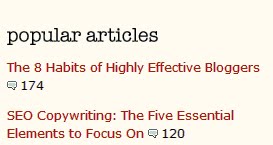
In each case Copyblogger could have omitted the numbers but they’d lose out on opportunities because those numbers will cause more people to take action in way that will increase readership. Now, having shared that, there are times when you want to leave the numbers out because they can work against you. For example, what do you think a first time visitor to Copyblogger would have concluded if they only had 100 subscribers or 50 Twitter followers? That might actually work against people deciding to become subscribers or followers. Also, if the numbers are low on comments people might not bother to look at those older posts.

What does this mean for you? As a general rule; if your numbers are not high then don’t show them because you could be shooting yourself in the foot. I’ve seen this with a feature on many websites that lets you know how many people are attending a particular event. I outlined this last year in an article I called “Make Your Next Event the One Everybody Attends.” What constitutes a large number will vary depending on many things. For example, 15 people attending an event is not many but if there are only 20 seats available it’s a large number by comparison. Showing that number will also invoke the principle of scarcity because only a few seats are left so sharing 15 in that context could be very persuasive.

So remember, consensus can work for you or against you depending on the situation. Make sure you’re thinking how your audience will perceive the numbers you share and you’ll probably do just fine. Of course, referring back to this article would be a smart move too.

Brian
Helping You Learn to Hear “Yes!”

Is Expert Advice Always Worth the Price?

A few weeks ago I took the day off to blog and do other social media related things but as the hours passed I had writer’s block. Nothing was coming to me until I read a very interesting article, Chris Brogan – Anchoring and Social Proof – Influencing Your Audience, by Paul Hebert. The article talked about how Chris Brogan, a social media guru, publicly stated his $22,000 a day fee for his consulting services. The angle for Paul’s article was how this publicly stated price impacts what other consultants can charge because of the anchor that’s been set.

The article also explores the principle of consensus (a.k.a. social proof) because undoubtedly other social media consultants will move in the upward direction as they see peers begin to do so. It’s a very interesting article so you should take a look.


Here’s my question for you (please feel free to comment below) – Would the advice Chris gives be worth $22,000 IF you or I could give the same advice but we charged significantly less only because we’re not as well known? In other words, is the advice more valuable just because it comes from Chris Brogan as opposed to me or you?

As I pondered this it brought to mind an article I wrote last year, Golf Advice from Corey Pavin. My wife Jane is an avid (addicted?) golfer! In that article I explained how I shared some golf advice with her. It was sound advice based on psychology but it went in one ear and out the other. However, weeks later she read a quote from Corey Pavin that was almost exactly what I had told her and she acted as it if was a revelation! For her it was more believable because it came from Corey Pavin. After all, he’s an authority having won the ’95 US Open.

But think about it for a moment, that fact that he said it didn’t change the reality that the advice was the same and should have worked every bit as well for Jane whether he said it or I said it. His expertise and track record make him an authority, giving him more credibility than I have when it comes to golf, but if you are going to pay for something based on authority shouldn’t you get something more for your money? Shouldn’t the expert give something that’s new or unique in some way?
I’m sure a golf lesson from Corey Pavin would include other tips and insights most people couldn’t give and that would make his higher fee worth it for the average weekend golfer. By the same token, Chris Brogan probably brings additional perspectives other less savvy social media folks won’t have. My point is not to say Chris Brogan isn’t worth his fee, it’s to get you to think.
Part of the influence process is establishing your authority because it makes you more believable and as a result you’ll hear “Yes” more often. I have two points for you to consider when it comes to being influenced by a perceived authority:
  1. Is this person really a legitimate authority? Chris Brogan has authority status having written Trust Agents (a very good book by the way) on using the web to build influence. Because of his work and time in the social media arena he’s recognized as an expert in the field. But that’s not always the case. For example, many spokespeople on TV have no real expertise and yet we’re subconsciously swayed by them.
  2. Is the advice something I could get elsewhere for less (money, time, effort, etc.)? Isn’t it disappointing to visit the doctor only to hear, “Rest it and take some Tylenol”? An expert – yes – but worth the money? Probably not when we all know rest is helpful and Tylenol reduces pain and discomfort. Or maybe you’ve attended a conference with big name speakers only to walk away thinking, “I didn’t learn anything new.” Worth it? Probably not because we expect something more from the expert.
The mind is an amazing thing. If someone believes Chris Brogan’s advice, or Corey Pavin’s, more than my advice or your advice (and lets assume it’s the same advice) then they’ll probably work harder to implement it. I know Jane will stay on the driving range for many more hours trying whatever Corey says, as opposed to what I might suggest, and she will be a better golfer as a result of her extra effort. Businesses will likely do the same with Brogan’s advice and that will legitimize his fee. Maybe that’s some of the value they offer?
The question of value reminds me of the experiment that showed kids prefer food in McDonald’s packaging and rate it as better tasting than the same food in plain packaging. As a parent, if it makes them eat the food then it’s probably worth the extra money and fewer hassles. If a customer is gung ho about the advice some authority gives vs. the same advice given by an average Joe then they’ll work harder to apply the guru’s advice and realize more benefit from it. If that happens I think you can legitimately say the expert advice was worth it.

In closing I’ll share a fascinating resource on this subject of value, the book Priceless: The Myth of Fair Value and How to Take Advantage of It. I read the book not long ago and it was an eye opener about how people value things. I highly recommend it because it will change your outlook as a consumer.

Brian
Helping You Learn to Hear “Yes!”

Facebook: Right Ways and Wrong Ways to Motivate

There’s a right way and a wrong way to go about motivating people to take action. I thought I’d write about this subject because it’s relevant based on some Facebook messages I’ve seen several times in recent months. If you’re on Facebook you might have seen the following message or some variation of it:

“In memory of family and friends who have lost the battle of cancer and the ones who continue to conquer it! Put this on your page if you know someone who has or had cancer. Dear God, I pray for the cure of cancer. Amen. 93% won’t copy and paste this, will you?”

The intent of the person and message is wonderful, to get people to pray for those with cancer, pass along the message and create more awareness. Unfortunately the method to motivate people to act on it is poor. After all, if 93% of people won’t copy and paste the message, why should you or I? Worse yet, that phrase tries to shame people into action. If someone feels shamed you can bet they won’t take action. This type of “motivation” is seen all the time in chain letter emails:

– “There were 12 tribes of Israel and 12 disciples. If you love God will you take a moment to send this to 12 friends?”
– “I cared enough to send this to you and 10 others; will you do the same for 10 people you care about?”
– “Please don’t break this. Send it to at least 7 of your friends.”

This isn’t an indictment against anyone who did take the time to post the message because they didn’t come up with the message. All they’ve done is copy and paste the message that’s been floating around. We can applaud their effort to do something good but there’s a more effective way to spread the word.

In psychology there’s a principle of influence known as consensus which tells us people are motivated to certain behaviors when they see others engaged in the same behavior. The motive to act is strengthened if the people observed are just like us or if there happen to be many people engaged in the behavior. Parents know all about this except they call it peer pressure, not consensus.

As a society all too often we make the same mistake the Facebook message makes. Consider the following two scenarios:
Voting – Messaging used to focus on what a shame it was that so few people voted. Shame was used when we were reminded that people died for our right to vote. Result – why go vote when so many others are not. Contrast that with the messaging before the 2008 presidential election, “A record turnout is expected.” That simple message helped change behaviors and we did end up having a record turnout. The thought process for many people was, “I better get there early if I want to vote.” There was an interesting Time magazine article on this, “How Obama is Using the Science of Change.”

Cheating in School – “Back in 1940, only 20 percent of college students admitted to cheating during their academic careers. Today, that number has increased to 75 to 98 percent.” (Education-Portal.com) Interpretation for students – I might as well cheat because everyone else is cheating.

So let’s circle back to the Facebook message and see what might be more effective. Simply replace, “93 % won’t copy and paste this, will you?” with something like this, “After reading this some of my other FB friends took time to copy and paste this onto their wall. I’d appreciate it if you would too.” This change is small but could produce a big result because it appeals to consensus; my Facebook friends, people like you, are doing this.

Beyond Facebook, take a look at how you’re trying to motivate people to action. If you talk about a negative behavior and how so many people are engaging in that behavior you’re probably hurting your attempt to change the behavior. Talk about how many kids aren’t cheating or how few kids were cheating in 2008 vs. some other year. Mention how fewer people are driving drunk or how more people voted than ever in 2008 and that number will go up on 2012. With a little forethought and small changes in your messaging you could see much, much better results for your cause.

Finally, thanks to all of you who forwarded Influence PEOPLE to others last week. I had a nice bump in readership, my third highest week ever, and got some new followers to boot. As I shared in last Monday’s post, someone would win Dr. Cialdin’s book Yes! 50 Scientifically Proven Ways to be Persuasive. Congratulations to the lucky winner Kelli Moore.Brian
Helping You Learn to Hear “Yes!”

So There’s a Knock at the Door…

I had an interesting experience recently. One evening, around 9 p.m., there was a knock at the door to my home. Nothing interesting about that except that I was surprised because our front lights were off and that usually signals no one is home. However, because the knock sounded different I thought perhaps it was a neighbor so I turned on the lights and opened the door.

The face was not that of a neighbor. Instead there were two young men, activists for an environmental issue, combing the neighborhood. I have to admit, had I known that’s what I would have been faced with I would not have opened the door. Once I’m at home I’m usually not too social because it’s family time or I’m trying to get things done.

Nonetheless, because I’d already opened the door I wasn’t about to say, “If I’d have known it wasn’t a friend or neighbor I would not have answered the door. Good night.” I thought about it but I’m not that rude. That meant I was obligated to listen to their presentation.

There’s a proverb in the Bible that says, “The first to present his case seems right, until another comes along.” In other words, there are two sides to every story. However, as I listened to them talk about river water being polluted because of the strip mining of mountain tops I thought, “Who could be against this?”

Since they were asking for signatures on what seemed to be a good cause I obliged. Of course, holding the clipboard and seeing the names and addresses of my neighbors made me feel more compelled to sign. That’s the power of consensus at work. We feel drawn to move with the crowd, especially when the crowd is composed of people just like us. Neighbors qualify big time in that regard.

Now to the very interesting part of the story. After I signed the petition the individual who’d done most of the talking asked for a donation. Mind you, as I already stated, I didn’t want to listen to a solicitor at 9 p.m., let alone make a donation so I politely declined. The response to my declination was something along the lines of, “We’re not looking to break anyone. Any donation will do. Most neighbors are giving anywhere from $36-$48.” Again, I said, “No” followed with, “goodbye.”

Next I walked over to my computer and started typing this. I understood exactly what was going on and felt it was a little manipulative. I’m guessing many people would have gone through a similar thought process. You hear about a good cause and think a signature to support it is no big deal. There was no mention of financial support being needed at any time during the presentation. However, after signing the petition it was very hard for me to resist giving a donation.

Why was it hard to refuse to monetarily support their cause? Because of the pull I was feeling from the principle of consistency. This principle of influence tells us people want to behave in ways that are consistent with what they’ve said or done in the past as well as remain true to their beliefs and values. Because I’d signed the petition I was implicitly saying the legislation they were proposing was good and should be pursued. I wasn’t thinking it takes money but if I stop and consider I know it does. So when I was asked to “put my money where my mouth is” it became very, very hard to refuse.

Throw on top of that more consensus pressure – not only did my neighbors sign, supposedly they were donating $36 to $48 – and that made it even harder to say no.

Even though I completely understood the psychological forces at work I still wrestled with my decision. How about people who had no idea what was going on? I think many people probably felt trapped and donated not because they wanted to but because they felt compelled to.

So what’s the moral of the story? First, be careful about what you agree to. Something as simple as signing a petition can lead to other unintended consequences.

Second, and more important, trust your gut. Your “gut feeling” is usually an accumulation of things you can’t quite put your finger on but are taking in through many of your senses. The good news is you don’t have to rationalize every feeling. If you feel trapped and uncomfortable with what’s being asked of you, just say “no.” You might feel awkward in the moment but you’ll probably feel much better when you look back on your decision.

Brian
Helping You Learn to Hear “Yes!”

What’s Your Worldview?

I’ve been thinking about my “worldview” lately, so I’ll pose this question to you, “What’s your worldview?” When I think of the term “worldview,” I think about how people try to make sense of what they observe others doing. I’m a pretty religious person and I have a worldview that first and foremost centers around my Christian faith. My faith colors perception of the here and now as well as the afterlife. But I also view things through another lens – influence.

Let me explain a bit further. I’m curious about why people do the things they do. I’m also interested in getting people to go along with my ideas and suggestions. Just like you, I want to hear people say “Yes” when I ask them to do something. That person could be my wife, my daughter, a coworker, vendor or the checkout person at the store.

I was working with someone today and we covered material on influence. I told this person about the science behind influence. I didn’t want her to think it was just grandma’s good advice (not that grandma’s advice was bad; she seems to have been right most of the time!) because it was grounded in real life scientific studies. Those studies don’t give me the ability to predict what you or any other person will do in particular situations because we are complex beings with a lifetime of experiences that shape us and our behaviors. But I can say with certainty that I communicate with confidence and take certain actions because I know my influence approaches will make me more successful on the whole.

There’s more than 60 years of social science to back up my last statement. If you pick up Influence Science and PracticeYes: 50 Ways Proven Ways to be PersuasiveMaximum Influence or any number of other books on influence and persuasion you’ll see the studies. For example, one restaurant owner saw no shows dropped from 30% to 10% because of two simple words. In another study nearly twice as many people completed a survey because of something they were asked immediately prior to the survey request. Or how about the person who saw a 610% increase in sales because he instructed his salespeople to include some truthful, relevant information!

I can’t tell you how many people will attend your next meeting, and I certainly can’t tell you which specific people will say “Yes.” However, I can tell you things to do, and things to avoid, so you’ll know you have the best chance of maximizing attendance. I can’t tell you if you say or do one particular thing that your child will clean her room, or your boss will give you a raise. But I can tell you things you can do that will increase the odds of both.

Because I’ve seen the studies and experienced the results personally, I’m a believer! My worldview helps me explain an awful lot of why people do what they do. Not everything can be explained by reciprocity, likingconsensusauthorityconsistency and scarcity but I’m amazed by how much can!

Earlier I wrote that a worldview was in essence the lens through which I view much of the world. I remember when I was a teenager getting glasses. I didn’t realize my eyesight was poor until I went to the optometrist. I simply figured everyone saw things the way I did. When I got that first set of glasses – WOW! All of a sudden, I could see blades of grass, leaves on trees and so much other detail. I didn’t realize what I was missing. That’s what the lens of influence has done for me. I’m not interested in doing research; I’m interested in understanding it so I can make sense of the world around me and the actions of others. I also enjoy taking the concepts and applying them to different situations to see if they can make me or my coworkers more successful. Now, because of this blog I get an opportunity to go beyond those boundaries. Thanks to Google Analytics, I can see people in nearly 40 countries follow this blog. That excites me!

So, I guess this week’s post wasn’t so much about persuasion tips as it was insight into my mind, my worldview. I would like to take this time to say thanks to all of you who read, who’ve commented and who’ve emailed me with questions or to just say how much you’ve enjoyed reading. That means a lot to me and without a doubt makes my day. Keep looking for posts every Monday at 5:30 p.m.

Brian
Helping You Learn to Hear “Yes!”

Are You a Twitter Snob?

I’m still a total novice, a geek you might say, when it comes to Twitter. I signed up at the advice of a friend and have mostly tried to use it as a tool to promote this blog. Facebook continues to be the place where I get more personal.

Because I just didn’t feel I was getting the hang of Twitter I bought Twitter Power by Joel Comm. For my wife and daughter, the fact that I would buy and read a book like that confirms them that I am indeed a geek, a twit, a tweet.

As I type this I’m half way through the book and have learned several good pointers. But, this post isn’t about the book; rather it’s about what I’m observing about Twitter from a social influence standpoint.

First I must confess, I’ve become a Twitter snob. Are you? You might discover you’re one too and didn’t know it. Why do I say I’m I a snob? Well, for the simple reason that I don’t “follow” everyone who follows me. Kind of rude isn’t it? In my defense there’s a psychological force at work on me. It’s called consensus, also known as social proof.

Consensus is the psychological principle whereby people look to others for clues on how to act. That gets heightened when we are not sure what to do. So I’m new to Twitter, fumbling around not knowing what to do and I look to see what others are doing. I’ve received notification that people or organizations are following me so I pop over to their Twitter home page to see what’s up. Here’s where consensus comes into play which leads me to a question for you. If you saw “Following 1,567” and “Followers 138” would you be like me and wonder, “Why are so few people following this person?”

It’s not that 138 is a small number; after all, we all have to start somewhere. The problem is that 138 is a small number compared to 1,567. We naturally compare and contrast to gauge things. It’s no different than looking inside a small restaurant, seeing a large crowd, people waiting and all the tables filled. I don’t know about you but when I see that I naturally assume it must be a good place. By contrast, when you pop your head into a large place and see more empty tables than full ones it’s easy to conclude something must be wrong with the food, service or something else. In reality there may be more people in the big restaurant but you don’t really notice that. In both cases we’re influenced by groups, or lack of, and that is heightened when comparing it to the number of tables.

At first I felt bad not following someone who followed me. My feeling bad goes to another principle of influence, reciprocity, which tells us we should respond in kind when someone does something for us. Someone smiles at us and we smile back or they do something for us and we feel obligated to return the favor. So naturally, when someone follows us on Twitter we feel somewhat obligated to follow them back.

So what’s a person to do if they find themselves in a follower deficit? Again, I’m no Twitter expert but here are a few things that come to mind:

  • Friends and Family – Use the AT&T strategy and try connecting with people you know so they’ll follow you and you can build up that number.
  • Sympathy – Start sending messages to some of those you follow to tell them you made a mistake and ask them to start following you.
  • Slow Down Cowboy – As people do start following you, don’t be so quick to follow back for a time so you can even out your “following” and “follow” numbers.
  • Last Resort – If all else fails, set up a new Twitter account and be more careful as you build up your followers. This might seem like a hassle but it will be worse to go months, maybe years and never see many followers.

Again, I don’t claim to be an authority on Twitter, that’s why I needed a book! However, I know enough about social influence to realize when people are shooting themselves in the foot. By the way, feel free to follow me on Twitter or become my friend on Facebook. Links to both are on the side of the Web site.Brian
Helping You Learn to Hear “Yes!”

Coming to Terms

I thought it would be good time to review some influence and persuasion terms with you. A few of these you’ve seen in some past blogs and others you will certainly see in future posts.

Understanding and ethically applying these psychological principles doesn’t guarantee everybody will do what you want. After all, they don’t represent some kind of magic wand. However, I can say with certainty; if you employee these more strategically and regularly you will hear more people say “Yes!” to your requests.

As you read through these you might think, “That doesn’t apply to me” or “I don’t fall for that.” That assessment may be true quite often but certainly not all the time. To get you to critically think it through I’ve added a question after each principle to give you cause to pause and think. While you may have seen right through some manipulative person’s attempts to persuade you, I’m willing to bet there are other times where you were influenced into action without even knowing it.

Reciprocity – Some might describe reciprocity as the “good old give and take principle” or “you scratch my back and I’ll scratch yours.” This principle describes the internal pressure we all feel to return the favor. At its most extreme it might be the person trying to think of a way to repay someone who saved their life. For most of us it’s as simple as picking up the tab at a restaurant because our friend got it last time. Have you ever sent someone a Christmas card because they sent you one first? If so, it’s because of reciprocity.

Liking – In business there’s a saying, “People like to do business with people they like.” Jeffrey
Gitomer, sales trainer and author, likes to say, “All things being equal, people want to do business with their friends. All things being not so equal, people still want to do business with their friends.” We like to be around people we like and they naturally have more influence on us than those we don’t know or don’t like. In turn, the more likable we are the more persuasive we’ll be. Have you ever bought something because a good friend recommended the product or service?

Consensus – A farmer would say we’re like cattle because we like to “mooove” with the crowd. When we see lots of people taking action, or people just like us, quite often that’s enough to get us to go along with the crowd. You’ll also hear consensus referred to as “social proof.” Be honest now; have you ever stood up during a standing ovation when truthfully, you didn’t think the performance deserved it? If so, it’s because you were moved along by the actions of others.

Authority – We don’t have enough time to weigh all the decisions that come our way so quite often we defer to people we view as authorities, or experts. In fact we do so with such regularity that studies show our brain activity actually slows down when experts tell us what to do! In other words, critical reasoning can go right out the door! Experts need not be actual people either. Have you bought something, perhaps a car or major appliance, primarily because Consumer Reports rated the vehicle high?

Consistency – We all feel an internal pressure to live up to our promises. We feel good about ourselves when our words and deeds match, when we’ve done what we said we would. Have you ever found yourself doing something, not because you really wanted to (i.e., help someone move), but because you gave your word?

Scarcity – When we sense something is becoming less available or diminishing in some way, there’s something in us that all of a sudden wants the thing even more. When was the last time you rushed out to the store because you suddenly remembered, “Sale Ends Sunday!”? If that was you it’s because you were motivated by the potential loss of an opportunity.

Compare and Contrast – Did you know two things can appear more different than they really are depending on how they are presented? Considered for a moment how that might impact your decision making. For example, you go to the store to buy something and you’re not sure what that item might cost. When you arrive you see a sign that states, “Normally $150, now only $99!” By comparison $99 appears to be a very good deal. I’ve hear people justify purchases like that because “it was too good a deal to pass up.”

So there you have it, the layman’s overview of several psychological principles than affect us all to one degree or another every day. Most of the time these principles impact us in such subtle ways that we’re not aware of it and yet they’re major factors in our decision making. As we continue our journey together I think your eyes will be opened to how politicians, marketers, salesmen and so many others try to persuade you to do what they want.

Brian
Helping You Learn to Hear “Yes!”