
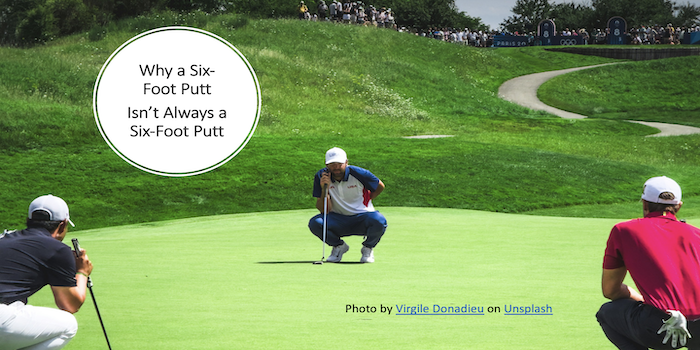
Why a Six-Foot Putt Isn’t Always a Six-Foot Putt
I used to play golf, but I haven’t picked up the clubs in decades. My wife Jane, however, is a big-time golfer, so when the major championships and other big PGA tournaments roll around, we spend plenty of Saturdays and Sundays watching.
This past Sunday we watched the final round of the BMW Championship. Wyndham Clark began the day with a five-shot lead. By the back nine, that lead had disappeared. Then, after some mistakes by the golfers chasing him and a fantastic three-birdie finish, Clark walked away with a well-earned three-shot victory.
Watching the drama unfold reminded me of fascinating research I came across years ago.
Is a six-foot putt just a six-foot putt?
Physically, perhaps. Psychologically, not necessarily.
In 2011, researchers Devin Pope and Maurice Schweitzer published “Is Tiger Woods Loss Averse? Persistent Bias in the Face of Experience, Competition, and High Stakes” in the American Economic Review.
Using precise ShotLink measurements, they analyzed more than 2.5 million PGA Tour putts from 421 golfers over a five-year period (2004–2009).
Their finding? Professional golfers were approximately 2 to 4 percentage points more likely to make a par putt than a comparable birdie putt.
Think about that. Same golfer. Same distance. Similar circumstances. But a different result depending, in part, on whether the putt was for birdie or par.
Why? Loss Aversion!
Loss aversion is closely related to Cialdini’s principle of scarcity. Behavioral scientists Daniel Kahneman and Amos Tversky famously demonstrated that losses tend to loom larger psychologically than equivalent gains. We hate losing more than we enjoy gaining.
Now think about golf. Standing over a birdie putt, the golfer has an opportunity to gain a stroke relative to par. Miss it and, assuming the next putt goes in, par is still available.
Standing over a par putt feels different. Miss it and the golfer loses a stroke.
Objectively, every stroke counts the same on the scorecard. Psychologically, however, they don’t necessarily feel the same in the moment. That subtle difference appears to influence even the best golfers in the world.
Interestingly, Pope and Schweitzer found the difference between par and birdie putting decreased as tournaments progressed, from 3.8 percentage points in the first round to 2.1 in the final round, but the phenomenon never completely disappeared.
The drop was attributed to another change in psychology. In the final round players are more concerned with their score vs. the field of golfers as opposed to their score against par for the course in earlier rounds.
That’s important because professional golfers have enormous experience, practice relentlessly, compete under intense pressure, and have potentially millions of dollars riding on their performance.
Yet they’re still human. So are you and I, and here’s the larger lesson. Scarcity isn’t always a salesperson telling you, “Only two left!” or a website flashing, “Sale ends at midnight!”
Sometimes scarcity is simply the possibility of losing something you already have. A golfer desperately wants to avoid dropping a stroke and…
- A customer worries about losing a benefit.
- An investor doesn’t want to give back gains.
- A leader worries about losing status.
In each case, the possibility of loss may influence the decision more than an equivalent opportunity for gain.
That’s why ethical influence starts with awareness. The goal isn’t to manipulate someone’s fear of loss. It’s to understand how people naturally make decisions then communicate relevant information truthfully.
So, the next time you’re making an important decision, ask yourself: Am I pursuing something I genuinely want, or am I reacting more strongly because I’m afraid of losing something?
The difference may be more significant than you realize.
And if you happen to be a golfer reading this, I’m curious: Do you feel different standing over a six-foot birdie putt versus a six-foot par putt?
Edited by ChatGPT
Brian Ahearn
 Brian Ahearn is the Chief Influence Officer at Influence PEOPLE and a faculty member at the Cialdini Institute. An author, TEDx presenter, international speaker, coach, and consultant, Brian helps clients apply influence in everyday situations to boost results.
As one of only a dozen Cialdini Method Certified Trainers in the world, Brian was personally trained and endorsed by Robert Cialdini, Ph.D., the most cited living social psychologist on the science of ethical influence.
Brian’s first book, Influence PEOPLE, was named one of the 100 Best Influence Books of All Time by Book Authority. Persuasive Selling and Influenced from Above were Amazon new release bestsellers. His LinkedIn courses on persuasive selling and coaching have been viewed by over 850,000 people around the world and his TEDx Talk on pre-suasion has more than a million views!


Leave a Reply
Want to join the discussion?Feel free to contribute!