Is the System Broken?

“May you live in interesting times,” is said to be an ancient Chinese curse. While there’s no documented proof of the Chinese origin, one could say we are cursed to live in such a time in American politics.

With the acquittal of President Trump by the Senate last week, people who wanted to see him convicted are crying foul and claim the system doesn’t work. However, Trump supporters thought the system worked just fine.

Go back several months and it was Trump supports who emphatically said the impeachment vote in Congress showed the system didn’t work. Of course, the Democrats felt the process in Congress worked exactly as our founding fathers intended.

We see instances of similar divides continually. When O.J. Simpson was acquitted (the glove didn’t fit) in the deaths of Nicole Brown Simpson and Ronald Goldman many people said it was a travesty of justice because of the seeming mountain of evidence against him. Others praised the decision for a variety of reasons.

Many years later the tables were turned when George Zimmerman was acquitted in the death of Trayvon Martin. There was public outrage by many Americans but there were also plenty of George Zimmerman supporters.

How can groups of people see things so differently? As is so often the case, viewpoints are split along racial lines, sexual orientation, religious affiliation, political parties and other groups.

The problem is, we can’t judge the system simply based on the decisions it hands down. The Supreme Court isn’t only right when it votes the way you or I think it should. And, it’s not wrong when it goes against how you or I see the facts. If that were the case then you and I, without all the facts, legal background and constitutional knowledge, would be the final arbiters of good and bad, right and wrong, not the Supreme Court.

Our system of justice, including recent political proceedings, is flawed because it was created by flawed human beings. And it gets more flawed because imperfect, biased human beings ultimately render the decisions.

No matter what any judge, jury, attorney or politician may claim, biases do come into play in every decision. There’s no such thing as an impartial juror because, by definition, you’re not even aware of your hidden biases. This is why many outwardly good, well-meaning people, are shocked when someone points out what they said or did was somewhat racist, homophobic or misogynistic. They didn’t intend to be and they had no idea what they said or did was offensive. Do you think that reality stops with elected officials or jurors? Of course not!

There was no better example of status quo bias than the recent senate decision on President Trump. This was the third time in American history that a president stood trial in the senate after being impeached by congress. In those three instances there were a total of seven charges brought up against those presidents (Andrew Johnson, Bill Clinton, Donald Trump). In all that time only one person ever voted against his or her party’s president to convict. That’s 1 vote out of 223 possible votes cast from senators whose party president was on trial.

The fact that republican Senator Mitt Romney voted against his party to convict Donald Trump is hailed by Democrats as some sort of victory. However, you can also easily conclude the whole process is clearly partisan. It’s not designed to get to the truth because if it was there would certainly be a more diverse vote than the strictly party line voting we’ve seen in each case.

Conclusion

A few votes the other way last week and the anger at the system would be flipped. The same goes for many Supreme Court decisions. And this blog post would be just as relevant!

As noted earlier, our justice system was created by flawed people and decisions within that framework are handed down by flawed people. Compound that with the reality that we have an addiction to being right. How do we change it? The first step is to acknowledge we have a problem. While our current system may be the best devised so far, we should always look for ways to improve it with one goal – getting to the truth.

Brian Ahearn, CMCT®, is the Chief Influence Officer at Influence PEOPLE, LLC. An author, international trainer, coach and consultant, he’s one of only 20 people in the world personally trained by Robert Cialdini, Ph.D., the most cited living social psychologist on the planet on the science of ethical influence and persuasion.

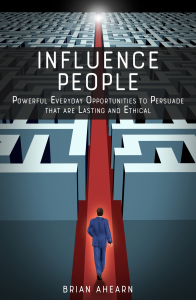
Brian’s book, Influence PEOPLE: Powerful Everyday Opportunities to Persuade that are Lasting and Ethical, was a top 10 selling Amazon book in several insurance categories and top 50 in sales & selling. His LinkedIn Learning courses on sales and coaching have been viewed by more than 90,000 people around the world!

Don’t Memorize, Internalize. Embrace, Anticipate, Practice!

At a recent sales training event I encouraged attendees; don’t memorize, internalize. These were salespeople and we were talking about how to deal with objections whenever they arise. The key with objections is to embrace them. After all, if you’re in sales then objections are part of the game just like running is part of soccer or jumping is essential in basketball. Nobody would start playing soccer and complain about all the running. Likewise, no one would take up basketball if they didn’t like jumping. Now apply that thought process to sales and dealing with objections.

No surprises here

If you’ve been selling for any length of time you face the same objections over and over. Sure, there are rare case something new is tossed at you but the vast majority of the time there’s no surprise when an objection is lobbed your way.

I recall when I was learning hapkido (Korean version of aikido, think Steven Segal) every offensive attack move I attempted, the black belt I was working with had a counter move that would break my wrist, elbow or arm. No punch I threw at him caught him off guard.

You’re in control

With objections the ball is in your court so to speak because when you know what to expect you’re actually in control. Consider this; if you were playing a competitive sport and had an answer for every move you opponent might make there’s no way you’d lose!

Back to hapkido; because I could not surprise my black belt opponent he was always calm in control. That allowed him to stay focused on what needed to be done to protect himself and subdue me.

You have answers

You can’t control other people but you can control yourself. Not only do you know what’s coming, which allows you to stay in control, you should know exactly how you’re going to respond.

As noted previously, the black belt I was working with had a counter to every move I made. His counters, if fully executed, would have quickly ended the confrontation and because of the damage he could do it was scary stuff.

Practice you moves

There’s nothing worse than dealing with a salesperson or customer service rep who gives pat answers that sound like a bad telemarketer who mindlessly memorized a script. Even worse might be the person who obviously doesn’t care because “they’ve heard it a thousand times before.”

My black belt friend needed more than knowledge of what I would do and how he would respond. He needed to be really good at his response in order to protect himself and end the confrontation. That meant countless hours of practice on his moves.

Conclusion

You may not be in sales but you’re sure to run into objections in your career. Those objections may be to a project you’re proposing, training you believe is needed, budget approval or any number of other initiatives. Knowing this you need to be embrace the reality of objections, anticipate them and practice your responses. The better you get at this the more likely you are to get the approval you need.

To Do This Week

Take time to write down the five most common objections you face. Next, think about how you might incorporate the principles of influence into your responses to make it easier to hear yes. Then begin to practice your responses out loud.

Two principles that are excellent when it comes to dealing with objections are social proof and authority.

  1. The more you are viewed as an expert or invoke expertise (principle of authority) the easier it will be to get beyond the objection.
  2. Tapping into social proof, what many or similar others are doing, is often an indicator that the person or group you’re trying to influence might want to consider doing the same.

Remember, just like my black belt friend, anticipate, practice and respond. Don’t memorize, internalize so your responses become and authentic part of who you are.

Brian Ahearn, CMCT®, is the Chief Influence Officer at Influence PEOPLE, LLC. An author, international trainer, coach and consultant, he’s one of only 20 people in the world personally trained by Robert Cialdini, Ph.D., the most cited living social psychologist on the planet on the science of ethical influence and persuasion.

Brian’s book, Influence PEOPLE: Powerful Everyday Opportunities to Persuade that are Lasting and Ethical, was a top 10 selling Amazon book in several insurance categories and top 50 in sales & selling. His LinkedIn Learning courses on sales and coaching have been viewed by almost 90,000 people around the world!

PS That’s a picture of me with our daughter Abigail at Taekwondo.

Persuasion: Your Key to Professional Success and Personal Happiness

Persuasion is more than changing hearts and minds, it’s about changing behavior. Aristotle said as much when he told the world persuasion was, “the art of getting someone to do something they wouldn’t ordinarily do if you didn’t ask.” Whether you want someone to buy from you, your boss to approve your project, get a promotion, or just get your kids to do their homework, persuasion is the skill that can help you achieve those goals and more.

We Need People…

Jack Welch, former CEO of General Electric, said, “Nearly everything I’ve accomplished in life has been with other people.” It didn’t matter how good Jack’s vision or strategies were if he couldn’t persuade people to execute. People are vital to your professional success and personal happiness so understanding how to ethically influence people is an essential skill.

But There’s a Catch…

Okay, you need people but things aren’t always so easy. Dale Carnegie, author of How to Win Friends and Influence People, told the world more than 85 years ago, “Dealing with people is the biggest challenge you will face, especially if you’re in business.” You need people but they’re your biggest challenge. This is why understanding how to ethically persuade is critical to your professional success and personal happiness!

Three Hours a Day!

In To Sell is Human, Daniel Pink cites a survey of more than 7,000 business people when he wrote, “People are now spending about 40% of their time at work engaged in non-sales selling – persuading, influencing, and convincing others in ways that don’t involve anyone making a purchase.” This means the average worker spends more than three hours a day trying to persuade others. If you’re going to spend that much time on one activity doesn’t it make sense to learn how to do it well?

Persuasion is a Skill

Make no mistake a about it, persuasion is a skill. However, unlike hitting a 300 yard drive, dunking a basketball or running a 5-minute mile, it’s not something only a chosen few are capable of. Persuasion can be learned, practiced, and perfected by anyone. My focus is teaching you how to use the principles of ethical influence to change people’s behavior. For a short introduction to these principles watch this video from Robert B. Cialdini, Ph.D., and Steve Martin, CMCT,

Want to Learn How to Influence People?

I’ll teach you the science of persuasion and more importantly, how to apply that knowledge to ensure your professional success and personal happiness. Are you looking for a speaker at your next event? Do you  need one-on-one coaching or consulting? How about training for your team? Whatever it is, I’m ready to help you and your organization. Contact me today and we’ll explore how we can begin working together.

Brian Ahearn, CMCT®, is the Chief Influence Officer at Influence PEOPLE, LLC. An author, international trainer, coach and consultant, he’s one of only 20 people in the world personally trained by Robert Cialdini, Ph.D., the most cited living social psychologist on the planet on the science of ethical influence and persuasion.

Brian’s book, Influence PEOPLE: Powerful Everyday Opportunities to Persuade that are Lasting and Ethical, was a top 10 selling Amazon book in several insurance categories and top 50 in sales & selling. His LinkedIn Learning courses on incorporating persuasion into sales and coaching have been viewed by 90,000 people around the world!


Just Okay Is Not Okay

Commercials are designed to move consumers to action. One commercial caught my attention recently because it made me laugh. AT&T’s Just Okay Is Not Okay shows a concerned couple in a hospital room waiting to meet the surgeon. They ask if the nurse has ever worked with the doctor. The nurse replies, “Oh yea, he’s okay.” The couple gets a concerned look and says, “Just okay?” The commercial concludes with “Just okay is not okay, especially when it comes to your network.” Want a good laugh? Watch the commercial.

Expertise

You rely on experts every day and just okay is not okay. Sometimes you’re very aware of the need for expertise, like finding the right surgeon before an important procedure. Other times you don’t think as much about the level of expertise. Calling a plumber or finding an auto mechanic might fall into this category.

How do you tell the difference between? You don’t choose a surgeon based on his or her fees. Your concern is more about the reputation of the surgeon. What people have to say means far more than cost. However, when it comes to a plumber, mechanic or electrician quite often people will get several quotes and price is a big factor in the decision make process. You assume expertise because it’s likely the plumber, mechanic or electrician knows more than you but you’re not as nearly concerned with reputation.

Over my lifetime I’ve heard many people talk about their surgeon saying, “He’s great, one of the best in the area,” or “She’s been in practice for more than 20 years.” Not once have I heard such statements about a plumber, mechanic or electrician. Nope, it’s usually, “They did a great job and they weren’t a lot less than the other quotes I got.”

When the stakes go up you naturally become more concerned with reputation and less with cost. People will pay almost anything to get healthy but not to unclog a drain or have their brakes replaced.

Trust

But expertise by itself is not enough. The AT&T commercial highlights this when the doctor says, “Guess who got reinstated?” What? Why was he suspended? Who cares because you’d never feel good hearing that and whatever you might learn wouldn’t make you feel comfortable.

So, you don’t hire people on expertise alone. Whether it’s someone in home repair, investments or health care, if you hear anything negative about regarding trustworthiness you’re not likely to take a chance on the individual or firm.

For example, Bernie Madoff may know more about markets and investing than you or I but I’m confident you would never trust him with your money. In much the same way that reputation becomes more important as the stakes go up, so does the trust factor.

Conclusion

The commercial is a bit over the top but it’s funny because it’s true. You want to work with people who are great – not just okay – at what they do. And, you want those same experts to be trustworthy. That’s a powerful combination to justify doing business with someone.

To Do This Week

Let’s bring this back to you. What are you doing to increase your skills so you’re viewed as an expert? The law of averages says not everyone is great. Most are average and some are below average. Neither of those categories should be acceptable to you because they won’t be acceptable to someone who’s considering hiring you. One great way you can upskill is leveraging LinkedIn Learning. There are nearly 14,000 courses on almost anything you can imagine. Check it out, decide what you want to get better at then avail yourself of all the resources they offer.

What are you doing to build your trust level with people? Doing great work won’t be enough if you don’t deliver it when you said you would. You can reinforce your trust with simple phrases like, “As promised,” or “I wanted to get this to you early.” Those simple prompts will remind people you’re a person of your word.

Bottom line, set your sights on becoming a trusted expert and your ability to ethically persuade others will go up significantly.

Brian Ahearn, CMCT®, is the Chief Influence Officer at Influence PEOPLE, LLC. An author, international trainer, coach and consultant, he’s one of only 20 people in the world personally trained by Robert Cialdini, Ph.D., the most cited living social psychologist on the planet on the science of ethical influence and persuasion.

Brian’s book, Influence PEOPLE: Powerful Everyday Opportunities to Persuade that are Lasting and Ethical, was a top 10 selling Amazon book in several insurance categories and top 50 in sales & selling. His LinkedIn Learning courses on sales and coaching have been viewed by almost 90,000 people around the world!

2 Books Radically Changed How I Present

Speaking in public can make or break your career. Why? Because it won’t matter how good your idea, product or service is if you can’t get buy-in from your audience. If you don’t know how to hook an audience not only do you lose, so does everyone who might have benefitted from your great idea, unique product or new service. Don’t let that happen!

In addition, presenting to groups can do wonders for your career because people respect individuals who can confidently and succinctly present ideas in such a way that the audience says, “I get it!” With this in mind, I want to share two books that radically changed how I present.

The Presentation Secrets of Steve Jobs

Carmine Gallo wrote this book a decade ago and it’s just as relevant as we start 2020 as it was in 2010. As I read the book I took seven pages of typed notes! I reinforced what I was learning with “to do” notes to myself. Below are a few of my biggest take away ideas.

“Throughout this book, ask yourself, “What am I really selling?” Remember, your widget doesn’t inspire. Show me how your widget improves my life, and you’ve won me over.”
My Note: Professional success and personal happiness.

“HEADLINE What is the one big idea you want to leave with your audience? It should be short (140 characters or less), memorable, and written in the subject-verb-object sequence.”
My Note: Wouldn’t you agree; much of your professional success and personal happiness depends on getting others to say “Yes” to you?

“Create your headline, a one-sentence vision statement for your company, product, or service. The most effective headlines are concise (140 characters maximum), are specific, and offer a personal benefit.” My Note: Helping You Hear “Yes!” 

“Simple slides keep the focus where it belongs—on you, the speaker.” My Note: Exactly

Do you like what you’ve seen so far? If so, get yourself a copy of the book today.

Presentation Zen

Garr Reynolds published this book in 2012. As I read this book I kept going back to my power point slides to rework them. I moved away from the traditional word and bullet point filled slides with cheesy animation and pictures. I’m a little embarrassed to show you some before and after slides but I think by doing so you’ll clearly see the difference this book made for me. On the left are slides from a 2010 presentation and on the right is what I currently do with the same slide. Night and day difference!


                                                                                                                   Photo by Charles Forerunner on Unsplash


                                                                                                                                       Photo by Louis Reed on Unsplash

What I came to realize is this: your slides support your talk. Because people think in pictures, incorporating high resolution pictures to drive home your points makes a huge, huge difference. In case you’re interested, three picture sources I’ve used over the years are Unsplash, Maxpixels, iStock. The first two are free but don’t discount iStock just because you have to pay. It’s worth it when you find the perfect picture for your presentation.

Is it scary to move away from text filled slides? A little because you can’t refer to your slides for your talking points. But, there’s also a freedom that comes with this change. First, if you miss a point nobody knows because it’s not like they can say, “Hey, he never addressed the second bullet point.”

Another freedom you’ll experience is not being tied to specific talking points. What that means is you can change your talk on the fly depending on things like audience feedback or time restrictions. For example, if a group is responding more to my personal stories I will start incorporating more by way of examples throughout the presentation. If my time was unexpectedly cut short I don’t need to say, “I’ll have to cut out some things out due to time.” Instead I might tell an audience, “Even though we have a little less time don’t worry, we’re going to cover everything you were looking forward to.” Then I adjust on the fly.

Conclusion

Let me emphasize that everything I’ve just shared is predicated on two very important things; 1) you know your material by heart and 2) you practice, practice, practice. These two things combined with your slide changes and advice from Steve Jobs will make you look like a pro next time you’re in front of an audience!

To Do This Week

Pick up copies of Presentation Zen and The Presentation Secrets of Steve Jobs. For a tiny monetary investment, you’ll get HUGE returns once you start making the types of changes I did. Imagine going into your next big presentation and blowing people away because you’re so much better than everyone else. It might make the difference in landing that big sale, getting a new job or earning a promotion.

Brian Ahearn, CMCT®, is the Chief Influence Officer at Influence PEOPLE, LLC. An author, international trainer, coach and consultant, he’s one of only 20 people in the world personally trained by Robert Cialdini, Ph.D., the most cited living social psychologist on the planet on the science of ethical influence and persuasion.

Brian’s book, Influence PEOPLE: Powerful Everyday Opportunities to Persuade that are Lasting and Ethical, was a top 10 selling Amazon book in several insurance categories and top 50 in sales & selling. His LinkedIn Learning courses on incorporating persuasion into sales and coaching have been viewed by more than 85,000 people around the world!

Quarterly Newsletter

It’s hard to believe 2019 is over and we’re into 2020. I hope 2019 was great for you on a professional and personal level. It was for me and I look forward to an even better 2020. I hope you do too. As always, I appreciate you giving me a few moments of your time to catch you up on what’s happening with Influence PEOPLE and to share resources that can help you become a more persuasive person.

Sincerely,
Brian


What’s Influence PEOPLE all about?

Why – Help you enjoy more professional success and personal happiness.
How – Teach you the science of ethical influence.
What – Speak, write, train, coach and consult.
Who – We work primarily with sales-people, business leaders, coaches and attorneys.

The move to Influence PEOPLE full time was tougher than I expected in some respects but much more satisfying than I ever would have imagined! The autonomy, and opp-ortunity to focus on what I deem most important every day,  is wonderful.

It’s very different working for yourself with no one to be accountable to except you. Several things stand out when I think about it vs. my time in corporate America.

First, removing the distractions and meetings that come with a big company increases your ability to accomplish meaningful work. If I spend three or four hours at Starbucks I easily accomplish more than what I would have done in eight hours at the office.

Second, having to do everything yourself is hard but highlights how much waste there is when you work for a big company. Work has a very different feel when it’s your time, money and effort on the line. It’s the difference between thinking like an owner versus being an employee.

Third, time feels different. This was highlighted around the holidays. I used to get excited about extended breaks for the holidays. Not having an office to go to, and not “taking time off” were strange feelings.

Here’s to a great 2020. I hope it’s your best year so far and that each one only gets better and better.

Here’s What’s New

TED Talk in March!

I’m thrilled to tell you I’ve been selected to present at the TEDx New Albany event on Sunday, March 22, 2020. Giving a TED Talk is something I’ve aspired to for more than a decade so I’m beyond excited! My talk will be about how to set the stage for more success and happiness using pre-suasion. If you’d like to attend in person click here for details on time, location and tickets.

Audio Book will be available this month!

Influence PEOPLE: Powerful Everyday Opportunities to Persuade that are Lasting and Ethical came out in paperback and eBook in August. My goal in writing the book was to give you tangible ideas you can use immediately to enjoy more professional success and personal happiness. I was thrilled when it made the top 10 in Amazon’s Casualty Insurance and Insurance categories. It also cracked the top 50 in Sales & Selling. Now I’m excited to let you know the audio version should be available by the end of January. In the meantime, if you prefer paperback of eBook click here to order your copy.

New Podcasts

I was a guest on a dozen podcasts in the fourth quarter and nearly three dozen during the year. I’ve learned getting on podcasts is like compound interest – the more you’re on, the more you get on because podcasters listen to other podcasts. If you want to catch any episodes from 2019, there are links to each on my website. Click here to find the ones you’d like to listen to.

New LinkedIn Courses

In 2019 I had three new LinkedIn Learning courses go live:

  • Persuasive Coaching
  • Building a Coaching Culture
  • Advanced Persuasive Selling

I cannot say enough great things about the folks at LinkedIn. They’re awesome people to work with! Click here to check out short previews for each course.

Best of…

Do you enjoy learning but find it difficult to locate good content? Time is your most valuable commodoty so don’t spin your wheels searching. To help you save some of that precious resource below are some great books to read, podcasts to listen to and TED Talks to watch.

Books

Messengers: Who We Listen to, Who We Don’t and Why by Steve Martin and Joseph Marks. Two people can say the very same thing and get very different results. Coming from the mouth of one person a message may fall on deaf ears but from another that same message changes the world! Why? This book helps you understand that it’s more than what’s communicated, it’s who is communicating. The authors don’t just leave you with an understanding of why; they give you the how. They tell you how you can become a messenger more people listen to. The book is good for anyone who wants to be more influential but it’s critically important for salespeople, coaches and leaders in every field.

Entrepreneurial You by Dorie Clark. Here’s what I wrote in my Amazon review: Stepping out on your own is scary and exciting, energizing and draining, and so many other polar opposites so it’s good to have a resource to come back to for grounding and to realize you’re normal with these feelings. I just finished this book and I’m working through the 80+ page workbook Dorie provides for free. Don’t short change yourself – read the book then complete the workbook because both have immense value. I had a very good general idea of how I wanted to approach my business but Dorie’s book and the actual exercises in the workbook have opened my eyes to even more possibilities. The book has many ideas I had not considered and writing in the workbook stimulated lots of new ideas. My initial challenge will be to narrow my focus as opposed to trying to do too much. Both activities will be worth your while IF you make time to do them. I’m glad I did and I bet you will be too.

Podcasts

Applied Curiosity Lab Radio is cohosted by sisters Becki Saltzman and Jennifer Felberg. I’ve known Becki for many years and have been a guest on the show a couple of times. She is also a LinkedIn Learning instructor. Becki and Jennifer apply their curiosity muscles to a variety of topics. I guarantee two things: you will laugh and learn. Hard to beat that so why not check them out?

Brainfluence is hosted by Roger Dooley. Roger is the author of Brainfluence, The Persuasion Slide and Friction. If you want to get to the neuroscience of sales, marketing and customer experience then this is the podcast for you. Roger has hundreds of episodes to choose from and has some of the biggest names in social psychology and behavior economics on the show including Robert Cialdini and Dan Ariely.

TED Talks

How Great Leaders Inspire Action from Simon Sinek. There’s a reason this talk from 2009 has nearly 48 million views; it’s inspirational and the message is timeless. Bottom line; people don’t buy what you do, they buy why you do it. This talk helped spur on the concept of “Why?” and skyrocketed Simon Sinek to fame as a business thought leader. Even if you’ve seen it, it’s worth watching again as you start the new year.

The Power of Vulnerability from Brene Brown. With 45 million views Brene Brown’s message obviously hit home for lots of people. A humorous talk based on research, she defies the notion “never let them see you sweat.” Being vulnerable is what people want because it’s the basis for connection. You may have been one of the 45 million who’ve already watched it but take a moment to do so again.

Brian Ahearn

Brian Ahearn, CMCT®, is the Chief Influence Officer at Influence PEOPLE, LLC. An author, international trainer, coach and consultant, he’s one of only 20 people in the world personally trained by Robert Cialdini, Ph.D., the most cited living social psychologist on the planet on the science of ethical influence and persuasion.

Brian’s book, Influence PEOPLE: Powerful Everyday Opportunities to Persuade that are Lasting and Ethical, was a top 10 selling Amazon book in several insurance categories and top 50 in sales & selling. His LinkedIn Learning courses on sales and coaching have been viewed by more than 85,000 people around the world!

Brian.Ahearn@influencepeople.biz
614.313.1663

PAVE the Way for New Year’s Resolutions

The following is a chapter from my new book Influence PEOPLE: Powerful Everyday Opportunities to Persuade that are Lasting and Ethical. The book explores the practical application of the psychology of persuasion. This chapter is particularly appropriate for this time of year. I hope it helps you start 2020 the right way.

If you’re like many people, then you make New Year’s resolutions; and, if you’re like most people, you break your resolutions within a week or two. According to one study, more than half the people who make resolutions are confident of achieving them, yet only about 10% do so.

That’s unfortunate because most resolutions are good! Here are some of the most popular New Year’s resolutions:

  • Prioritize family
  • Lose weight
  • Begin exercising
  • Quit smoking
  • Reduce debt
  • Get organized
  • Stop drinking

The list is admirable so why are these goals so difficult to achieve for nine out of 10 people? There are as many reasons as there are resolu- tions and dwelling on those reasons would not be as beneficial as giv- ing you scientifically proven ideas that can help make next New Year’s different. I’ll share an influence technique that can help you PAVE the way to success in the New Year.

In the study of persuasion there’s a powerful motivator of behavior known as the principle of consistency. This proven rule tells us people feel internal and external psychological pressure to act in ways that are consistent with their prior actions, words, deeds, beliefs and val- ues. When we act in consistent ways we feel better about ourselves and other people perceive us in a more favorable light. Mahatma Gandhi put it this way, “Happiness is when what you think, what you say and what you do are in harmony.”

There are four simple things you can do with consistency to help you keep your resolutions. These easy to implement ideas will help you PAVE the way to success because they’ll dramatically increase the odds that you’ll follow through on your New Year’s resolutions – or any other personal changes you want to make.

Public – Whenever you make a public statement, whether verbally or in writing, you put yourself and your reputation on the line. The mere fact that another person knows your intentions and might ask you how you’re doing, often motivates you to follow through.

This came to light in a study with a group of students who wanted to improve their college grades. One group was asked to share their goal with some people. One group kept their goals in their heads and a third group made no specific goal whatsoever. As you might guess, the group with the publicly stated goals succeeded, with nearly 90% of students increasing their grades by a full letter grade! With the other two groups the results were identical and poor. In each group fewer than one in six students improved by a full letter grade. It’s worth noting, they were all given the same study materials so they all had the same opportunity to better their GPA.

Recommendation #1 – Publicize! Share your New Year’s reso- lution with another person, or group of people, and ask them to hold you accountable.

Active – You have to actively do something. Merely thinking about a resolution, just keeping it to yourself as some sort of secret, will lead to the same results as people who don’t make any resolutions. In other words, nothing will change. However, when you do a few things, you build momentum towards your goal. Each active step gets you closer to success.

Recommendation #2 – Make sure you have to take some active steps. It could be as simple as buying a book about the changes you hope to make or writing your goals down and posting on your mirror.

Voluntary – This has to be your goal, not someone else’s goal for you. If you’re trying to do something – quit smoking, lose weight, get in shape – it’s not likely your motivation will last if someone basically forced you to do it. The goal has to come from you because if it’s imposed it’s not likely your willpower will last long. Samuel Butler said it best when he wrote, “He who complies against his will is of the same opinion still.”

Recommendation #3 – Make sure it’s something you really want to do – of your own free choice.

Effort – It was already noted that you have to actively do something. In other words, making the commitment should require some effort on your part and the more effort you expend setting up your goal, the more likely you are to succeed. Something as simple as writing down your resolution in a journal can make a difference but don’t stop there. Share it with others to fulfill the public requirement, which gives you more bang for the buck!

Recommendation #4 – A little more effort, like committing pen to paper in a daily journal, will increase your chances for success significantly.

How can you Influence PEOPLE? Sometimes the person you need to influence is yourself! Try to PAVE the way to your success and enjoy the results. If you’ve failed at your resolutions, or other types of personal change, then why not give the PAVE approach a try?

  1. Public – Share your resolutions with others.
  2. Active – Take some active steps.
  3. Voluntary – Make it your goal and own it.
  4. Effort – Remember, more effort equals more commitment.

Brian Ahearn, CMCT®, is the Chief Influence Officer at Influence PEOPLE, LLC. An author, international trainer, coach and consultant, he’s one of only 20 people in the world personally trained by Robert Cialdini, Ph.D., the most cited living social psychologist on the planet on the science of ethical influence and persuasion.

Brian’s book, Influence PEOPLE: Powerful Everyday Opportunities to Persuade that are Lasting and Ethical, was a top 10 selling Amazon book in several insurance categories and top 50 in sales & selling. His LinkedIn Learning courses on sales and coaching have been viewed by more than 85,000 people around the world!

6 Reasons Santa is the Greatest Salesman Who Ever Lived

I’ve shared variations of this post in the past. Because Christmas is just days away I thought it appropriate to share it once again. Enjoy and Merry Christmas!

Santa Claus is the greatest salesman who ever lived! Why do I believe Santa is the ultimate salesman? To start, he has a couple of success stories most of us can’t compete with. First, he’s successfully run the same family business for hundreds of years. There’s something to be said for stability, especially over the long haul.

Second, Santa has a client base that expands every year — no matter the state of the global economy.

Can your business make those two claims?

But those aren’t the reasons I believe Santa is the greatest salesman who ever lived. Contrary to what you might think, his success doesn’t come from his business savvy. After all, consider the obstacles he has to deal with.

  • Business attire: Santa obviously doesn’t buy into the “dress for success” business attire philosophy. Power suits are fine but a red suit and hat, both lined with fur, is a little over the top in today’s casual business environment.
  • Delivery system: Santa’s remains way behind the times here. His “One Day Delivery” is literally that – you get your packages one day a year. He doesn’t seem to notice in today’s economy people want what they want, when they want it, and that usually means now. But the real problem behind “One Day Delivery” might just be his delivery method. I think you’d agree the U.S. Postal Service, FedEx or UPS would be much more efficient than eight tiny reindeer pulling a small sleigh.
  • Manufacturing: Some say Santa’s operation is too labor-intensive to survive much longer. After all, he’s competing with Wal-Mart, Amazon, Apple and other giant organizations. In today’s marketplace, how can any business can get by without automating? Perhaps if he automated a process or two he’d have enough inventory to open this store more than one day a year.
  • Efficiency: I realize Santa gives his product away for free but that doesn’t mean it costs him nothing. He has all those elves and reindeer to take care of. Food and lodging are bad enough but health care costs have to be crushing his profit margin! And what about worker’s compensation costs? If he automated at least he’d save a little money and might be able to take Mrs. Claus on a nice vacation – somewhere warm for a change!
  • Branding: All companies change their branding to fit the times and Santa might want to consider doing the same. After all, “Ho, Ho, Ho, Merry Christmas!” has gotten a bit old and stale.
  • Orders: I think Santa could fill orders much faster if only he’d just set up a website. And how about replacing all those last minute letters with email, text, instant messaging or a Twitter account? It has to be painfully slow for him to read all those handwritten letters.

So, all this begs the question, “Why is Santa so successful…in spite of himself?” In business if you continually land new customers and retain the old ones then you’re doing something right. Here are six reasons Santa continually attracts new customers and retains all his current ones:

  1. He loves his job! Perhaps, “Ho, Ho, Ho,” is his corporate culture and not just some slick branding slogan.
    – Could you do the same job day after day, year after year, for most of your life, and remain so upbeat and jolly?
  2. He genuinely cares for his customers. His goal is to meet everyone’s needs and all he hopes for in return is to see joy on their faces. He personifies what it means to be customer focused.
    – Do you get joy from serving others?
  3. He gets to the personal side of selling. Granted he’s not always accessible but he doesn’t expect clients to come to him. When he’s at his absolute busiest, with his deadline approaching and delivery date nearing, he can be seen everywhere talking with his customers. How he can be in so many places at one time I’ll never know.
    – How often do you initiate contact with your customers, even when it’s inconvenient for you?
  4. He creates an experience. A toy is just a toy, except when it’s from Santa. Because it only comes once a year and will be found under the tree on Christmas morning it creates anticipation and builds excitement! That’s so much better than getting something online or from some mail order catalog.
    – Do you create an experience for your customers?
  5. He adds value. When people hear the word “free” they often think “cheap” or wonder, “What’s the catch?” Even though Santa gives his products away we love what he gives us mostly because it comes from him. Don’t you have a few things you value above all others because of the person who gave it to you?
    – Do your customers see you adding value?
  6. He delivers on his promise. Santa does what he says and always delivers; no excuses, no extra charge, always on time!
    – Can your customer count on you to be that consistent?

So there you have it, six reasons behind the success of jolly old St. Nick. Did you notice that everything Santa does is within your power to do with your customers? That’s right, there’s no reason you can’t do the same things Santa does. And here’s some welcome news for most of you – you don’t have to wear a silly red uniform while you do those things!

I hope you enjoyed this post and that you and your loved ones have a very Merry Christmas and Happy New Year!

Brian Ahearn, CMCT®, is the Chief Influence Officer at Influence PEOPLE, LLC. An author, international trainer, coach and consultant, he’s one of only 20 people in the world personally trained by Robert Cialdini, Ph.D., the most cited living social psychologist on the planet on the science of ethical influence and persuasion.

Brian’s book, Influence PEOPLE: Powerful Everyday Opportunities to Persuade that are Lasting and Ethical, was a top 10 selling Amazon book in several insurance categories and top 50 in sales & selling. His LinkedIn Learning courses on sales and coaching have been viewed by more than 85,000 people around the world!

What Goes Around Comes Around: Dysfunctional Politics

If you’ve read my blog for any length of time you’ve probably seen me mention that last election I didn’t vote for Hilary Clinton. I didn’t vote for Donald Trump either. I found both candidates distasteful for many reasons and was not going to succumb to “the lesser of two evils.” Some people considered my vote for Gary Johnson a wasted vote. It was no more wasted than any other vote that goes for the losing candidate every four years.

I voted for Obama the first time around but voted for Romney the second time. That was because the economy was still struggling and I thought Romney was much stronger on economic issues based on his business savvy and his debate performance.

When it comes to the “news” I regularly flip between MSNBC and Fox so I can understand opinions (not news) from both far left and far right positions.

I share those facts because I want you to know I consider myself a middle of the road citizen when it comes to politics. When it comes to politics I’ve observed this over my adult life; what goes around comes around. That’s reciprocity in action and it’s led to dysfunction in our government.

Bill Clinton

You may remember Bill Clinton was impeached by congress in 1998. That came about because he lied to a grand jury about facts surrounding his extra marital affair with Monica Lewinsky and his obstruction of justice. The senate did not get the two-thirds majority needed to remove him from office.

Everything around that situation caused a big divide in the country. Democrats contended Republicans had been trying to get the Clintons from the day they took office. Remember Whitewater and all the women who accused Bill of sexual advances?

Donald Trump

Here we are just over 20 years later and Donald Trump will be impeached. The charges are different but the approach is eerily similar. Republicans believe Democrats have been trying to get Donald Trump since before he took office, including spying on him and his campaign.

Just like Clinton had his scandals, Trump’s include Trump University, withholding his tax documents, and a bevy of women who’ve claimed inappropriate sexual advances. And, just like Clinton’s impeachment, this one is dividing our country.

Mitch McConnell and Jerry Nadler

Back in October 2010, during an interview in the National Journal, McConnell said, “The single most important thing we want to achieve is for President Obama to be a one-term president.” Hmmm, seems like there were more important issues he and the Republicans could have focused their time and efforts on for the good of all Americans.

Jerry Nadler doesn’t believe the next election will be enough to unseat Trump so impeachment, and all the divide that comes with that as nation, is the best way to prevent Trump from winning the next election. As was the case with Clinton, there’s no chance the senate will get the two-thirds vote needed to remove Trump. Votes in the house and senate will be almost strictly along party lines. When you see nearly complete party line voting you know it’s a dysfunctional government because no one is listening to the other side or trying to work with them.

Confirmation Bias

As I watched some of the impeachment hearings it was apparent that the grandstanding on each side was not going to persuade anyone on the other side to change one iota. It was completely an exercise in, “Let me tell you why I’m going to vote the way I’m going to vote.”

Do I believe the Democrats inappropriately spied on Trump? Yes, despite some of the IG report findings. Why? Because we’ve already seen how the Democrats plotted against one of their own – Bernie Sanders – in the last election. They wanted Hilary Clinton to win and did everything they could to make it happen.

Do I think Trump was deal making on the call with Ukraine? Yes, because that’s what he’s done his whole life. I also believe government officials on both sides make all kinds of “deals” every day.

Do I think something underhanded went on with Hunter Biden in the Ukraine? Absolutely! Why else does a company pay $50K per month to a guy with so many personal problems and so little industry experience? Because his daddy was the Vice President.

Conclusion

Forgive me if I say, I just don’t give a damn about all of it anymore. I really don’t because I believe there’s so much that goes on behind the scenes with both parties that would probably make your stomach turn if exposed. That is, assuming you really care about ethics and values.

In the situation we’re witnessing right now there’s plenty of blame and ugly shenanigans going on with each party. Neither side has the moral high ground because history seems to be repeating itself right before our eyes. When it comes to retaining power there’s a lot of manipulation going on.

To Do This Week

Don’t waste too much time on the news for several reasons. First, because it’s a time suck. Just like scrolling through Facebook can waste hours you can waste countless hours listening to pundits all day long.

Second, what you’re getting from the likes of MSNBC, CNN, Fox, OAN and others, isn’t really news, it’s highly slanted group-think opinions disguised as news.

Third, there’s nothing you can do about something like impeachment. If you don’t like the result the only thing you can do that might make a difference is to start voting differently. If we keep putting the same people and same parties in power expecting things to change, well, that’s the definition of insanity according to Einstein.

Brian Ahearn, CMCT®, is the Chief Influence Officer at Influence PEOPLE, LLC. An author, international trainer, coach and consultant, he’s one of only 20 people in the world personally trained by Robert Cialdini, Ph.D., the most cited living social psychologist on the planet on the science of ethical influence and persuasion.

Brian’s book, Influence PEOPLE: Powerful Everyday Opportunities to Persuade that are Lasting and Ethical, was a top 10 selling Amazon book in several insurance categories and top 50 in sales & selling. His LinkedIn Learning courses on sales and coaching have been viewed by more than 85,000 people around the world!

Peloton’s “Outrageous” Commercial is Causing Quite a Stir

If you’ve spent any time on the internet lately, or watched the news, you’ve probably seen the uproar over the television ad featuring a woman who received a Peloton stationary bike from her husband for Christmas. As someone who lifts weights and runs every day, I liked the commercial. I must say, I was taken back by all the harsh criticism on social media. Watch the commercial and see what you think.

Body Image

Much of the criticism revolved around the fact that the woman in the ad is pretty and seemingly fit already. I write “seemingly” because being thin does not necessarily mean someone is healthy. Even thin people can have high blood pressure and cholesterol, low aerobic capacity and weak muscles.

Some people believe the ad promotes an unhealthy lifestyle. Many social media comments said this 116 lb woman (they don’t know if that’s her real weight) doesn’t need to be 112 lbs. Who said she was trying to lose weight? What if she viewed exercise as a keystone habit that will help build discipline in other areas of life?

Consider this; if the woman in the ad had been overweight the outrage probably would have been around body shaming. Seems like a no win situation for Peloton when it’s all it’s trying to do is promote its exercise equipment.

Appropriate Gifts

Can a spouse give a gift like exercise equipment without conveying; “I don’t accept you as you are, you need to be thinner or more fit?” Yes, they can. As noted earlier, I run and lift daily so my wife has bought me lots of exercise equipment over the years including a treadmill. Not once did I think she was doing so because she doesn’t accept me as I am.

In the ad, nothing in the woman’s response to the bike, or her use of the bike, indicated she felt “less than” in the eyes of her husband. Her response was genuine excitement when she saw the gift. She also seemed pretty happy at the end when she and her husband watched the video of her journey.

Perspective

We all come at the world from our own perspective and in large part that’s shaped by prior experience. If someone never felt good enough or disliked their body perhaps their response to the ad was triggered by those prior life experiences.

Another viewpoint, no less valid (the ad doesn’t give any context) is that the woman asked for the bike, or mentioned in passing how she thought it would be great to have one. As noted above, her response was genuine excitement.

I saw a Home Depot ad recently where a woman bought her husband tools for Christmas. Funny, but I didn’t see any complaints online that ad being sexist. I could contend the ad is totally sexist because in our house Jane is the fixer-upper. She’s never bought me tools but I’ve bought her tools. Why would Home Depot only assume men use tools? (I don’t believe they think that)

Good and Bad

Nothing is perfect and no person is perfect. Look for the bad and you’ll find it. You can read into the Peloton as whatever you want. Look for the good an you’ll find it too. I choose to believe the guy loved his wife, had the means to get her a very nice gift, did so AND that she loved it!

Conclusion

Don’t we have more important things to get upset about and act on than a Christmas commercial featuring workout equipment? What about all the people who commit suicide every day? How about our homeless vets? Cancer still has not been cured. Did you know we have a $23 trillion debt that will take 60,000 years to pay off if we pay it down a million dollars a day? Those are real issues to upset over.

To Do This Week

Some people look for things to get upset about. Compared to what I just noted above, this is fake outrage or some might call it a first world problem. People have a right to be upset about something and comment on it but that doesn’t mean they should always be with ones to control the narrative. In protest I might give Jane some golf equipment for Christmas. Her game is great but let’s face it, I’d love her soooooo much more if her handicap was 6, not 8.

Brian Ahearn, CMCT®, is the Chief Influence Officer at Influence PEOPLE, LLC. An author, international trainer, coach and consultant, he’s one of only 20 people in the world personally trained by Robert Cialdini, Ph.D., the most cited living social psychologist on the planet on the science of ethical influence and persuasion.

Brian’s book, Influence PEOPLE: Powerful Everyday Opportunities to Persuade that are Lasting and Ethical, was a top 10 selling Amazon book in several insurance categories and top 50 in sales & selling. His LinkedIn Learning courses on sales and coaching have been viewed by more than 85,000 people around the world!