Now Here’s a Great Question

I learned a long time ago the value of asking great questions. Asking great questions isn’t only about getting answers. Sometimes you ask questions just to get people to think for themselves. When you ask great questions they stimulate thinking because most people feel compelled to answer questions.

A Powerful Example

I’ll never forget what took place when a sales trainer came into a room with about 40 attendees right after lunch. Before he got started with his afternoon presentation he asked, “Does anyone know a good place to go for dinner in Columbus?”

Suddenly people were shouting out restaurant names and many others raised their hands. After a few moments he said, “Stop. I know exactly where I’m going for dinner. I asked a question to prove a point. People feel compelled to answer questions. Look at how many of you were shouting out answers or raising your hands. And for those who didn’t say something or raise your hand, were you thinking of a place?”

Suddenly the more reserved people were smiling because they too were thinking of restaurants. Point made. Almost everyone feels compelled to answer questions, either out loud or in their head.

Doubt Versus Belief

Author and sales trainer Tom Hopkins tells readers and audiences, “When you say it, they doubt it. When they say it, they believe it!”

There’s something about verbally stating an answer that makes people believe it even more. It’s the power of the principle of consistency. That’s where you feel internal psychological pressure and external social pressure to be consistent in what you say and do. I boil it down to “word and deed.” We feel better about ourselves and look better to others when our words and deeds match.

The Great Question

During my corporate life one of my big responsibilities was managing a bonus plan for my prior company. I did lots of training on the plan for our field salespeople but it was complicated so I still got lots of questions.

I usually spent a good bit of time researching to gather information before answering their questions. At the very end of my email response, on a line all by itself, I would ask one of the following questions:

  • Does that answer your question?
  • Was that what you were looking for?
  • Does that give you everything you need?

The responses I received were usually along these lines:

  • That’s above and beyond. Thank you!
  • Thank you so much! That’s more than I expected.
  • Wow, I appreciate that. Yes, it answers all my questions.

The Result

Whichever variation of the question I used, asking was primarily for confirmation. I wanted to avoid miscommunication and make sure the person got everything they needed. It worked!

Another benefit I quickly realized was the question was also building my personal brand. When people came back with enthusiastic responses that indicated I went above and beyond what they’d expected they thought more highly of me. The more highly they thought, the more they relied on me.

This taps into the principle of authority. This principle of influence says we listen to people more when they believe they are an expert. Asking for the confirmation can be a reminder of your expertise when you do your job well.

To Do This Week

When you’re asked for help and you’ve done your job, take a moment to ask a question that confirms you’ve met or exceeded expectations. Doing so will avoid miscommunication AND build your personal brand at the same time. Both will make you a more influential person.

Brian Ahearn, CMCT®, is the Chief Influence Officer at Influence PEOPLE, LLC. An international speaker, coach, consultant, and author, he’s one of only 20 people in the worldpersonally trained by Robert Cialdini, Ph.D., the most cited living social psychologist on the planet when it comes to the science of ethical influence.

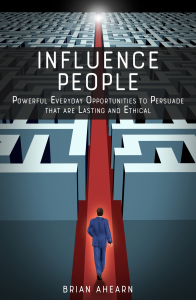
Brian’s first book – Influence PEOPLE: Powerful Everyday Opportunities to Persuade that are Lasting and Ethical – went live this summer. It’s been one of the top 10 selling Amazon books in several insurance categories and cracked the top 50 in sales & selling since launching.

Brian’s LinkedIn Learning courseshave been viewed by more than 75,000 people! His latest course – Advanced Persuasive Selling: Persuading Different Personalities – is now available through LinkedIn Learning and Lynda.com.

Do What You Don’t Feel Like Doing!

Last week I posted something to my social media that got a lot of likes and comments so I decided it would be the focus of this week’s blog post. Early one morning, when I was very tired, I wrote:

“Poor night of sleep, awoke at 2:30, decided to get out of bed at 3:30. Very tired when 5:30 rolled around. The LAST thing I wanted to do was run. BUT, I’ve learned that doing the right thing, the hard thing, is MOST important when you don’t FEEL like it. The moon was full, the run was good and it’s off to another great day.”

Can You Relate?

I’m sure you can relate to what I was feeling. We’ve all been there before. Maybe you stayed up too late watching television. Perhaps you had too much food and drink the night before. Sometimes you wake up and just don’t feel well.

Whatever the reason, we all have days when we don’t “feel” like doing things…even things we know will be good for us.

The Choice

How our lives unfold is primarily a result of the choices we make. Stuff happens and some people have much more adversity to overcome. But never forget; no matter what you’re facing you always have a choice in how you will respond.

Viktor Frankl, a Nazi concentration camp survivor, learned this valuable lesson during his three years of imprisonment. I’ve shared his quote before but it’s worth posting again because I want to encourage you:

“Everything can be taken from a man but one thing; the last of human freedoms – to choose one’s attitude in any given circumstances, to choose one’s own way.”

No matter what, until your last breath, YOU get to choose where you will place your thoughts! And your thoughts will determine your behavior and that will be the driving force for your life.

The Feeling

Last week it would have been easy to hit the alarm and gone back to sleep. I’ve learned that we humans can justify almost any action. Maybe you can relate to these thoughts that ran through my mind:

  • I’ll get the run in later today.
  • I’ll hit it harder tomorrow.
  • Skipping one workout won’t matter.
  • Don’t be so hard on yourself.

To use healthy living as an example; one meal doesn’t make or break a diet. One workout doesn’t make or break training. It’s the accumulation of meals that makes the difference in gaining or losing weight. It’s the accumulation of workouts that make or break fitness. Each starts with a choice.

Flexible Discipline

Friends say I’m one of the most disciplined people they know. I take pride in that because I’ve worked hard for decades on how I approach life and it’s nice when people notice that hard work. However, I know I’m no different than you or anyone else. I’ve not been endowed with a discipline gene.

I’m fortunate that I had good coaches and mentors along the way. If you have not had such luck, make it a point to seek out a mentor or coach today.

I’ve learned over the years what works and what doesn’t when it comes to my personal growth. I try to shed what doesn’t work, leverage what works, and remain open to new and better ways to approach things.

In other words, while I’m disciplined I try to maintain flexibility. If my routine has to change I’m okay with that because I’ll figure out a new routine that will serve me well.

Conclusion

Here’s my perspective; much of life is about sustained effort. In college I quickly realized studying consistently, as opposed to cramming, led to better learning and good grades. When I went off to college my dad told me to treat school like a business. Put in the work every day, all day, then you can have fun at night and on the weekends. He was right!

When it came to lifting weights or running, there were no “secret” workouts. It was a willingness to grind it out every day in a smart, disciplined way.

To Do This Week

To build the discipline that will lead to success in whatever you desire to do won’t be easy. I’m just being honest and you know it’s true. Change is never easy but it’s also not impossible. If it’s not impossible that means you can do it and it starts with a choice each and every day. Make the choice to the hard thing, the right thing, the thing you don’t feel like doing but know you should, and success will eventually make its way to your doorstep.

A couple of resources you might want to look into are the following:

  • Pick up the book Atomic Habits by James Clear. It’s the best book on forming and breaking habits that I’ve read.
  • Watch this video from Mel Robbins on The 5 Second Rule. She will encourage you that one decision can change your life.

Brian Ahearn, CMCT®, is the Chief Influence Officer at Influence PEOPLE, LLC. An international speaker, coach, consultant, and author, he’s one of only 20 people in the world personally trained by Robert Cialdini, Ph.D., the most cited living social psychologist on the planet when it comes to the science of ethical influence.

Brian’s first book – Influence PEOPLE: Powerful Everyday Opportunities to Persuade that are Lasting and Ethical – went live this sum. It’s been one of the top 10 selling Amazon books in the insurance categories and cracked the top 50 in sales & selling since launching.

Brian’s LinkedIn Learning courseshave been viewed by more than 75,000 people! His latest course – Advanced Persuasive Selling: Persuading Different Personalities – is now available so make sure you check it out.

A Special Gift for You!

When I began publicizing my book, Influence PEOPLE, I offered a gift to anyone who bought it on pre-sale. The gift was a 15-minute training video on something not covered in the book: pre-suasion.

Pre-suasion is a term Robert Cialdini introduced in his NY Times best-seller Pre-suasion: A Revolutionary Way to Influence and Persuade. It’s a fascinating read, one I highly recommend! My video will give you an introduction to this powerful psychological concept.

Getting Influence PEOPLE online took longer than anticipated which shortened the pre-sale period significantly. Because not nearly as many of you got to take advantage of the gift offer as I had hoped, I’ve decided to offer the gift to everyone – whether or not you’ve purchase a copy of Influence PEOPLE.

Do I want you to get a copy of the book? Of course! But, even if you don’t, I appreciate that you read my blog. So, if you’d like to start learning about pre-suasion just email BookLaunch@influencepeople.biz.

Brian Ahearn, CMCT®, is the Chief Influence Officer at Influence PEOPLE, LLC. An international speaker, coach, consultant, and author, he’s one of only 20 people in the world personally trained by Robert Cialdini, Ph.D., the most cited living social psychologist on the planet when it comes to the science of ethical influence.

Brian’s first book – Influence PEOPLE: Powerful Everyday Opportunities to Persuade that are Lasting and Ethical – went live on August 20. It was the #1 new release in Amazon’s Casualty Insurance category, was in the top 5 in Insurance and cracked the top 50 in the Sales & Selling category.

Brian’s LinkedIn Learning courses Persuasive SellingPersuasive Coaching and Building a Coaching Culture, have been viewed by more than 70,000 people! Keep an eye out for Advanced Persuasive Selling: Persuading Different Personalities which will be available on September 12.


I’m Sorry

Last week I wrote about the importance of saying, “Thank you.” It’s always appreciated and might make someone’s day. This week we’ll go to the opposite end of the spectrum to focus on, “I’m sorry.” Saying you’re sorry is hard but it can also make someone’s day a little brighter and make you more influential in the long run.

This post was inspired by someone I met in June when I was the opening keynote speaker at the S.I.T.E. Conference in Memphis, TN. Meg McKeen and I struck up a conversation over dinner then connected on LinkedIn. She’s an insurance agent in Chicago and recently posted about her car getting sideswiped. Being an insurance agent, she’s properly covered. However, the person who damaged her car didn’t take responsibility. No note, no “I’m sorry,” no nothing. She said that stung and I get it.

A Story with a Moral

When my daughter Abigail was 10 years old my wife had gone out of town. She asked that I take Abigail to Walmart to pick up her new glasses. Abigail was excited to get her new glasses just in time for the movies that night.

We walked into the eye care section of the store and were helped right away. Unfortunately, the person helping us could not locate the glasses and said they must be at another store. I explained that my wife had taken Abigail to that particular Walmart because it was very close to our eye doctor.

Finally, a manager came over and tried to help but to no avail. He said the glasses were at another store on Morse Road, about seven miles away. To his credit, he did everything right. Nonetheless, I wasn’t happy. I didn’t do or say anything I would have been embarrassed by but had you seen me you would have known I wasn’t a happy customer.

As we left I called my wife to let her know what happened. She said, “You know, I think we were at the store on Morse Road.” My initial thought was, “You made me look like an idiot!” Then I caught myself and thought, “No, I made me look like an idiot.”

Convicted that I could have handled the situation differently, Monday morning I called Walmart and asked for Jason, the manager. We had an exchange that went something like this:

  • Me – “I don’t know if you remember me but I was in last weekend to pick up some glasses for my daughter.”
  • Jason – “I remember you. How can I help you?”
  • Me – “I’m calling to apologize.”
  • Jason – “Apologize for what?”
  • Me – “For how I acted.”
  • Jason – “You didn’t act bad compared to most customers.”
  • Me – “Maybe not but I was upset with something that wasn’t your fault. You did everything right and I should not have been angry.”
  • Jason – “Man, you just made my day. No, you made my week! If you ever need anything please ask for me and I’ll personally help you.”

The Moral of the Story

Most good stories have a moral, something to learn. In this case it was a lesson for me and for my daughter. Later I told Abigail I had called the store to apologize. She asked why and I told her I should not have been upset with the manager. I also let her know mom and dad wouldn’t always be around to prompt her to say “I’m sorry,” that sometimes you just have to step up to apologize without someone telling you to do so.

Apologizing and Influence

Most people don’t enjoy saying, “I’m sorry.” We don’t like to think we’re wrong, have done something wrong or might have hurt someone. But, none of those negates that reality that we might have blown it.

One benefit of admitting a mistake is that you can actually build your authority with others. The principle of authority tells us people pay more attention to credible experts. Part of your credibility is being trustworthy and trust often comes when you admit a weakness. Don’t you respect someone more when they’ve owned up to something like a mistake? I know I do. We’d all be better off if more people said, “I’m sorry,” and took took responsibility.

To Do This Week

Last week I encouraged you to take a moment to thank someone. This week the encouragement is to step up and say, “I’m sorry,” if you’ve made a mistake or hurt someone. You’ll feel relieved, might make someone’s day a little brighter despite what happened and you’ll remove some of the sting from whatever prompted the apology.

Brian Ahearn, CMCT®, is the Chief Influence Officer at Influence PEOPLE, LLC. An international speaker, coach, consultant, and author, he’s one of only 20 people in the world personally trained by Robert Cialdini, Ph.D., the most cited living social psychologist on the planet when it comes to the science of ethical influence.

Brian’s first book – Influence PEOPLE: Powerful Everyday Opportunities to Persuade that are Lasting and Ethical – went live on August 20 and has been one of the top 10 selling Amazon books in the insurance space and in the top 100 in the sales & selling category since launching.

Brian’s LinkedIn Learning courses Persuasive SellingPersuasive Coaching and Building a Coaching Culture, have been viewed by more than 70,000 people! Keep an eye out for Advanced Persuasive Selling: Persuading Different Personalitiesthis month.

Thank You!

Thank you! Sales of my new book, Influence PEOPLE: Powerful Everyday Opportunities to Persuade that are Lasting and Ethical, are going great! On Amazon the book hit #1 in the Casualty Insurance category, was in the top 10 in Insurance and cracked the top 50 in Sales & Selling! It’s so important to say “thank you” that I devoted a chapter to it in the book. I try to practice what I preach so I want to thank the many people who’ve been helpful in making the book a success.

You

First, I want to thank you…the person reading this. I know you’re inundated with information and only have so much time in the day. I’m thankful that you’ve chosen to give me a little of your time and attention. I hope what I share through this blog each week helps you professionally and personally.

I want to thank everyone who bought a copy of Influence PEOPLE and give advanced thanks to those who are planning to buy the book. I’ve told several people that holding the first copy of the book was a great feeling. It was finally real that I’d written a book. It wasn’t quite as amazing as holding Abigail when she was born but it was pretty darn nice.

Coach

I want to thank Barbara Grassey, The Book Boss. She’s my book coach. We met many years ago through Facebook and had the chance to meet in person once when I was in Florida. She has been amazing! She helped me through the self-publishing process, developed a marketing plan for the book and is helping with my business. Every week we’ve connected on Zoom so she could hold me accountable to do what needed to be done. If you’re thinking of writing a book hire Barbara! Thank you Barbara.

Website

Do you like my website? Nick DeFrancisco, owner of NDesign, built it. Beyond his creativity, what I appreciate most about Nick is his responsiveness. It doesn’t matter what day or time I reach out with questions, he answers pronto. If you are looking at getting a website or redoing yours reach out to Nick. Thank you Nick.

Creative Design

I’ve had lots of compliments on the book cover. That’s the handy work of Michael Franzese, owner of Franzese Ink. Mike and I go way back to high school. He not only designed the book cover, he created the Influence PEOPLE logo. When I started 10+ years ago I thought I’d created a nice design…until Michael gave me honest feedback. I appreciate honesty! If you have creative design needs you should contact Michael. Thank you Michael.

Photography

Most of the photos on my website come from Jenny Kay Photography. Working with Jenny and Brent Mackey is fun! I appreciate how much they get into the whole process. When they take a great photo they get excited which gets you excited. I asked that they make me look like George Clooney and, while we didn’t quite get there, they made me look much better than I actually do. Thank you Jenny and Brent.

Video

The video on my website was either shot, edited or shot and edited by the guys at Outsider Entertainment. The person you want to talk with if you need video is Andy Emery. He’s a really good dude. He’s laid back, easy to work with and loves the challenge of creating something that will make people say, “Wow!” Thank you Andy.

Acknowledgements

In the acknowledgement section of Influence PEOPLE I thank quite a few folks but I also want to publicly thank them here because each has been important to writing the book and my career. Thank you…

Jane Ahearn, Abigail Ahearn, Robert Cialdini, Bobette Gorden, Greg Neidert, Ph.D., Cara Tracy, Eily VanderMeer, John Petrucci, Nancy Edwards, Debbie Conkel, George Black, Mike Figliuolo, Frank Agin, Michael Franzese, Barbara Grassey, Todd Alles, Brian F. Ahearn (dad), Ann Strausburg (mom), Hoh Kim, Anthony McLean, Cathrine Moestue, Sean Patrick, Yago de Marta and Marco Germani.

To Do This Week

When you read Influence PEOPLE you’ll come across the chapter on The Importance of Saying “Thank You”. If Navy Seal Lieutenant Mike Murphy could find the time to say thanks only moments before he knew he’d probably die, then we can all find time to say thank you. Take a moment to thank someone today. You’ll feel good, you’ll probable make someone’s day a little brighter and you will be a positive influence in the world.

Brian Ahearn, CMCT®, is the Chief Influence Officer at Influence PEOPLE, LLC. An international speaker, coach, consultant, and author, he’s one of only 20 people in the world personally trained by Robert Cialdini, Ph.D., the most cited living social psychologist on the planet when it comes to the science of ethical influence.

Brian’s first book – Influence PEOPLE: Powerful Everyday Opportunities to Persuade that are Lasting and Ethical – went live on August 20 and has been one of the top 10 selling Amazon books in the insurance space and in the top 100 in the sales & selling category since launching.


Influence is all about PEOPLE

When it comes to influence it’s all about PEOPLE. After all, you can’t persuade things. No matter how persuasive you are, you can’t persuade your lawnmower to start on a hot summer day and cut the grass. However, if you’re good you might persuade your spouse, significant other or child, to start the lawnmower and cut the grass.

Dale Carnegie had it right when he wrote, “Dealing with people is probably the biggest problem you face, especially if you’re in business.” That holds true as much today as when he first penned those words more than 80 years ago. The more you understand how people think and behave, then combine that with an understanding of how to ethically influence people, the better your chances for success at the office and happiness at home.

When it comes to PEOPLE, remember it’s about those Powerful Everyday Opportunities to Persuade that are Lasting and Ethical. Let’s take a quick look at each component of PEOPLE.

Powerful

Who says influence is powerful? Here are what a few well-known people from history had to say about persuasion:

“Persuasion is often more effective than force.” – Aesop, Greek fabulist

“If I can persuade, I can move the universe.” – Frederick Douglass, American social reformer, abolitionist, writer, and statesman

“The only real power available to the leader is the power of persuasion.” – Lyndon B. Johnson, 36th President of the United States

In addition to those intelligent, successful people (and countless others over history), we now have research to rely on. There are more than seven decades of research from social psychology, behavioral economics, and now neuroscience, to prove how powerful persuasion can be…when it’s done right.

Everyday

Unless you’re Tom Hanks in Castaway you interact with people every day. Quite often in your communication with others you make requests hoping to hear “Yes!” Getting people to say yes is important because nobody goes it alone. That’s especially true for highly successful people. Jack Welch, former General Electric CEO said, “Nearly everything I’ve done in my life has been accomplished through other people.”

Here’s something I love about persuasion; it applies at work and home. Think of it as a 24x7x365 skill. At work you try to persuade your boss, direct reports, coworkers, vendors and customers. At home influence helps with your parents, significant other, children, neighbors and anyone else you come in contact with.

Opportunities

Every interaction with others presents opportunities to do “little things” differently to reap big rewards. For example; would you be curious to find out what the Cancer Society did to increase their volunteer rate 700% in one area of town? How American Veterans doubling the donations the received? Both were accomplished by doing a few, nearly costless, things differently using psychology.

The problem is, all too often people miss the opportunities that are right in front of them. Have you ever had someone point out a speaker saying “um” and then you notice it all the time? And so it is when you begin to learn the language of persuasion. You’ll be amazed at how often you begin noticing opportunities to engage the psychology to leverage better results.

Persuade

What exactly is persuasion? The definitions I hear most often are “to chance someone’s mind” or “to convince someone of something.” Those may be good starts but they’re not enough. In the end you want to see people change their behavior.

With a focus on behavior change let’s consider Aristotle’s perspective. He said, “Persuasion was the art of getting people to do something they wouldn’t ordinarily do if you didn’t ask.”

Lasting

Sometimes your interaction with another person is “one and done” but quite often you have ongoing relationships. When it comes to relationships, you don’t want to go back to the drawing board time after time do you? Of course not. Ideally, you want to communication one time and see people’s thinking and behavior change for the long haul.

Former President Dwight D. Eisenhower understood the power of persuasion could create a lasting effect. He said, “I would rather persuade a man to go along, because once I have persuaded him, he will stick. If I scare him, he will stay just as long as he is scared, and then he is gone.” Done right, persuasion will stick, have a lasting impact on others.

Ethical

According to the Merriam-Webster Dictionary, manipulation is, “to treat or operate with or as if with the hands or by mechanical means especially in a skillful manner.” That’s not so bad. However, a more familiar definition is, “to control or play upon by artful, unfair, or insidious means especially to one’s own advantage.”

The word manipulation makes most of us bristle! That’s so because it connotes taking advantage of someone. I’m confident in writing this next statement; you don’t want to be manipulated. I’m also certain you don’t want to be seen as a manipulator either.

What’s the difference between ethical influence and manipulation? This quote from The Art of WOO sums it up well. “An earnest and sincere lover buys flowers and candy for the object of his affections. So does the cad who succeeds to take advantage of another’s heart. But when the cad succeeds, we don’t blame the flowers and candy. We rightly question his character.” It’s a character issue. Will you use the tools – principles of influence in this case – for good or bad?

Conclusion

Your ability to influence people is critical to your professional success and personal happiness. Knowing that, and knowing how much you use this one skill each day, doesn’t it make sense to get better at it? My new book, Influence PEOPLE, will help you do that.

Brian Ahearn, CMCT®, is the Chief Influence Officer at Influence PEOPLE, LLC. An international speaker, coach and consultant, he’s one of only 20 people in the world personally trained by Robert Cialdini, Ph.D., the most cited living social psychologist on the topic of ethical influence.

Brian’s first book – Influence PEOPLE: Powerful Everyday Opportunities to Persuade that are Lasting and Ethical – is available online through Amazon, Barnes & Noble, and most other online sites.

His LinkedIn Learning courses Persuasive SellingPersuasive Coaching and Building a Coaching Culture: Improving Performance through Timely Feedback, have been viewed by more than 70,000 people! Keep an eye out forAdvanced Persuasive Selling: Persuading Different Personalitiesthis fall.


BIG NEWS…It’s Finally Here!

BIG NEWS…Influence PEOPLE the book is now available for pre-order!

Influence PEOPLE: Powerful Everyday Opportunities to Persuade that are Lasting and Ethical is available for pre-ordered at Amazon, Barnes & Noble and most other online book providers with a delivery date of August 20. Please note; if you order the paperback version it might say “Out of Stock” because it’s print on demand. That’s okay, go ahead and order then keep an eye out for it around August 20 or shortly thereafter.

Influence PEOPLE takes the complex science of influence and breaks it down into easy to understand, practical ideas you can start using immediately. My goal in writing the book is to help you hear “Yes!” more often at work and home. Why work and home? Because I believe getting people to say yes to you is critical for your professional success and personal happiness.

What are people saying about the book?

Influence PEOPLE is a treasure trove of instructive and entertaining personal accounts, informative research results, and extraordinarily useful tips for becoming consistently more influential. It shouldn’t be missed.” – Robert B. Cialdini, Ph.D., President, INFLUENCE AT WORK and author of Influence: Science and Practice and Pre-suasion: A Revolutionary New Way to Influence and Persuade

“In Influence PEOPLEBrian breaks persuasion down into manageable and easy to use chunks that anyone can learn and apply. He takes an idea that can be as complex as you’d like to make it and helps you learn in a fun, easy style.” – Dave Lakhani, author of Persuasion: The Art of Getting What You Want and Subliminal Persuasion

“Brian Ahearn’s new book has its roots in science but is highly readable and endlessly practical. Influence PEOPLE is packed with bite-size stories and nuggets of actionable advice. Anyone who wants to influence or persuade others should read this book.” – Roger Dooley, author of Friction and Brainfluence

Influence PEOPLE takes the science of influence out of the academic realm and makes it something you can easily use in the real world. Brian provides a ton of outstanding ideas that will help you enjoy more success at the office as well as peace and happiness at home. If you want to be more influential with everyone you meet, pick up your copy today!” – Mike Figliuolo, Managing Director of thoughtLEADERS and author of One Piece of Paper, Lead Inside the Box and The Elegant Pitch

“If your professional and personal success is dependent on getting others to say Yes to you–which it is by the way–then the obvious question is how? Brian Ahearn’s Influence PEOPLE doesn’t provide a single response, but rather a series of compelling answers. Importantly, they are all as practical and actionable as they are rooted in solid scientific evidence. 5 Stars!” – Steve Martin, New York Times bestselling co-author of Yes! and Messengers! Who We Listen To, Who We Don’t and Why

How Do I Order My Copy?

To order your copy of Influence PEOPLE: Powerful Everyday Opportunities to Persuade that are Lasting and Ethical click on one of these links: Amazon or Barnes & Noble.

But wait, there’s more! As a thank you for pre-ordering the book I have a free training video to share with you. The 15-minute video will introduce you to something not in the book – the psychology of pre-suasion. Once you’ve placed your order email proof of purchase to BookLaunch@influencepeople.biz and you’ll receive an email with a link to the training. The training link will only be up until month-end so make sure you watch it shortly after you order your copy of the book.

Brian Ahearn, CMCT®, is the Chief Influence Officer at Influence PEOPLE, LLC. An international speaker, coach, consultant, and author, he’s one of only 20 people in the world personally trained by Robert Cialdini, Ph.D., the most cited living social psychologist on the topic of ethical influence.

Brian is the author of the new book Influence PEOPLE: Powerful Everyday Opportunities to Persuade that are Lasting and Ethical. His LinkedIn Learning courses Persuasive SellingPersuasive Coaching and Building a Coaching Culture: Improving Performance through Timely Feedback, have been viewed by more than 70,000 people! Keep an eye out for Advanced Persuasive Selling: Persuading Different Personalitiesthis fall.


Take A Look At This Persuasive Marketing Piece

I still get lots of junk mail. I’m sure you do too. I usually glance at it mostly to see if any is effective. Most isn’t but every now and then I come across a persuasive marketing piece. A few weeks ago, I received something from Amica Insurance about auto insurance. The mailer did several things I’ll point out.

The Envelope

The envelope said only 1 in 25 drivers qualified for their special offer. That’s good use of scarcity. It feels good to be in an exclusive club and get benefits not everyone gets.

It then listed my potential savings of $596. That’s good and much more eye catching that saving $50 a month. Last but not least, I’m given a deadline – September 1 – to respond. Another application of scarcity.

Inside the Envelope

When I opened the envelope a yellow sticky note catches my eye. According to two independent studies the use of sticky notes doubles response rates.

In red it says there are important facts to review. Not only did I see facts, I saw how much I might save if I were currently with State Farm, Liberty Mutual or other well-known insurance carriers.

The Mailer – Page 1

When I open the actual mailer inside the envelope I’m immediately hit with the fact that American drivers overpay for auto insurance by an average of $368. More scarcity because people will take more action to avoid losing money than to save money.

I’m told I can get a free quote. Even though no insurance carrier will charge you to quote your insurance the word free is a big trigger for people. We love free stuff!

The Mailer – Page 2

The next page says at the top “Better drivers deserve a better value.” That appeals to the fact that we all believe we’re better than average. We believe we’re better looking, smarter, kinder and better drivers. If we’re better then we deserve better.

The box that follows lists four features of the policy. Most of the features are included with the majority of auto policies but, because people don’t read their insurance policies, the coverages stand out as novel. I also like that Amica limits it to four. More than five and people will forget them but fewer and people might feel like there’s not much that’s different with an Amica policy.

And Dinari DuPont personally signed the letter! Well, not actually but it looks like it.

Conclusion

Overall, I give Amica an A on their marketing piece. I think it has too much information but what it does share incorporates a lot of persuasive psychology.

Here’s my challenge for you over the next week. Don’t just toss the junk mail that makes its way to your mailbox and don’t delete all the spammy looking emails that hit your inbox. Take a few minutes to read some and see if you can pick up on the persuasive psychology that’s being used to try to move you to action.

Do this and two things will happen:

  1. You’ll become better at spotting how marketers, salespeople, politicians and others are trying to change your thinking and actions.
  2. You will begin to see opportunities you can use to ethically influence people.

Brian Ahearn, CMCT®, is the Chief Influence Officer at Influence PEOPLE, LLC. An international speaker, coach and consultant, he’s one of only 20 people in the world personally trained by Robert Cialdini, Ph.D., the most cited living social psychologist on the topic of ethical influence.

Brian’s first book – Influence PEOPLE: Powerful Everyday Opportunities to Persuade that are Lasting and Ethical – will be available for pre-sale then live sales in August 2019.

His LinkedIn Learning courses Persuasive SellingPersuasive Coaching and Building a Coaching Culture: Improving Performance through Timely Feedback, have been viewed by more than 70,000 people! Keep an eye out for Advanced Persuasive Selling: Persuading Different Personalitiesthis fall.

LinkedIn Learning – A New Course Coming Soon!

As I type this I’m in Carpinteria, CA, formerly home to Lynda.com, now LinkedIn Learning. This is my fourth time here to film a course. Advanced Selling: Persuading Different Personality Types will be released this fall. Working with LinkedIn is like you might imagine a cutting edge tech company to be. As soon as yo walk into their main facility you see ping pong and foosball tables. Breakfast, lunch are included along with unlimited coffee and snacks. My waistline is glad I don’t work there full time!

But the coolest thing at LinkedIn are the people. They are off the charts amazing at what they do and so much fun to work with. Preparation for a course begins months in advance with script writing. You work with an editor to get the words just right for LinkedIn’s worldwide audience. When you arrive to film you have make-up (yes, I wore make-up!), hair, lighting and sound technicians and a producer. After the filming the graphics folks work their magic. It amazes me what they produce after a day or two in a dark room in front of a green screen. It puts me in awe of what it must take to make motion pictures and televisions shows.

Below is the intro video to my course on Persuasive Selling. I encourage you to take a look and visit LinkedIn Learning to watch it and some of the thousands of other courses they offer. From Adobe to Excel to just about anything else business related, you can learn about everything at LinkedIn Learning.


Eight key psychological concepts in sales from Persuasive Selling by Brian Ahearn


Brian Ahearn, CMCT®, is the Chief Influence Officer at Influence PEOPLE, LLC. An international speaker, coach and consultant, he’s one of only 20 people in the world personally trained by Robert Cialdini, Ph.D., the most cited living social psychologist on the science of ethical influence.

Brian’s LinkedIn Learning courses Persuasive SellingPersuasive Coaching and Building a Coaching Culture: Improving Performance through Timely Feedback, have been viewed by more than 70,000 people! Keep an eye out for Advanced Persuasive Selling: Persuading Different Personalitiesthis fall.


Influence PEOPLE: the book – Ethical

In August my first book will be available in eBook and paperback online at Amazon.com, Barnes & Noble and other outlets. Influence PEOPLE: Powerful Everyday Opportunities to Persuade that are Lasting and Ethical was written to give you practical, real-world ideas on how to use the science of influence. The goal is to help you enjoy more success at the office and happiness at home. I hope you’ll consider getting a copy.

This week’s blog post is an excerpt from the book on what it means too be ethical when it comes to persuasion.

Ethical

“A man is truly ethical only when he obeys the compulsion to help all life which he is able to assist.”

Albert Schweitzer, theologian, philosopher, humanitarian

Do you know the difference between ethical persuasion and manipulation? Manipulators lookout only for themselves, unconcerned about the impact on others. It doesn’t matter to them if they stretch the truth – or outright lie – to get what they want. They don’t care if they disingenuously use their knowledge of psychology to twist your arm because they only care about how things work out for themselves.

This is why a good bit of advertising, particularly political ads, turn off so many people – because it’s apparent many companies and politicians distort the truth just to sell more products and win elections.

When it comes to ethics I like the following quote from The Art of Woo by G. Richards Shell and Mario Moussa; “An earnest and sincere lover buys flowers and candy for the object of his affections. So does the cad who seeks to take advantage of another’s heart. But when the cad succeeds we don’t blame the flowers and candy. We rightly question his character.” 

Are flowers and candy good or bad? They’re neither good nor bad. They’re neutral objects that acquire meaning based on how we use them.

The same is true of the principles of influence. They’re neither good nor bad, they describe how people typically think and behave. How you use your knowledge of influence will reveal your character. Will you use your new knowledge of influence in a mutually beneficial way, looking for the proverbial “win-win”? Will you be truthful? Will you employ principles natural to the situation you find yourself in? If you know you are telling the truth, using principles natural for the situation, and what you ask will benefit the other person in some way, then you can feel confident moving ahead with your ethical request. 

Using the principles of influence ethically cannot be overstated. Use them ethically and you can build strong, lasting relationships in your personal life and in business. However, if people feel you’re manipulating them, not only will they sever the relationship, they’re likely to spread the word and damage your reputation. We’d all do well to remember what Aristotle said; “Character may almost be called the most effective means of persuasion.” As your use of ethical persuasion skills grows, so does your influence.

Brian Ahearn, CMCT®, is the Chief Influence Officer at Influence PEOPLE, LLC. An international speaker, coach and consultant, he’s one of only 20 people in the world personally trained by Robert Cialdini, Ph.D., the most cited living social psychologist on the science of ethical influence.

Brian’s LinkedIn Learning courses Persuasive SellingPersuasive Coaching and Building a Coaching Culture: Improving Performance through Timely Feedback, have been viewed by more than 70,000 people! Keep an eye out for Advanced Persuasive Selling: Persuading Different Personalitiesthis fall.