Stop! I mean, Go! Confused?

Mixed signals cause a lot of confusion. In business confusion in communication often leads to errors, delays and lost opportunities. It’s like telling someone to stop, then go, then stop. Do that and they will be confused. “But I thought you want me to…?”

This was top of mind recently when I was working on a presentation around the ideas of pre-suasion. Pre-suasion focuses on things you can do before you make a request of someone to increase the odds of hearing yes. A couple of examples include:

  1. A man sending flowers to a woman before asking her out. Flowers boost the chance of getting a date because they prompt thoughts of romance.
  2. Playing upbeat music later in the day. This will lift the mood and energy at a training event or conference. If you want people to say “Yes” to you then your chance goes up significantly if they’re feeling energetic and positive.

Much of persuasion and pre-suasion take place at the subconscious level which means, most of the time people are unaware of the impact. Something that affects your thinking is color. For example:

  1. Green has positive associations for most people. It conjures up thoughts of “Go” because of traffic lights. In the United States it makes people think about money because that’s the color of our printed currency. And more recently, it prompts thoughts of the environment.
  2. Red is usually experienced in a more negative way. When you’re losing money, you’re said to be “in the red.” Red signals to “Stop!” because of traffic lights and stop signs. It’s also the color of aggression – think Tiger Woods in Sunday in his trademark red shirt. And then there’s blood!

Sometimes marketers, advertisers and others forget these associations and hurt their efforts when it comes to moving people to action. This came to mind when I was on the New Yorker Magazine site recently. A pop-up box appeared to encourage people to subscribe to the monthly magazine and the “Sign me up” button was red. As I looked around the site I found another instance of the same thing.

The website designer probably thought the color stood out and would get attention. While it does that, it also subconsciously is telling your brain to stop. The magazine would be much better off having a green box because it signals “go” as in “Go ahead and sign me up!”

On the flip side, if you wanted someone to stop doing something it would be unwise to incorporate the color green. Doing so will cause confusion because the subconscious will think “Go!” and end up working against the conscious.

Conclusion

You might think what I’ve just described is insignificant but it matters. Despite a very good economy businesses are always looking for ways to impact the top and bottom line. If something as simple – and costless – as aligning the right colors with the actions you want people to take can reduce expenses or increase sales why wouldn’t you take advantage?

Brian Ahearn, CMCT®, is the Chief Influence Officer at Influence PEOPLE, LLC. An international speaker, coach and consultant, he’s one of only 20 people in the world personally trained by Robert Cialdini, the most cited living social psychologist on the topic of ethical influence. Brian’s LinkedIn Learning courses Persuasive SellingPersuasive Coaching and Building a Coaching Culture: Improving Performance through Timely Feedbackhave been viewed by more than 65,000 people! Have you watched them yet? Click a course title to see what you’ve been missing.

Luck is Where Preparation Meets Opportunity

Like so many people, a coach had a huge impact on my life. For me that person was Todd Alles, the head football coach at Dublin during my high school years. Among the many things he said that stuck with me was this – “Luck is where preparation meets opportunity.”

Whether or not we want to admit it, much of success has to do with luck. One definition for luck is, “success or failure apparently brought by chance rather than through one’s own actions.”

It’s the chance part that’s outside your control. For example; being born into your family, growing up where you did, the opportunities (sports, music and other activities) afforded you, and so much more had very little or nothing at all to do with your choices or skills.

Sometimes it’s randomly meeting a person who gives you a big break. Maybe it’s being fortunate to have a teacher or coach who took special interest in you and changed your life.

Chance has impacted me in numerous ways over the years. I’d like to share with you a couple of random events changed my life forever.

On a personal level luck…

led to my marriage. Having accepted a job before graduation college, I still decided to go to one last interview. The Travelers, a national insurance company, was looking for an underwriter and I only went to the interview because the job was in Columbus, Ohio, my hometown. My family and friends were in Columbus as was a girl I was dating so I thought it would be nice if I could stay in town. I got the job and on my first day I walked into the HR on boarding session and laid eyes on Jane, the woman who would become my wife.

On a professional level luck…

changed the course of my career. While at State Auto Insurance a good friend, Nancy Edwards, gave a video to me and my boss. She thought it would hit home with us because of our sales training. The video was Robert Cialdini presenting research on ethical influence at Stanford’s Breakfast Briefings. What he shared resonated with me on many levels so I began using Cialdini’s concepts in my sales training.

Even more random was an email I sent to Stanford sometime later when their marketing referred to Cialdini’s training as manipulation. I never heard from Stanford but that email led to a phone call from a representative at INFLUENCE AT WORK. She called to thank me on behalf of Dr. Cialdini for pointing out Stanford’s mistake. Because of my email Stanford changed their marketing of the video and it led to a relationship with INFLUENCE AT WORK that’s now spanned more than 15 years. Were it not for that email it’s very likely I would not have pursued the career path I’m on and you certainly would not be reading my blog right now.

Where was the preparation?

In both cases opportunities presented themselves and I was prepared to seize them. When it came to the job interview, if I had not worked hard in school, gotten good grades and interviewed extensively, it’s very likely I would not have gotten the job…and never met Jane. Travelers is a fine company and I’m sure many college grads would have loved the opportunity to work for them but I was the one who was prepared.

With regard to my career, I could have easily disregarded the Stanford marketing piece that mentioned manipulation but I didn’t because being an ethical person is a core value for me. I felt compelled to address the situation and was articulate enough to bring about change. Again, I was prepared for the opportunity that presented itself.

Conclusion

Sometimes unfortunate opportunities come your way, things that are completely outside of your control that pose a threat or have a negative impact. Even in those cases the question is; are you ready to deal with the situation in a way that lessens the bad outcome or perhaps turns it into something positive?

When it comes to good luck there’s no room for boasting. But there is room for confidence that says, “I’m ready whenever the opportunity presents itself.” There’s a well-known saying on this that’s sometimes attributed to Arnold Palmer, “The more I practice, the luckier I get.” Make sure you’re prepared for the opportunities that might come your way someday.

Brian Ahearn, CMCT®, is the Chief Influence Officer at Influence PEOPLE, LLC. An international speaker, coach and consultant, he’s one of only 20 people in the world personally trained by Robert Cialdini, the most cited living social psychologist on the topic of ethical influence. Brian’s LinkedIn Learning courses Persuasive SellingPersuasive Coaching and Building a Coaching Culture: Improving Performance through Timely Feedback have been viewed by nearly 65,000 people! Have you watched them yet? Click a course title to see what you’ve been missing.

Fake Influence – It’s Manipulation

No doubt you’re familiar with the term fake news. Faking it isn’t limited to the news. Fake influence is a real thing, it’s growing and it hurts everyone.

Would you loan money to someone you believed had a big bank account? It’s probably a sound business decision to do so because you assume they have the ability to repay the loan. What if it turns out they lied? That fake information most certainly would have changed your decision regarding the loan.

A similar situation exists with fake influence – manipulation to be more precise – and you’re probably unaware of it in most situations. I know I was until I learned about click farms.

What is a Click Farm?

Click farms are where fake influence grows. Imagine a wall with 100-200 cell phones. A low paid worker stands in front of the phones and gets paid to click on specific links to drive the impression that people are viewing particular websites, Facebook posts, Instagram photos, YouTube videos and various advertising. They also sign up for newsletters and other offers.

If you’ve ever seen ads to gain followers, increase likes, boost shares, etc., there’s a good chance a click farm was behind it.

Fake Followers

If you’re looking to gain a following in order to promote your product or service you’re hoping for legitimate people who might buy whatever you sell. Gaining access to new followers is analogous to advertising.

Let’s say you sell surf boards and want to grow your social media presence. You might find it worthwhile to have more views and followers. How would you feel if saw your numbers increasing but no change in sales? That’s exactly what happens when you get thousands of fake clicks and follows. There’s nobody there to actually buy.

Fake Social Proof

It’s very common for people to go online to look at product ratings and reviews before making a purchase. If you thought a product or service was rated 4.5 stars from hundreds or thousands of people that will sway your buying decision. How would you feel if you learned many of those positive reviews were fake?

Fake Influencers

Fake influences are a big way some people and businesses get hurt. The term influencer refers to people will large social media followings. These influencers interact with different organizations promising to give them “advertising” by using their products. Think of it like celebrity advertising except it’s from people who’ve not done anything other than gain followers on social media.

Let’s assume you run a resort hotel on a beach. It’s a good bet competition is tough and margins are small so you look for new opportunities to attract business. Now suppose an influencer comes along and tries to negotiate a deal. They want you to let them and a handful of their friends stay at your place for free and comp their meals and drinks. In return they promise to constantly post about their great experience while staying at your place. Why would you do this? To get thousands, maybe hundreds of thousands of views from people who are your target market.

This might be a tempting offer because you’re not shelling out any cash like you would for traditional advertising. Instead, you’re only accruing expenses related to the free rooms, food and drink for a half dozen people. But you’re doing this because you believe so many people will see what a great resort you have. Well, maybe not as many people as you thought because so many “followers” were generated through click farms. Bottom line, they’re not real and could never stay at your resort.

Fake Advertising

If you happen to run a company that pays people for clicks or access to certain sites, you’re hurt by click farms because those clicks will never lead to any business.

Conclusion

The examples could go on and on but I’m sure you get the picture. You can call it fake influence, manipulation or fraud, because if you knew the truth you would have made a different decision. The influence is one sided, for the benefit of the influencer. There have always been scammers and there will always be. With new technology come new ways to make a buck at the expense of unsuspecting people. Just remember, ethical influence is not only good for the influencer, it’s good for the person being influenced. In other words, it should produce a win-win outcome.

Have a comment or question?Click here. If you liked what you just read why not share it with a friend or coworker?

Brian Ahearn, CMCT®, is the Chief Influence Officer at Influence PEOPLE, LLC. An international speaker and trainer, he’s one of only 20 people in the world personally trained by Robert Cialdini. Brian’s LinkedIn Learning courses on Persuasive Selling and Persuasive Coaching have been viewed by more than 65,000 people! His latest course, Creating a Coaching Culture, will be online soon. Have you watched them yet? Click a link to see what you’ve been missing.

The Madness of People – Our Irrational Selves

“I can calculate the motion of the heavenly bodies, but not the madness of people.” 
– Sir Isaac Newton

I came across this quote while reading Robert Greene’s latest book, The Laws of Human Nature. Greene has authored many books including The 48 Laws of Power and The 33 Strategies of War. All are excellent reads because they’re well written and Greene weaves history and interesting stories throughout to illustrate his points.

The quote from Isaac Newton came after Greene shared the story of the South Sea Company. In the early 1700s the South Sea Company was supposed to open trade in South America for England. Suffice it to say, their approach was similar to Bernie Madoff’s Ponzi scheme when it came to raising funds. It swept up people across England as they invested in what looked to be a sure-fire get rich quick opportunity. Even the brilliant, rational thinker Isaac Newton fell prey to the madness.

How did that happen? How did it happen again with Bernie Madoff? Why will it happen again? Three big reasons – recency bias, consensus and scarcity.

Recency bias

This is the distorted thinking where we give more weight to recent events than they deserve and we prioritize the present ahead of the future. Over the course of evolution giving immediate, focused attention to whatever was in front of us served humans well. That’s so because most dangers and opportunities were in the moment and needed to be acted upon right away to ensure survival.

Survival isn’t always at stake nowadays but our minds still focus far more on the present than the future. This is why so much importance is put on quarterly earnings by Wall Street. This pressure causes many companies to take actions to satisfy “the street” and investors in the short term but often at the expense of better long-term approaches.

In the case of the South Sea Company it was hard for people to resist investing when they kept seeing the stock price rise and people getting rich…even though the company never actually began trading in South America. Sounds a little like the dot com bust doesn’t it?

Consensus

We’re social animals so it’s natural for us to follow the crowd. This too served humans well when it came to survival. There’s safety in numbers and being part of the group felt more comfortable and safer than going it alone.

We don’t face the same kinds of physical dangers today that our ancestors faced so being part of the crowd shouldn’t be as important. But it is. Studies show exclusion from groups registers in the brain in the same region where physical pain is detected. In other words, there’s very little difference between physical pain and the pain we feel when we’re ostracized from groups.

We still see this mentality today with “hot stocks.” There are always those stocks that everyone seems to flock to which causes more people to flock to them. As this happens stock prices rise even if nothing tangible has been created yet. Sound a little like bitcoin?

Scarcity

The fear of missing out (FOMO) is a powerful motivator to act. Humans are wired to be more sensitive to loss than gain. In Robert Cialdini’s book Influence Science and Practice he quotes social scientists Martie Haselton and Daniel Nettle:

“One prominent theory accounts for the primacy of loss over gain in evolutionary terms. If one has enough to survive, an increase in resources will be helpful but a decrease in those same resources could be fatal. Consequently, it would be adaptive to be especially sensitive to the possibility of loss.”

As people learned about the fantastic gains investors were making with the South Sea Company they couldn’t bear the thought of missing out on their chance to change their lot in life. Many dumped their life savings into the company in hopes of becoming fabulously wealthy.

It still happens today. Bernie Madoff’s stellar investment returns were an example. Smart, wealthy individuals and people with very intelligent investment advisors got sucked in. If those people and someone as rational and smart as Sir Isaac Newton can make the same mistake don’t fool yourself thinking you’re above it.

Conclusion

The wiring of your brain generally serves you well. However, we live in an unprecedented time of change and the pace of change is accelerating rapidly. Your brain on the other hand evolves very slowly and sometimes relying on old mental shortcuts can work against you instead of for you.

Next time something is consuming you, where you sense the pull of the crowd and feel like you’ll miss out if you don’t act quickly, take that as a cue to hit the pause button. If you’ll take time to slow down, consider why you’re feeling the way you are and take a long view, that might be enough for you to make a better, more rational decision. Sir Isaac Newton might not have done it but now you know a little more about the madness of human behavior than he did.


Brian Ahearn, CMCT®, is the Chief Influence Officer at Influence PEOPLE, LLC. An international speaker and trainer, he’s one of only 20 people in the world personally trained by Robert Cialdini. Brian’s LinkedIn Learning courses, Persuasive Selling  and  Persuasive Coaching have been viewed by nearly 65,000 people! His latest course, Creating a Coaching Culture, will be online in the second quarter. Have you watched them yet? Click a link to see what you’ve been missing.

Influence PEOPLE: The Book – Mental Shortcuts

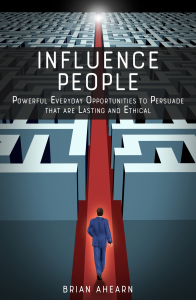
As I’ve transitioned from corporate America to Influence PEOPLE much of my time has been spent finishing a book I started years ago. Influence PEOPLE: Powerful Everyday Opportunities to Persuade that are Lasting and Ethical should be available online by the end of June. To start building anticipation I will share some excerpts in the months leading up to its publication.

Mental Shortcuts

“This year, the average consumer will see or hear one million marketing messages – that’s almost 3,000 per day”
William C. Taylor, co-founder Fast Company Magazine

In his article titled “Permission Marketing” which appeared in the magazine Fast Company, William C. Taylor wrote, “This year, the average consumer will see or hear one million marketing messages – that is almost 3,000 per day.” Wow! Did you realize you are bombarded with nearly 3,000 marketing messages per day? Here’s a scary thought – Taylor’s quote is from 1998! With the explosion of the Internet and particularly social media, this estimate is as high as 5,000 per day now!

Can anyone realistically process this many marketing messages each day? Of course not! That’s part of the reason Martin Lindstrom, author of Buyology: Truth and Lies about Why We Buy, contends “85% of what you do every day is non-conscious.” Some scientists, like Leonard Mlodinow, author of Subliminal: How Your Unconscious Mind Rules Your Behavior, put the number at 95%. Let’s split the difference and say nine out of every 10 decisions and/or actions the average person undertakes are not consciously thought out in some rational fashion. While that might seem troublesome on the surface it’s actually beneficial because it helps us keep our sanity. Many choices we make don’t require lots of effort, which leaves more time and energy for the more important decisions and actions we undertake.

Consider your daily commute to work. If you’re like most people you go through very complex steps to make that commute. Driving a car is no easy task and neither is successfully negotiating traffic with other people driving at high speeds and yet you do it every day with very little thought. You make it to work most days without remembering too much about the drive because you were on autopilot in a very real sense. And so it is with most things we do each day.

This same phenomenon occurs with our thought processes. We don’t analyze every ad, decision or request that comes our way. Sometimes we give deep thought to those things but quite often we don’t because of a lack of time, energy and desire. To maintain our sanity and successfully make it through the day we rely on mental shortcuts. Think of these influence principles as time tested mental shortcuts that help people make quick, satisfactory decisions in the information overloaded society we find ourselves.

Bottom line: we need mental shortcuts to deal with the complexity of life and the principles of influence explain many of the mental shortcuts people use.

Brian Ahearn, CMCT®, is the Chief Influence Officer at Influence PEOPLE, LLC. An international speaker and trainer, he’s one of only 20 people in the world personally trained by Robert Cialdini. Brian’s LinkedIn Learning courses, Persuasive Selling and Persuasive Coaching have been viewed by more than 60,000 people! His latest course, Creating a Coaching Culture, will be online in the second quarter. Have you watched them yet? Click a link to see what you’ve been missing.

Just Don’t Do It!

I’ve no doubt you’re familiar with Nike’s famous slogan Just Do It! As someone who spends most of his time communicating through keynote presentations, training, coaching and consulting, sometimes the best advice is Just Don’t Do It!

When I attend conferences and workshops, in addition to learning new information, I pay close attention to the presenters. I do so because I’m always looking for ways to improve my communication skills. The better job I do as a presenter, the more likely audience members are to walk away with ideas to help them professionally and personally. Sometimes what I learn while watching other presenters is what not to do.

I was at a training event recently where it was apparent the presenter knew the material. Unfortunately, he was an awful presenter. Here are a handful of phrases he uttered that caught my attention:

  • “Thanks for coming to listen to me drone on.” Really, that’s what you’re going to do for three hours?
  • “Contrary to popular demand I won’t cover…” If people want it, why not cover it? At least don’t mention it if you’re not because it causes disappointment.
  • “If you’ve zoned out for some of this presentation I don’t blame you.” Then why should we have even come?
  • “In order to break up the monotony I’ll show a video.” How about trying to make it less monotonous?
  • He used example that wasn’t directly related to his subject and told us not only did it fail, he “went down in flames.” Why highlight your failure with an irrelevant example? Instead, how about telling us what you did that worked?

I texted my wife and said I was about ready to gouge my eyes out with my pen. She suggested I handle it like a bad blind date – go to the restroom and don’t go back. I took her advice and slipped out during a break.

Words Matter

In his NY Times bester-seller, Pre-suasion: A Revolutionary New Way to Influence and Persuade, Robert Cialdini builds the case the setting the stage can make a big difference when it comes to influence. Maybe you occasionally lead meetings, facilitate training or perhaps you’re a fulltime teacher. In each case you’re influencing people as you teach them.

I’ve heard professional educators, people in corporate training, open workshops saying, “I know some of you are here because you have to be,” or “I know some of you are here because your boss made you come.” No, no, no!

Approaches like those just noted either implant negative thoughts or reinforce a negative perceptions attendees might already have. Your job as a facilitator is to help them learn and one step in that direction is to put them in a state of mind that’s conducive to learning. To do this, early on in my workshops I typically ask three questions:

  1. Where are you from?
  2. What do you enjoy doing outside of work?
  3. Why are you excited to be here?

The first question is a nice way for people to connect because oftentimes attendees find out they’re from the same geographic area as others in the workshop. It’s a natural conversation starter.

Question 2 begins to change people’s thinking. Some people don’t enjoy their jobs but getting them focused on activities apart from work that they do enjoy puts them in a better frame of mind.

The final question is geared towards changing their mindsets about learning. When I ask why they’re excited the vast majority of people come up with at least one reason and respond with, “I’m excited to be here because…”

If a person can’t come up with something I might ask, “If I can help you get your kid to empty the dishwasher more often would that make our time together worthwhile?” That usually gets a laugh and positive response. Then I make sure to address that for the individual.

When it comes to learning, subtle shifts in the following mindsets can make a big difference:

  • Closed minded to open minded
  • Bored to curious
  • Uninterested to interested
  • Apathetic to excited

Using a little pre-suasion can make that happen. You can accomplish that using the right questions, certain types of music or the right imagery. I think of this as setting the stage. When your session starts off well it becomes much easier to keep people engaged and learning.

Conclusion

Your words matter because they set a tone. At all costs avoid the kinds of phrases I described near the beginning of this post. But don’t settle for avoidance. Whether you call it pre-suasion, setting the stage or creating the right atmosphere, don’t leave it to chance. Think about frame of mind you want people in as your event starts and do what you can to create an environment that’s conducive.

Brian Ahearn, CMCT®, is the Chief Influence Officer at Influence PEOPLE, LLC. An international speaker and trainer, he’s one of only 20 people in the world personally trained by Robert Cialdini. Brian’s LinkedIn Learning courses, Persuasive Selling and Persuasive Coaching have been viewed by more than 60,000 people! His latest course, Creating a Coaching Culture, will be online in the second quarter. Have you watched them yet? Click a link to see what you’ve been missing.

The Dumbing Down of Social Media

Did you know, in many European countries (Austria, Belgium, France, Poland) organ donation rates are almost 100%? However, in some countries (U.K., Germany, Denmark) it’s less than 25%! Are some Europeans four times more socially conscious than their continental partners or is something else going on?

The gap can be explained by one simple difference – in many countries the default when getting a drivers license is to be an organ donor. In countries with high donation rates Europeans drivers have to check a box to opt out of organ donation. In countries with low participation rates people have to check a box to become an organ donor.

Checking a box takes virtually no effort but that small change in the default – check to opt in vs. check to opt out – makes a huge difference! Many people argue it’s good for society to make certain choices, like organ donation or saving for retirement, easier whenever possible.

Behavioral economics looks how people make choices and what’s been discovered can help individuals and organizations structure choices in ways that benefit more people. But, resetting defaults doesn’t always lead to the hoped-for outcomes, especially with social media. The problem is many sites are dumbing things down.

Congrats on your work anniversary!

If you spend any time on LinkedIn then it’s a good bet you’ve seen notifications alerting you about work anniversaries for your connections. That’s nice because those milestones might otherwise go unnoticed.

To make life easier for LinkedIn users the platform lets you click on a link that automatically sets up a message which reads, “Congrats on your work anniversary!” The vast majority of people hit the send button and move on with their day.

But here’s the problem, we’ve come to realize it takes almost no time, effort or thought on the part of the person who sent the message. It’s like getting spam except it comes from someone you know. The same applies to the birthday alerts.

What Can You Do?

People value what you do for them, the gifts you give and the congratulations you offer, much more when you take time to personalize them. In one study, a simple handwritten message on a yellow sticky note doubled response rates on a survey. Why? Reciprocity dictates the more someone does something for us the more we feel we should do for them.

When you take a moment to personalize whatever you’ve done it makes people feel special and shows you put in some extra thought, time and effort. That’s a great way to build or strengthen relationships.

Gifts. You could argue a gift card is the best gift because it lets the receiver buy whatever he or she wants. Letting the other person choose their gift may be nice but there are a couple of problems with this approach:

  1. Now the burden is on the recipient to go to the store.
  2. It might indicate you don’t know them well enough, or care enough, to understand what they might like.

The best time for gift cards are when you know something about the person so it becomes personalized. For example, if someone loves to browse books at Barnes & Noble then a gift card is a reason to go somewhere they enjoy. If they happen to walk away with an unexpected find they’ll remember it was your gift card that led to the purchase.

Congratulations. We all like to be recognized, especially on important dates. It hardly takes time to modify the “Happy birthday!” or “Congrats on your work anniversary!” that automatically pop up daily on LinkedIn.

  1. Happy birthday Joe. Any fun plans for today? Enjoy!
  2. 15 years is a long time Ann! Congrats on the anniversary!

If you take a moment to send a text instead of the LinkedIn message you’ll be surprised at the responses you get. Taking it one step further, there are people I call every year on birthdays. I know they really appreciate it because not only do they tell me, they tell others. A friend recently told me she mentioned my birthday calls to Nick, a mutual connection. Nick told her he doesn’t get a call on his birthday so I sent him this message the same day:

I had lunch with Christy today and she told me you two know each other. I got the sense you weren’t feeling as loved as she does so I’ve marked December 16 as a special day to give you a call. Hopefully we’ll see each other well before then. Enjoy the downside of the week.

Little things like this can make a big difference! Nick and I will have a nice laugh on December 16 and I know this; if I ever need his assistance he’ll gladly help, not because he has to, but because he wants to.

Conclusion

A few weeks ago, I wrote a post about social media being social. I applaud the efforts of LinkedIn, Facebook and other social platforms to make it easier for us to remember important milestones for the people we’re connected to. But, don’t let the ease create a laziness in you. Building and maintaining relationships is different than prompting behavior change for social causes. If you don’t understand this you might end up hurting relationships when your intent was to do something nice.

Brian Ahearn, CMCT®, is the Chief Influence Officer at Influence PEOPLE, LLC. An international speaker and trainer, he’s one of only 20 people in the world personally trained by Robert Cialdini. Brian’s LinkedIn Learning courses, Persuasive Selling and Persuasive Coaching have been viewed by more than 60,000 people! His latest course, Creating a Coaching Culture, will be online in the second quarter. Have you watched them yet? Click a link to see what you’ve been missing.

The Mindless Things We Say Affect Us and Others

When you communicate your words create thoughts and feelings within you and for others. Sometimes the feelings come first then trigger thoughts. Other times thoughts may be prompted followed by feelings. Whatever the order (feelings-thoughts or thoughts-feelings) next comes behavior. If you agree with that assertion you’ll also agree that some of the mindless things you say affect your behavior and the behavior of those who hear your words.

I’m Sorry

There are certainly times for legitimate, heart felt apologies. However, if you pay close attention to the times you say you’re sorry, or when others do, you’ll realize quite often sorry isn’t necessary. This came to my attention when I watched a Ted Talk from sociologist Maja Jovanovic.

In early childhood parents and others teach us to say we’re sorry for a variety of reasons. Most are legitimate but after that our need to apologize seems to takes on a life of its own. As Jovanovic points out, constant apologizing disempowers you and can lead others to think less of you.

Here is an example. Let’s say you’re on your way to a meeting and a major car accident will cause you to be late. As soon as you realize this you call the person you’re supposed to meet with and say, “I’m sorry, I’m going be late. There’s an accident on the highway and the traffic is at a standstill.” The accident wasn’t your fault which means being late isn’t your fault so why apologize? It would be just as legitimate to say, “I’m calling to let you know I’m going be late because there’s an accident on the highway and the traffic is at a standstill.”

Again, I point this out because apologizing isn’t always necessary and can actually be counterproductive in terms of how people may view you.

Not Bad

This one is a pet peeve of mine. When you ask someone, “How are you?” it’s very common to hear, “Not bad.” You might be thinking, I know what they mean, but do you really? Let’s analyze this phrase just a little.

Does saying “not bad” mean you’re actually doing well? If so, why not say, “I’m doing well. Thanks for asking.” If bad is the standard are you content simply because you’ve avoided the bad state? That’s not the same as doing well. Or how about this one, “Not too bad.” You could be doing bad but as long as you’re not doing too bad you’re okay. Really?

You might think this is knit picking but it’s important. Doesn’t it make you feel different – in a good way – when someone answers you with “Doing well” or “Things are great” or “Fantastic”? Remember, your words create thoughts and feelings which lead to actions.

No Problem

Recall a time when someone did something you appreciated. It’s likely you said, “Thank you.” I bet you’ve heard the response “No problem” more times than you can count. If someone is paid to help you – restaurant server, customer service, salesperson, etc. – do you really care if it was a problem for them to help you? It’s their job and jobs are created to help people solve problems!

When someone thanks you for helping them any of the following responses are much better:

  • Thank you, it’s nice to be appreciated.
  • You’re welcome. We’re here to help.
  • I enjoy helping people so it was my pleasure.

Those are just a few potential responses to a heartfelt thank you. I’m sure you can come up with many more if you take a moment to think about it. Any of those phrases will leave someone feeling better about their experience than “no problem.”

Conclusion

Having just read this you might begin to notice some of these phrases in your communication. Or, you may notice other words and phrases that don’t serve you or others well. That’s great! Habits are hard to break and it begins with awareness. When you catch yourself don’t get down, be thankful for your awareness. The next step is to begin using words and phrases that will create the kinds of thoughts, feelings and actions in others that you’d like to see.

Brian Ahearn, CMCT®, is the Chief Influence Officer at Influence PEOPLE, LLC. An international speaker and trainer, he’s one of only 20 people in the world personally trained by Robert Cialdini. Brian’s LinkedIn Learning course, Persuasive Selling, has been viewed by almost 55,000 people! Persuasive Coaching went live earlier this year and Creating a Coaching Culture will be online in the second quarter. Have you watched these courses yet? Click a link to see what you’ve been missing.

What’s the Worst that Can Happen?

Did you parents ever try to convince you to try something new or different by asking you, “What’s the worst that can happen?” They were subtly trying to get you to realize you’d probably be no worse off for having tried. For example, asking someone for help, what’s the worst that can happen? If they refuse your offer you’re no worse off. However, if they yes you’re better off.

Asking for Help

If you’re struggling with something – driving directions, a project at work, chores at home – you’d think asking for help would be a no brainer. Unfortunately, all too often people don’t ask for help because of fear. Here are three fears you might have when it comes to asking for help:

  1. You’ll look incompetent. This is an outward focus. You want to appear like you have everything under control. In your mind asking for help indicates weakness in the eyes of others.
  2. You’ll feel stupid. This is an inward focus where you put pressure on yourself to have all the answers. Not wanting to feel stupid you may spend much more time than necessary to come up with the answers you need.
  3. The other person might say no. For the most part humans are little pleasure seekers and pain avoiders so it’s natural for you to want to avoid the pain of rejection.

People are More Willing to Help than You Think

Here’s some good news – research shows people are more willing to help than you might think. In one study university students were given a task – ask for an escort, not just directions – to the college gymnasium. The gym was about a 10 minute walk from where the ask was made so it was going to be a bit of an inconvenience for anyone agreeing to help.

Before getting to the task, each student was asked how many people they thought they’d have to approach in order to get a yes. The typical student thought they’d have to approach seven or eight people in order to get someone to help. The average guess was 7.2 people.

When the participants began asking they typically got help after approaching just two or three people. The average for all students was 2.3 people.

That’s significant! People overestimated rejection by more than 200%. If you knew you’d get the help you needed two or three times more than you thought, you’d be much more likely to ask for help whenever you needed it.

The Benefits of Asking for Help

There are lots of benefits to asking for assistance but we’ll focus on three that are very significant.

First, you get the help you needed. Getting help allows you to finish whatever you were trying to accomplish. That feels good but it also feels good knowing people were willing to help you. It restores a little faith in humanity.

Second, the people you help feel good about themselves. When we help others we get a little shot of oxytocin and that feels good. That good feeling reinforces people’s willingness to help in the future. We can accomplish more together than alone so it’s one way humans were designed to ensure our survival.

The third reason is the people who help you will like you more. Typically, you’d think getting help would make you like the helper more. And it does. However, a side benefit of getting help is that the helper comes to like you more.  Those who help you will justify their actions by generating reasons for having done so. Some of those reasons will include thinking about things they like about you.

Conclusion

Imagine there was raffle with a $1,000 prize and all you had to do was fill out an entry form to possibly win. You don’t have to buy a ticket, you won’t be put on some email list and there are no strings attached. Simply put yoru name on a slip of paper and drop it in the bucket. Would you enter the raffle? You have nothing to lose and you might win big.

Next time you need assistance look at asking for help like gambling without having to put money down. The odds of winning are better than you think but even if you don’t win you’re no worse off.

Brian Ahearn, CMCT®, is the Chief Influence Officer at Influence PEOPLE, LLC. An international speaker and trainer, he’s one of only 20 people in the world personally trained by Robert Cialdini. Brian’s LinkedIn Learning course, Persuasive Selling, has been viewed by more than 53,000 people! Persuasive Coaching went live earlier this year and Creating a Coaching Culture will be online in the second quarter. Have you watched these courses yet? Click either to see what you’ve been missing.

Three Reasons Every Business Needs to Focus on Persuasion

Three Reasons Every Business Needs to
Focus on Persuasion

Last week I wrote about a big concern for every business – ROI, their return on investment. I also made the case when it comes to persuasion there’s an ROI – return on influence – that’s greater than you realize. This week we’ll dig a little further into ROI as I share three reasons your business needs to be concerned with each employee’s ability to ethically persuade others.

Employees Use Persuasion More than you Think

If being polite took up one third of your employees’ days you’d probably want them to learn to be as polite as possible. Any skill used that much is worth focusing time, effort and resources on. Persuasion is one of those skills that deserves focus because of how often it’s used in business. In To Sell is Human author Dan Pink wrote:

“People are now spending about 40 percent of their time at work engaged in non-sales selling – persuading, influencing, and convincing others in ways that don’t involve anyone making a purchase.”

Translated another way, it’s very likely your employees are spending about three hours a day using their influence skills. What would it mean for the bottom line if they were 10%, 15% or 20% more effective at getting people to do what needs to be done?

Persuasion is a Huge Economic Driver

Now you know your employees use persuasion more than you realized. However, you may not be aware of what an economic driver persuasion is for your business. Deirdre McCloskey, a Professor of Economics at the University of Illinois at Chicago, researched the impact of persuasion on the U.S. economy in the 1990s. In her book Knowledge and Persuasion in Economics she built the case that persuasion is responsible for 25% of our national income. More than 20 years since her book first came out, with the growth of the internet, some estimate that figure at closer to 30% now!

Why is persuasion so important economically? Because the underpinning of sales is the ability to persuade prospects and customers. Well-known author and sales trainer Brian Tracy put it this way:

“Selling is the process of persuading a person that your product or service is of greater value to him or her than the price you’re asking for it.”

Presuasion Helps at Home

As the business environment changes there’s a focus on considering “the whole person” when it comes to employees. In other words, when you walk into the office you’re not just a worker. You bring your whole self – beliefs, experiences, values, skills, and much more – each time you arrive at work.

Isn’t it nice when some of what you do at work can help outside the office? Transferable skills learned at work tend to add to employee engagement and satisfaction. While influence is a necessary skill at work, and a driver of business growth, it also comes in handy at home.

If you have a spouse or significant other it’s a good bet you want him or her to do certain things. If you have kids, you absolutely want them to do certain things and not do other things. Your ability to change someone’s thinking and behavior comes down to your ability to persuade and pre-suade people outside of the office.

Understanding how to ethically influence people is a 24 x 7 x 365 skill. It’s something you’ve been doing since you were born and will continue doing till you die because it’s an important way to get your needs met. So why not spend some time to get better at it?

Conclusion

Some skills may be beyond your ability depending on your age, fitness or natural abilities. For example, I’ve never been able to dunk a basketball. Jumping that high was not a skill I possessed. At 5’9 tall, weighing 200 lbs., and now in my mid 50s it’s a skill I’ll never possess.

Fortunately, influence doesn’t depend on age, fitness or natural abilities. It’s a skill you can master if you choose to do a few simple things:

  1. Learn. Take time to learn what the 70+ years of research has to say.
  2. Practice. Begin to practice and remember, perfect practice makes perfect.
  3. Apply. Look for opportunities to apply your skill strategically and ethically.

Given the importance of influence for your business and you personally, if you follow the three steps just noted you’re sure to enjoy more professional success and personal happiness.

Brian Ahearn, CMCT®, is the Chief Influence Officer at Influence PEOPLE, LLC. An international speaker and trainer, he’s one of only 20 people in the world personally trained by Robert Cialdini. Brian’s LinkedIn Learning course, Persuasive Selling, has been viewed by more than 53,000 people! Persuasive Coaching went live earlier this year and Creating a Coaching Culture will be online in the second quarter. Have you watched these courses yet? Click either to see what you’ve been missing.