Quarterly Newsletter

Wow, 2019 is now half over. I hope it’s going well for you on a professional and personal level. Thanks for giving me a few moments of your time and attention.

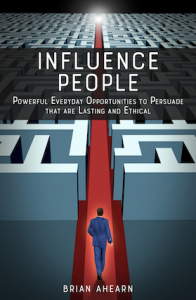
I have exciting news to share…my first book comes out next month! Influence PEOPLE: Powerful Everyday Opportunities to Persuade that are Lasting and Ethical will be available on Amazon in eBook and paperback initially with an audio version later this year. The book gives you the practical, “how to” application for the psychology of persuasion in every day situations. This has been years in the making so I’m thrilled to share it with you. Below is the amazing cover designed by Michael Franzese.

What is Influence PEOPLE?

The transition from corporate America to Influence PEOPLE continues to be an incredible experience! In some respects it’s been more challenging than expected but it’s also been much more fulfilling than I ever imagined. Every day I’m energized because I know what I do helps people like you enjoy more success at the office and happiness at home. Loving what you do and knowing it helps people makes every day a good day! Here’s what Influence PEOPLE is all about:

  • Why: Help you enjoy more professional success and personal happiness.
  • How: Teach you how to apply the science of ethical influence in every day situations.
  • What: Speak, write, train, coach and consult around the psychology of influence.
  • Who: We work with business leaders, salespeople, coaches, attor-neys and other people just like you.


LinkedIn Learning

During the second quarter my newest course, Building a Coaching Culture: Improving Performance Through Timely Feedback, went live. If you coach people then you won’t want to miss this learning opportunity. I also started my fourth LinkedIn Learning course which shows you how to persuade different personality types. Keep an eye out for that one in the 3rd quarter. To see short previews of each course click here.


Podcasts

The second quarter was busy with guest appearances on the following podcasts: David Avrin’s The Very Visible Podcast,  Networking Rx with Frank Agin, Jamming with Jason hosted by Jason Mefford, and Donald Meador’s The Corporate Middle. Podcasts are a great way to learn almost anywhere, even in the car. If you visit my podcast page you’ll see those podcasts and many others.


Workshops

The featured workshop this quarter is The Principles of Persuasion. This 2-day training is based on Robert Cialdini’s best-selling book Influence: Science and Practice. The workshop dives deep into the principles of persuasion that can be used to ethically influence people. The principles are scientifically proven and are universal across all cultures. In this workshop you’ll learn how to build relationships, overcome uncertainty and motivate people to action. To find out more click here.


Best of…

If you enjoy learning but find it difficult to locate good content look no further! Time is your most valuable asset so don’t spend too much of it searching. To help you save a little time below are a few great books to read, podcasts to listen to and videos to watch.

Books
Incognito by John Eagleman. This is a fascinating read on how your brain works and the implications on your choices, free will, who you are and much more. If you’re more into viewing than reading you can watch his documentary, The Brain with David Eagleman, on Prime Video.

Friction by Roger Dooley. Roger is an expert in neuromarketing. In his latest book he looks at things businesses do that cause friction and hurt their sales and customer service. You’ll never be the same after you read his book because you’ll spot friction everywhere. The good news is; you’ll also see friction in what you do and and you’ll have a chance to correct it.

Podcasts
Behavioral Grooves is hosted by Kurt Nelson and Tim Houlihan. I had the privilege of being a guest on their show last year. Not only will you learn how to use behavioral economics to improve your life and/or workplace, you’ll have fun doing it. I’ve not come across a more fun podcast than this one. Bonus: you’ll also learn a little about music from Tim.

American Negotiation Institute podcast is hosted by Kwame Christian. On the podcast you’ll learn about psychology and negotiations. Kwame invited me on the show but that’s not why I recommend it. Kwame’s love of learning, inquisitive interview style and interesting guests makes for an enjoyable experience whenever you tune in.

Video Presentations
Learn How to Control Your Mind from Joe Dispenza. Change is never easy but change can be easier if you know why you do what you do. In this short video Joe Dispenza talks about the subconscious programs that are running your life before you realize it. An eye opening presentation on why you do what you do and why you’re who you are.

Getting Stuck in the Negative is a Ted Talk from Alison Ledgerwood, a psychology professor at UC Davis. She explores why it’s so easy to get in a negative mindset and why it can be so hard to change a negative mindset. You’ll appreciate that she uses science to help you gain understanding.

Brian Ahearn, CPCU, CTM, CMCT®

Brian Ahearn is the Chief Influence Officer at Influence PEOPLE, LLC. An international speaker, coach and consultant, he’s one of only 20 people in the world personally trained by Robert Cialdini, Ph.D., the most cited living social psychologist on the topic of ethical influence.

Brian’s LinkedIn Learning courses Persuasive SellingPersuasive Coaching and Building a Coaching Culture: Improving Performance through Timely Feedback, have been viewed by more than 70,000 people! Keep an eye out for Advanced Persuasive Selling: Persuading Different Personalities this fall.

Brian can be reached at: Brian.Ahearn@influencepeople.biz or 614.313.1663.

Today Will Be A Good Day Because…

Do you believe in mantras or affirmations? I didn’t for a long time but I’m a believer now. I’ve seen the benefits firsthand and science supports how they can impact you. Each day at 5 am a message pops up on my phone that reads:

This is the day the Lord has made. I will be glad and rejoice in it.
Today will be a good day because I will approach everything with a positive attitude.
I will learn from every situation.

Depending on your belief system you may or may not appreciate or agree with the first line. That’s okay because we all have different views when it comes to faith. Let’s focus on the rest of the affirmation.

Today

I’ve heard it said if you’re standing with one foot in the past and one in the future you’re pissing on today. It’s a funny visual and I hope you’ll recall the following whenever you picture it: The past has shaped who you are today and the future will determine the kind of person you become. But, today is all you have and the only thing you can control are the choices you make.

Will be a good day

Good and bad are nothing more than a function of your mind. Shakespeare said as much when he wrote, “There’s nothing good or bad but thinking makes it so.” It’s not uncommon to hear people who’ve been through unbelievable hardship acknowledge that good came from their circumstances.

You can choose to make today a good day by making choices about what you see, listen to, do and set your mind on. You can choose to look for the positive in any situation. To think otherwise is to give up your freedom according to Viktor Frankl.

Because I will approach everything with a positive attitude.

Frankl knows a thing or two about freedom and captivity because he experienced both during his years in Nazi concentration camps. In Man’s Search for Meaning he told readers, “Everything can be taken from a man but one thing; the last of human freedoms – to choose one’s attitude in any given circumstances, to choose one’s own way.” Frankl came to realize nobody could make him think anything he didn’t want to think; that he was always free to choose where he would place his thoughts.

I will learn from every situation.

The human brain is a learning machine. It’s how you learn what you like, dislike, who to trust, fear and love, and much more. You may not realize it but much of what you’ve learned came about passively. That passivity often leads to less than optimal thought patterns and behaviors.

I am far from perfect in living out this affirmation. Quite often I realize in the middle of a situation, or afterwards, that my attitude was not good. But, in that moment of realization I have a choice. I can blow it off by blaming someone or circumstances. Or, I can learn by ask myself why my attitude was poor and question what I can do to change it next time.

The more I do learn the better I get at maintaining a positive attitude. It’s almost like catching myself in the moment and saying, “Wait, I’ve been here before. I’m not going to make the same mistake.”

Conclusion

Affirmations have gotten a bad rap over time and are often mocked. That’s understandable, especially when charlatans use them to take advantage of people. But don’t throw the baby out with the bathwater. Focusing on what you want – a positive attitude and learning mindset in my case – is good! The more you set your mind on positive qualities the more likely you are to live them or correct for them.

The more you focus on positive qualities, the deeper they penetrate your subconscious. As this happens, before you know it you’re living them without having to be so intentional. That’s how your brain learns and directs you.

Here’s my challenge for you. Give thought this week to one or two qualities you want to have or have in greater measure. Make sure they will benefit you and those who are around you. Come up with your own affirmation and make it a part of your daily ritual early and often. Then pay attention to the impact it has on you and others.

Brian Ahearn, CMCT®, is the Chief Influence Officer at Influence PEOPLE, LLC. An international speaker, coach and consultant, he’s one of only 20 people in the world personally trained by Robert Cialdini, Ph.D., the most cited living social psychologist on the topic of ethical influence.

Brian’s first book – Influence PEOPLE: Powerful Everyday Opportunities to Persuade that are Lasting and Ethical – will be available for pre-sale on July 9and goes live on August 20.

His LinkedIn Learning courses Persuasive SellingPersuasive Coaching and Building a Coaching Culture: Improving Performance through Timely Feedback, have been viewed by more than 70,000 people! Keep an eye out for Advanced Persuasive Selling: Persuading Different Personalitiesthis fall.

An Elephant Never Forgets!

“An elephant never forgets,” might be a familiar saying to you. Parents often use the fun visual to motivate children to do their homework. But, do elephants really have good memories? They do according to elephant ecologist Stephen Blake, from the Max Planck Institute for Ornithology. That’s because, weighing more than 10 lbs., elephant brains are the largest of any land mammal!

In psychology, many social scientists and behavioral economists use the analogy of the rider and the elephant as a visual for the interplay between your conscious and subconscious thinking. The tiny rider represents your conscious thought processes trying to direct your day. The big elephant is representative of your subconscious, which actually drives most of your day.

While the rider has the ability to direct the elephant, it’s not hard to imagine the elephant resisting or going wherever it wants when it decides to. And, when the elephant chooses to do something, oftentimes there’s very little the rider can do to change the elephant’s mind.

For instance, you know you shouldn’t eat that piece of chocolate cake. But, your subconscious takes over and convinces you to take a bite. It does so for a host of reasons; you worked out extra today, you watched your diet all week, you love chocolate, one bite won’t hurt, you deserve it, etc.

Consider how your brain functions.

Behavioral scientists estimate anywhere from 85% to 95% of your daily decisions and behaviors are driven by your subconscious. That means nine out of every 10 things you think and/or do are not consciously thought out. That’s so because your brain relegates most of what it learns to your subconscious. In doing so you don’t have to “think” about what you’re doing.

Take brushing your teeth for example. You decide to do it but the mechanics of how you brush happen effortlessly. You’ve done it for so long you no longer have to think about how to brush your teeth. Going one step further, even “deciding” to brush your teeth may be a subconscious act depending on your routine.

Not having to think isn’t bad.

To quote Henry Ford, “Thinking is the hardest work, which is probably the reason why so few people engage it.” Ford was on to something because, despite only being about 2% of your bodyweight, your brain chews up around 20% of your calories in a typical day. When it’s engaged in active thought, it ramps up its use by nearly 400%! And you thought your car was an energy hog!

The routines you learn take on a life of their own and before you know it, those routines dictate much of your day. In other words, the elephant, not the rider, is deciding where to go and when. Even as you become aware, sometimes there’s very little your conscious rider can do.

Conclusion

The elephant never forgets and neither does your brain. That’s why change is so hard. If you’ve never smoked you’ve never had a craving for a cigarette and there’s nothing to forget. But, ask any smoker who’s quit and they’ll tell you the cravings and triggers never leave. The only thing you can do is replace an old habit with a new one. If you want to learn how to break old habits and form new ones look into one of the following resources because each is excellent:

Atomic Habits by James Clear

The Power of Habits by Charles Duhigg

Tiny Habits by B.J. Fogg

Brian Ahearn, CMCT®, is the Chief Influence Officer at Influence PEOPLE, LLC. An international speaker, coach and consultant, he’s one of only 20 people in the world personally trained by Robert Cialdini, Ph.D., the most cited living social psychologist on the topic of ethical influence.

** Brian’s first book – Influence PEOPLE: Powerful Everyday Opportunities to Persuade that are Lasting and Ethical – will be available for pre-sale on July 9 and goes live on August 20.

His LinkedIn Learning courses Persuasive SellingPersuasive Coaching and Building a Coaching Culture: Improving Performance through Timely Feedback, have been viewed by nearly 70,000 people! Keep an eye out for Advanced Persuasive Selling: Persuading Different Personalities this fall.


Peer Pressure – None of Us Fully Escapes It

When you were a kid did your parents ever say, “If everyone decided to jump off the Golden Gate Bridge would you?” Okay, perhaps they used something other than the famous bridge as an example but you get my point. They were trying to warn you against mindlessly going along with the crowd. Their concern was even greater when the crowd was doing something potentially harmful.

Call it peer pressure, social proof or consensus, but each describes the same thing; humans are pack animals. As such, we are heavily influenced by others; what they’re thinking, feeling and doing. Each impacts what we think, how we feel, and what we do. Sorry, but there’s no getting around it.

This jumped out a me once again when I read the following from Brian Kight, CEO of Focus 3, in his daily email:

First, you and I are not immune to peer pressure. It doesn’t matter your age, experience, or what group you belong to. Believing you’re above peer pressure only blinds you to how much it drives behavior. Group dynamics don’t decrease as we progress in our careers, they increase. In emotions, complexity, and consequences. Second, peer pressure always pulls you in one of two directions: it propels you forward or it pulls you back. It’s never neutral. Keeping it simple and true accelerates your awareness of how social scenarios affect you.

Brian is right (me and him!). As much as we like to see ourselves as individuals, we bend to the crowd more than we realize on many things. Deep inside us is the sense that “everyone can’t be wrong” and “there’s safety in numbers.” Why? If you go back in history things worked out well more often than not when people followed the crowd.

Now let me acknowledge this; great things usually don’t come from going along with everyone else. Great thinking, amazing inventions and social change usually come about when people choose to break from the pack. But, most people aren’t looking to do such monumental things. Our days are full of many mundane tasks and decisions. Couple that with the fact that a deeper, stronger drive survive and you get a sense of why consensus has such a grip on us. Here are a few examples:

  • You disagree with the strategic direction at work but don’t speak up because everyone else seems to be on board.
  • You’re at an event that’s so boring you can hardly wait for it to end. Despite your boredom, when everyone gives a standing ovation you stand and clap too.
  • A contentious social subject comes up (Trump, abortion, diversity, etc.) and, although you disagree with the majority, you don’t say speak up.

In each case you decided to go along to get along. Oh sure, you’ll rationalize your decision but the fact remains; you went along with the crowd. Going along with the crowd is like swimming in the ocean. You don’t realize how much the current pulls down the beach unless you fix your eyes on a stationary point on shore.

Conclusion

Going along with the crowd the majority of the time isn’t bad. In fact, quite often it’s good because it generally works out well. Indeed, over history those who stayed with the crowd were typically the ones who survived, thrived and passed along their genes.

However, you need to be careful when your gut is telling you otherwise. When you were younger it would not have been good to jump off a bridge just because other kids were doing it. As an adult sometimes you need to speak up, break from the crowd or go against the grain to be true to yourself and for your personal well-being.

Brian Ahearn, CMCT®, is the Chief Influence Officer at Influence PEOPLE, LLC. An international speaker, coach and consultant, he’s one of only 20 people in the world personally trained by Robert Cialdini, the most cited living social psychologist on the topic of ethical influence. Brian’s first book – Influence PEOPLE: Powerful Everyday Opportunities to Persuade that are Lasting and Ethical– will be available for pre-sale July 9and live on August 20.

His LinkedIn Learning courses Persuasive SellingPersuasive Coaching and Building a Coaching Culture: Improving Performance through Timely Feedback, have been viewed by nearly 70,000 people! Have you watched them yet? Click a course title to see what you’ve been missing.


Hello Darkness My Old Friend – Volkswagen Overcoming Scandal

While watching the men’s U.S. Golf Open Championship this past weekend my attention was grabbed by the new Volkswagen commercial “Hello Light.” The commercial is easily the best I’ve seen in years! It’s eerie, dark, and set to Simon and Garfunkel’s classic folk rock song, The Sound of Silence. I encourage you to take a moment to watch it because I think you’ll be blown away.

You may recall, four years ago Volkswagen was embroiled in a scandal. The giant car manufacturer falsified emissions results in the lab for its turbo charged diesel engines. It turned out the engines actually emitted 40 times more nitrogen oxide in the real world than in the lab!

Until that point, Volkswagen had a great reputation with the public. They set themselves apart in the automotive industry in the 1960’s with the Volkswagen Beetle and Bus. However, their stock price fell from around $26 a share to about $10 in the wake of the scandal.

Here we are in 2019, and with the emissions scandal mostly behind them you might wonder why they would bring it up in their commercial. Because it will ultimately help them!

In the study of influence there’s a principle of persuasion known as authority. It describes the reality that people are more willing to follow the lead of people or companies that are viewed as authorities. Volkswagen enjoyed that status for many decades but lost the public’s trust in the wake of the scandal. That’s important because in order to leverage authority to move people to action you have to have expertise and trustworthiness.

It might seem counterintuitive to mention the scandal but it can actually help Volkswagen. Studies show, when you mention a weakness or own up to a mistake you’re seen as more trustworthy. By referencing the scandal Volkswagen is owning its mistake rather than hiding from it. In doing so they can regain some trust. They do this brilliantly near the end of the commercial when the following appears on screen; “In the darkness, we found the light.”

But you can’t just admit weakness and leave it there. If that’s all Volkswagen did then people would only talk about the emissions scandal. In order to turn the corner, the next step is to segue into a strength. By doing this people tend to remember the strength, not the weakness or mistake. In the case of Volkswagen, they end the commercial telling viewers they’re now making electric cars. With the move from diesel to electric cars the public doesn’t have to worry about emissions and pollution. No more emission producing cars, no more chance for emissions scandals.

Only time will tell if Volkswagen’s approach works but I’m betting it will. For the most part, people are forgiving with the passage of time when an organization or person apologizes. Enough time has passed since the scandal, the company has owned it, and they’re focusing the public on the fact that they’re moving in a new direction. Kudos to Volkswagen on all fronts.

Conclusion

Learn from Volkswagen and science. If you’ve made a mistake don’t try to cover it up, hope people won’t notice, or pray it will just go away. Own it! Make sure you mention your mistake early then use a transitional word like “but” or “however” to segue into a strength. In doing so you’ll be seen as more trustworthy and people will be far more likely to remember your strengths as opposed to weaknesses or mistakes.

Brian Ahearn, CMCT®, is the Chief Influence Officer at Influence PEOPLE, LLC. An international speaker, coach and consultant, he’s one of only 20 people in the world personally trained by Robert Cialdini, the most cited living social psychologist on the topic of ethical influence. Brian’s first book – Influence PEOPLE: Powerful Everyday Opportunities to Persuade that are Lasting and Ethical – will be available for pre-sale July 9and goes live on August 20.

His LinkedIn Learning courses Persuasive SellingPersuasive Coaching and Building a Coaching Culture: Improving Performance through Timely Feedback, have been viewed by nearly 70,000 people! Have you watched them yet? Click a course title to see what you’ve been missing.


When a Cookie is More than Just a Cookie

Have you ever stayed at a DoubleTree Hotel? If you have, then no doubt you received a cookie when you checked in at the front desk. And it wasn’t just any cookie, it was a warm chocolate chip cookie presented to you in a bag that read:

This delicious chocolate chip cookie is our way of saying welcome to the DoubleTree by Hilton. Enjoy your stay.

That’s a nice way to start your stay! Now, contrast that experience with other hotels. Many give free cookies. I know Hampton Inns put cookies out every afternoon. Getting them out of the plastic case with tongs isn’t quite the same as being presented with them at a DoubleTree.

I’ve stayed at many Embassy Suites and they put out free cookies too. They’re usually located between the hotel entryway and front desk so you can grab as many as you want on your way in our out.

In my travel experience nobody talks about the cookies at the Hampton Inn, Embassy Suites or any other hotel. However, people rave about the DoubleTree cookies! They’re very tasty but it’s more than just how they taste, it’s also how you experience them.

In persuasion there’s a principle of influence known as reciprocity. It describes the feeling you have – an obligation of sorts – to repay the favor when someone does something for you first. Reciprocity is the difference between the DoubleTree cookie and all others.

Just because something is “free” doesn’t mean it’s viewed as a gift. If you don’t perceive something as a gift then there’s no obligation to do anything in return. Grabbing a cookie on your way in or out of the hotel doesn’t fit the bill when it comes to reciprocity. A hotel employee presenting (not just handing) you with a cookie taps powerfully into reciprocity. At a minimum you thank the employee but, as noted earlier, people rave about the DoubleTree cookie. As I wrote in the opening paragraph, it’s a very good cookie but presenting it the way they do is what sets the DoubleTree apart. Some people stay at DoubleTree hotels for the cookie above all else!

Conclusion

Reciprocity is a powerful principle of influence because the need to repay the favor weighs heavy on us. That’s why it feels like an obligation. Do you have “free” items for employees, customers or vendors? If so, how do you present those items? If people are required to get those things themselves then they’re probably not perceived as gifts. If that’s the case then you’ve lost an opportunity to tap into reciprocity and perhaps move people to yes when you need it next.

Here’s my advice – look at what you freely give away and consider how you’re doing that. Think of ways you might present those same items so they’re perceived as gifts. Sometimes a cookie is more than just a cookie and so it is with other items you may give to people. Remember, it’s when you give, not when people take, that reciprocity is engaged.

Brian Ahearn, CMCT®, is the Chief Influence Officer at Influence PEOPLE, LLC. An international speaker, coach and consultant, he’s one of only 20 people in the world personally trained by Robert Cialdini, the most cited living social psychologist on the topic of ethical influence. Brian’s LinkedIn Learning courses Persuasive SellingPersuasive Coaching and Building a Coaching Culture: Improving Performance through Timely Feedback, have been viewed by more than 65,000 people! Have you watched them yet? Click a course title to see what you’ve been missing.


Hard Thinking is Like Your Mind Doing Sprints

“Thinking is some of the hardest work there is,
which is probably the reason so few engage in it.”
– Henry Ford, Founder of the Ford Motor Company

I suspect if you’re reading this you don’t have a physically demanding job. By that I mean, you’re probably making your living more with your brain than your brawn. However, just because your job doesn’t require demanding physical activity I’m sure it can be mentally demanding all the same.

It’s not uncommon to hear people talk about how exhausted they are by the time they leave the office. The exhaustion isn’t just in their head; they really are tired, almost as if they were laying bricks or chopping wood. Exhaustion comes because your brain, despite only being about 2% of your body weight, uses about 20% of your calories in any given day. And when your brain is engaged in hard thinking, its demand for energy goes up by about 400%!

To put it another way; focused concentration (hard thinking) is to our minds like sprinting is for a runner. No matter how fit a runner is, he or she cannot sustain sprinting for extended periods before muscle fatigue and exhaustion set in. By the same token, no matter how mentally gifted you may be, you cannot stustsain intense focus for extended periods before mental fatigue and exhaustion set in.

According to John Medina, a developmental molecular biologist and author of Brain Rules: 12 Principles for Surviving and Thriving at Work, Home, and School, people generally cannot stay focused for more than 40-50 minutes at a time. When it comes to the time devoted to critical thinking, oftentimes less is more. Here are some practical implications for you:

Personal Work

When you plan your work build in breaks so you can rest and replenish. It’s also a good idea to get some calories in you because as your energy wanes so does your ability to make good decisions. Dan Pink addresses this in his book When: The Scientific Secrets of Perfect TimingHe cites statistics about judges and their sentencing decisions before and after lunch. Hint: If you have to go to court get there first thing in the morning or right after lunch!

Running Meetings

Limit meetings to 45 minutes. If you need to go longer schedule regular breaks and let people know when to expect those breaks. Doing so will help them stay focused rather than wondering when they’ll be able to get food or use the restroom next.

I’ve sat through corporate meetings that have been two and three hours long without breaks! Meetings like that are a waste of time and productivity. During long meetings I’d look around and see people who were checked out, answering texts, leaving to use the bathroom or wandering around to grab food…even when senior leaders were addressing the group.

Hosting a morning or afternoon meeting with one break in the middle doesn’t cut it either because you’re still doubling the amount of time people can give good attention. If a meeting requires more than 45 minutes then plan on going 45 minutes with 15 minute breaks and keep repeating as needed.

Leading Training

If you’re leading all day training sessions build in 15 minute breaks every hour. Again, when people know breaks are coming they’ll generally wait to get food, use the restroom, make calls and return texts or email.

Also plan to have snacks and drinks because those little energy supplements will give people the calories their brains need to stay focused in the next session and throughout the day.

I used this approach successfully for years and people were amazed at how quickly the day flew by. Training was short and intense, breaks came frequently and people felt like they had time to decompress.

Conclusion

You may have heard of the story of the woodcutter contest. Two men set out to cut down as many trees as they could one day. One woodcutter worked tirelessly all day without a break. He was confident he’d win because he noticed his rival taking breaks every hour or so. He was shocked to learn he’d lost by a good margin. It turns out his rival wasn’t lazy, he rested his body and sharpened his axe so when he did swing it he was far more productive.

You can do a job or you can do a job well. Doing something well considers the optimal outcome you want then devising the best plan to make that happen. Whether you’re sitting down to work, hosting an important meeting or trying to train people, consider how the brain works. The more brain friendly your approach the better opportunity you’ll have to achieve your ultimate goals.

Brian Ahearn, CMCT®, is the Chief Influence Officer at Influence PEOPLE, LLC. An international speaker, coach and consultant, he’s one of only 20 people in the world personally trained by Robert Cialdini, the most cited living social psychologist on the topic of ethical influence.

Brian’s LinkedIn Learning courses Persuasive SellingPersuasive Coaching and Building a Coaching Culture: Improving Performance through Timely Feedback, have been viewed by more than 65,000 people! Have you watched them yet? Click a course title to see what you’ve been missing.


The 7%, 38%, 55% Myth Still Persists

Five years ago, I wrote a post offering up an apology to Albert Mehrabian, Ph.D. for unknowingly misrepresenting his work. It’s time to revisit the subject because the 7%, 38%, 55% myth still persists.

I recently attended an event where I heard a professional speaker and once again Dr. Mehrabian’s work was misrepresented. In this case the speaker tried to twist Merhabian’s work into the theme of charisma and liability.

Dr. Mehrabian is a Professor Emeritus of Psychology at the University of California, Los Angeles (UCLA). He gained widespread attention for his research in the area of non-verbal communication in the 1960s. If you’re in business, have been to a communications seminar or heard a motivational speaker then you’ve probably heard Merhabian’s work misquoted as follows:

In face-to-face communication only 7% of your message is based on what you say. Your tone of voice accounts for 38% and your body language is 55%.

This prompted many people – me included – to place too much importance on body language and tone of voice during communication training. It’s certainly good to work on those areas because they can make your communication more effective. However, the problem with misquoting Mehrabian’s work is that it has people putting too much emphasis on tone of voice and body language and not enough on their actual message.

It’s amazing how a story shared by a speaker, mentioned in a book or noted on a popular blog is eventually taken as gospel truth. After all, that well-respected speaker, author or blogger wouldn’t make such a glaring mistake, would they? I certainly did early on because of the number of times I came across the 7%, 38%, 55% rule.

Once my eyes were opened to the truth it seemed as if nearly everyone was misinterpreting and misappling Dr. Mehrabian’s work. When I was prompted to read more about Dr. Mehrabian and his research I learned his work very specifically had to do with communicating feelings and attitudes. If listeners felt there was inconsistency between a person’s words and tone or body language then the listeners took more of their cues from the tone and body language.

An example you can probably relate to is an apology. Two people can utter the very same words – “I’m sorry” – when apologizing and one person might be believed while the other might not. It’s easy to say the words but we also look for sincerity. Apologies are viewed as insincere when the person apologizing has a tone of voice, facial expressions or body language that conveys a different message. Can you recall a time when someone said the right things but you knew they didn’t mean it because of certain cues you noticed in their tone, face and body?

If you go to a presentation that’s not too emotionally based you will focus more on the words used. For example; if you went to a presentation on condo versus home ownership it’s not likely you’d be assessing the believability of the message based on the speaker’s tone of voice or body language. If you contend with anything it would most likely be the facts – words – used during the presentation. There’s much less assessment of attitude or feelings in such a fact-based presentation.

Conclusion

When it comes to your ability to persuade I’m not advocating you discount tone of voice or body language because both can enhance your presentation tremendously. But don’t forget, content is still king in most presentations. Would you rather have a meeting where people remembered: a) what you wore, or b) what you said? I’m sure you want them remembering what you said. After all, the reason for a meeting or presentation is to convey ideas so everything you do needs to enhance your message.

Five years ago, I apologized to Dr. Mehrabian. I learned a good lesson and now try to set the record straight when I learn his work is being misrepresented. If you could hear and see me I’m sure you’d notice my tone of voice and body language are in line with my words. My 7%-38%-55% messaging is congruent.

Brian Ahearn, CMCT®, is the Chief Influence Officer at Influence PEOPLE, LLC. An international speaker, coach and consultant, he’s one of only 20 people in the world personally trained by Robert Cialdini, the most cited living social psychologist on the topic of ethical influence. Brian’s LinkedIn Learning courses Persuasive SellingPersuasive Coaching and Building a Coaching Culture: Improving Performance through Timely Feedback, have been viewed by more than 65,000 people! Have you watched them yet? Click a course title to see what you’ve been missing.

Influence PEOPLE: The Book – Reciprocity

In early April I shared a little from a book I’m working on. To build a more excitement I thought I’d share another short section from Influence PEOPLE: Powerful Everyday Opportunities to Persuade that are Lasting and Ethical, which will be available this summer.

Principle #1 – Reciprocity

“You can get everything you want in life, if you will just help other people get what they want.”
Zig Ziglar, famous author & motivational speaker

Simply put, reciprocity is a mutual exchange. As a principle of influence it could be described in layman’s terms as the “good old give and take” principle or “you scratch my back and I’ll scratch yours.” When someone does something for us, we typically feel obligated to do something for them, to return the favor, so to speak.

You can easily think of a time when someone went out of their way to do something for you in return for a good deed you initially did for them. Although you probably recognize the principle just described, if you’re like most people, you may not realize how powerfully reciprocity actually works on you. Quite often reciprocity gets you to do things without you even realizing it! Take a moment to consider your response to each of the following questions:

  • Have you invited someone to a social gathering (summer cookout, wedding, graduation party, etc.) because they invited you to a similar event first?
  • Have you added someone to your Christmas card list after getting a card from them first?
  • Have you donated money to an organization because you received a free gift, like mailing labels?
  • If you’ve been to a home party like Pampered Chef or Tupperware, did you buy something because you would have felt bad not doing so, especially after you were served food and given a free gift?
  • During the holidays, have you ever bought Christmas wrapping paper, cards or some other items from neighborhood kids because their parents bought similar items from your kids?

If you answered yes to any of those questions, then reciprocity was influencing you! Society ingrains something in all of us from the time we are young: it’s right to repay the favor. When you do something for me, I feel obligated to do something for you in return.

In shows when someone saves another’s life, the one snatched from death expresses profound gratitude. The saved person may ask: “How can I ever repay you?” Of course Good Samaritans don’t help people to accrue favors, yet those who are helped feel a huge burden anyway and want to repay the Good Samaritan.

Let’s focus on understanding how the ball gets rolling when it comes to this principle. It happens when you take initiative and act first. In a sense you give a gift, whether tangible or intangible. This is the point: your action is usually met in kind by the person you gifted or helped.

Let’s go further with the principle of reciprocity and consider  concessions. When someone says “no” to you, if you immediately come back with another request, often the person will meet you part way because compromise is met with compromise. Concessions are the basis for negotiating as people barter their way to some sort of agreement.

When it comes to reciprocity, think of this word – Giving. When you give most of the time people will give in return.

Brian Ahearn, CMCT®, is the Chief Influence Officer at Influence PEOPLE, LLC. An international speaker, coach and consultant, he’s one of only 20 people in the world personally trained by Robert Cialdini, the most cited living social psychologist on the topic of ethical influence. Brian’s LinkedIn Learning courses Persuasive SellingPersuasive Coaching and Building a Coaching Culture: Improving Performance through Timely Feedback, have been viewed by more than 65,000 people! Have you watched them yet? Click a course title to see what you’ve been missing.


What Do These Have in Common?

What do these seven things have in common?

  1. Brass name plate
  2. House with a white picket fence
  3. Family playing a game
  4. Ancient map of the world
  5. Giant orange work glove
  6. Airplane flying by
  7. Golf clubs, tennis racquet and a basketball

If you put them together they form a slightly weird, but memorable word picture, and are prompts for questions you can ask when you meet someone for the first time. I learned this ice breaker approach in a Dale Carnegie class more than a dozen years ago. Here’s the weird word picture:

When you look at someone for the first time imagine a big, brass name plate above their head. As you approach them you see a nice home with a white picket fence. You enter the home and see a family playing a game. You look across the room and see a fireplace with an ancient map of the world on the mantle. Magically, you ascend the chimney and there’s a giant orange work glove at the top. As an airplane flies by the glove grabs it by the tail and on the wings you see golf clubs, a tennis racquet and a basketball.

Let’s dissect each of the items to find out how they can help you initiate conversation in a non-threatening way and kickstart the principle of liking.

  1. The brass name plate is a simple reminder to ask someone their name. Once you’ve done that, picture their name written on it to help you remember it.
  2. A house with white picket fence is a prompt to find out where someone currently lives.
  3. The family playing a game is a visual to ask, “Tell me about your family.” This is better than asking, “Do you have any kids?” because that can be a sensitive subject for some people who cannot have children or chose not to.
  4. The fireplace with an ancient map of the world is a subtle reminder to ask where someone is originally from. This question is good because most people don’t live in the same town where they were born.
  5. The giant orange work glove on top of a chimney is a prompt to ask what the person does for a living.
  6. The plane flying by is a trigger to find out, “Do you like to travel?” or “Where’s the coolest place you’ve ever been?”
  7. Finally, the golf clubs, tennis racquet and a basketball on the wing of the plane can start a conversation around hobbies and sports the person might enjoy.

Why all the questions? A big part of your ability to influence people is contingent on building good relationships. It’s a scientific fact according to principle of liking; the more someone likes you the better your chance of hearing yes when you try to persuade them. With that in mind, here are three big reasons to use this approach:

  • In How to Win Friends and Influence People Dale Carnegie encouraged readers to show genuine interest in the other person. I’m sure you feel good when someone shows real interest in you so be that person for someone else.
  • Connecting on what you have in common is a simple way to bond with another person. The more you find similarities the easier it is for them to like you and for you to like them.
  • Last, the more you learn about someone the more opportunities there are to pay a genuine compliment. The more you offer genuine praise, the more the person will like you and you’ll like them.

Conclusion

Whenever you meet someone for the first time – be it at a networking event, work, party – it can feel awkward to get a conversation going. But it doesn’t have to be when you have a script to follow. I encourage you to practice each question till they roll off your tongue in a natural, conversational way. Do so and you’ll be pleasantly surprised at how much more people like you and how you’ll come to like others in return.

Brian Ahearn, CMCT®, is the Chief Influence Officer at Influence PEOPLE, LLC. An international speaker, coach and consultant, he’s one of only 20 people in the world personally trained by Robert Cialdini, the most cited living social psychologist on the topic of ethical influence. Brian’s LinkedIn Learning courses Persuasive SellingPersuasive Coaching and Building a Coaching Culture: Improving Performance through Timely Feedback, have been viewed by more than 65,000 people! Have you watched them yet? Click a course title to see what you’ve been missing.