Arouse an Eager Want

Question: Would you rather do something of your own free will or be forced? I’m going to guess all of you said you’d prefer to exercise your free will. That’s not to say we all can’t stand a good kick in the seat of the pants every now and then. I’m thinking of my old high school football coach as I type that! We can always be pushed to do a little more than we think we’re capable of but that’s not what I’m talking about here. What’s important is this difference; if I’m forced to do something I’ll probably stop doing it the moment the force, or threat, is removed. However, if I do something of my own free will I’m likely to continue in that behavior, especially if I enjoy some benefits.

Dale Carnegie also understood that people want to exercise their right to choose and that’s why he encouraged readers to arouse in the other person an eager want. It’s usually fun and enjoyable to do things when we want to do them but quite often people don’t want to do what’s asked of them. So how do you make someone want to do the thing you’re asking of them? A few thoughts come to mind.

In sales we jokingly say everyone’s favorite radio station is WIIFM. That stands for “What’s In It For Me” and it’s where everyone’s attention is tuned in almost continually. Let’s face it, first and foremost people think about how they will be impacted by things. I once heard a psychologist build on the WIIFM concept by adding everyone’s favorite song to the mix, a derivation of Willy Nelson’s classic, “You were Always on My Mind.” Paula Butterfield, addressing a leadership group at Franklin University several years ago said people’s favorite song was, “I was Always on My Mind.” Every person you meet is thinking, “How will this affect me?” That means you have to think about how to put things in terms that will appeal to them.

Understanding the other person and what they want, hope for, desire – what motivates them – is key. While this seems simple, how many times have you seen people try to motivate others in ways that motivate themselves? It’s not about YOU, it’s about them. If making more money is your thing that’s not necessarily someone else’s carrot. The same could be said for title or position. Not everyone wants to be a VP, company owner, head coach or some other highly visible position. For some people that motivation is easily seen and tapped into but when it comes to others you have to pay close attention. What do people talk about? What do you observe in their office or home? For some people the motivation is a sense of belonging, knowing they’re making a difference, family, hobbies, etc.

Once you know what that motivation is, your next step is to align your request with it somehow. This is the concept of consistency; the principle that says people are likely to act in ways that are consistent with what they’ve said or done in the past. If another person sees how what you’re asking ties into what’s most important to them then they’re likely to tackle it with more enthusiasm and more likely follow through. That’s the principle of consistency at work. For example, many kids don’t enjoy the work that comes along with college but they might have career aspirations. Tying in how coursework or grades might help them realize their dreams will make them a little more eager to do well.

Sometimes making something seem special, something not many people can have, or do, is what does the trick. This taps into scarcity, the principle of influence that tells us people are motivated to action when they fear losing an opportunity. This isn’t new to the human condition. Mark Twain wrote of Tom Sawyer in The Adventures of Tom Sawyer, “He had discovered a great law of human action, without knowing it – namely, in order to make a man or a boy covet a thing, it is only necessary to make the thing difficult to attain.” This came about because Tom didn’t want to paint a fence. He convinced the other kids to do it when he made it seem special. All of a sudden they all wanted to do it.

So we’ve now covered three fundamental techniques for handling people:

  1. Don’t criticize, condemn or complain.
  2. Give honest, sincere appreciation.
  3. Arouse in the other person an eager want.

In the weeks to come we’ll explore Dale Carnegie’s six ideas to get people to like you. In the meantime, I’ve love to hear your thoughts about arousing an eager want in another person so feel free to leave a comment below.

Brian
Helping You Learn to Hear “Yes!”

An Influence Shortcut – What do you have to believe?

This week’s guest post is from Mike Figliuolo, Managing Director of thoughtLEADERS, LLC – a leadership development and training firm based in Columbus, Ohio. He regularly writes on the thoughtLEADERS blog (http://thoughtleadersllc.blogspot.com/). I know you’ll enjoy what Mike has to share.
Brian
Helping You Learn to Hear “Yes!”
Many times in business, we try to influence people with facts. Massive piles of data, reams of analysis, and countless presentations try to get people to buy, sell, or do something. We spend countless hours trying to influence others to take action because we have no direct authority over their decisions.

The thing is, many times all this effort is a total waste of time and energy. We try so hard to get someone to act by bludgeoning them with data. Another dynamic that surfaces is the “influencee” asks tons of questions about minute details because they know such data is available and the analysis is possible. Allow me to try to stop this insanity.

Repeat after me: “What do you have to believe?” It’s the greatest shortcut ever (and one of the most powerful ones to boot). I’ve covered aspects of this dynamic before in another post (http://thoughtleadersllc.blogspot.com/2008/01/getting-to-yes-does-it-change-answer.html) but this one bears some further elaboration.

When we sell our services to our clients, some of them want to quantify the return (and they should absolutely consider this point in their purchase decisions). Unfortunately, the nature of what we train people on is hard to quantify by virtue of the fact it covers soft skills (leadership, communications, strategy, etc.). That being said, we’re still able to demonstrate to clients that they get a phenomenal return on their training dollars. How? We use the “what do you have to believe?” technique.

Here’s how it goes:

  • Let’s assume a specific training event costs $500 for one person to attend. The course is focused on productivity (doing less irrelevant analysis, holding shorter and more effective meetings, etc.).
  • The client says “So if I spend that much money, am I making a good investment?”
  • I then ask “Do you believe if you send someone to this course they will be able to save 60 minutes of non-productive time per month?” to which the client resoundingly answers “Of course!”
  • I then say “Then the conversation is over.” The client says “Huh? I don’t understand.”
  • “Look, let’s assume the fully loaded compensation of the person you send to training is $100,000 per year. That equates to $50/hour ($100,000 / 250 days / 8 hours). The payback period of the training fee is 10 months. Your 1-year ROI is 20% ($600 saved / $500 invested).”
  • “Oh. Okay. I get it. It is a good investment.”
  • “No. It’s a GREAT investment because in year 2 you also save $600. And year 3 and so on. And you get those future savings with no additional investment. Doing a discounted cash flow of that time savings makes your return tremendous. On top of that, you have to realize the person will now do PRODUCTIVE work in that saved 60 minutes and that work has value we’re not even calculating here.”
  • “Okay. Let’s do the training.”

We got there with a simple “What do you have to believe?” The client very much believes they’ll save 60 minutes a month (which is a very low hurdle to get over). If they believe that, then the rest of the argument holds up.It’s basic break even analysis. I could go out and conduct massive research studies on all participants who have ever attended our training. I could develop statistical models to prove exactly what the ROI is. Doing all that work is a total waste of time. All the client REALLY wants to know is if they’re making a good investment. If we can show them they’re making not a good investment but a GREAT investment, any additional analysis done with the purpose of influencing them is wasted energy.Take a look at some of the decisions you’re trying to influence. Can you get to a compelling recommendation by simply asking “What do you have to believe?” I’ll bet you can. I hope I just freed up some time for you to spend on more value-added activities.Mike
Managing Director, thoughtLEADERS, LLC
http://thoughtleadersllc.com/

Give Honest, Sincere Appreciation

Last week we looked at some simple advice from Dale Carnegie; avoid criticism, condemnation and complaining. That could be shortened to “Bite your lip” or “Shut your mouth.” This week we move on to Carnegie’s next fundamental technique for handling people — give honest, sincere appreciation. This is one simple way to tap into the principle of influence known as liking.

So the call is to express appreciation, a grateful recognition for something, with two caveats – the expression needs to be true and it should be genuine. While flattery does endear people to the flatterer…even when they know it is flattery…because this blog is about ethical influence being honest and sincere in your praise is a must. Flattery is disingenuous, whereas appreciation is real.

Who doesn’t like to be recognized in a positive way? I know I like to hear, “Well done,” and I bet you do too. I think we all want that. I’m of the opinion that the person who gruffly says, “I don’t need a pat on the back to know I’m doing a good job,” needs it more than anyone! I make that assertion because they probably never get praise and their reaction is a self-defense mechanism. It would stink to acknowledge you want praise but never get it.

So remember to give honest, sincere appreciation when appropriate. This benefits you too, because if you look for something genuine to compliment someone about, you tend to change your own thinking about that person. If you don’t particularly like someone but consistently make the effort to look for, and point out, good qualities they have, eventually you’ll find yourself thinking, “They’re not so bad after all.”

Here’s the really cool thing — if you keep it up long enough you might actually start to like them! That’s right; you will actually come to like them. After all, how can you not like someone you consistently find praiseworthy?

What naturally follows is they start to like you in return because they can tell you genuinely like them. Believe me, it’s much easier to persuade people to your way of thinking when you like them and they like you.

Wouldn’t it be great if every person you interact with tomorrow you actually like? Sure it would. While that might not happen 100% of the time it can occur a lot more than it’s happening right now but it’s up to you. If you take this advice and nothing else happens other than you come to like people more, even those who seem unlikable, then you’ll have better days.

Since this post is about honest, sincere appreciation I’ll put that advice into practice by taking time to express gratitude to people who’ve influenced me when it comes to this blog.

First let me start with those of you who read this each week. It amazes me that people in nearly 50 countries have taken time to read what I write each week. That excites me!If it were not for a coworker, James Seay, I never would have ventured into the online world. I took a personal branding class from James and he talked about the need for an online presence. He got me going on Facebook and LinkedIn. He’s also given me really good blogging advice. Click here to learn more about James.

Next is a man named George Black. I probably never would have started this blog had it not been for a conversation I was having with George about social media. Give him a follow on Twitter @GeorgeBlack because he’s a good man.

Mike Figliuolo, founder of thoughtLEADERS, gives me great ideas every time we have lunch together. Mike’s a smart, funny, insightful guy. We’ll be swapping blog posts so you’ll see more of him in the months to come. In fact, he will be the feature article next week. You can also follow him on Twitter @Figliuolo.

Thanks to my high school buddy Michael Franzese who’s given me some very cool drawings for this blog, like the one above. Take a look at his blog, Franzeseinklings, to see more cool pictures as well as his funny, interesting insights on life.

Debbie Conkel is a lady I’ve worked work with for many years. Debbie has proofread my work for more than 15 years and graciously proofreads every one of these posts on her own time. If you like my writing style Debbie has a lot to do with it. If you don’t like my style then it’s probably the parts where I didn’t take her advice.

Last but not least, I have to thank my wife, Jane, and daughter, Abigail, because they give me so much great content to write about and just roll with it. When I published the article on Reverse Psychology and the Vacation Bathing Suit Jane wasn’t thrilled. In fact, she emailed me to say, “You MIGHT want to ask my permission before writing a story about me. No girl wants her picture in a bathing suit on the Internet.” My response, “I’m just glad you’re a reader!” Really, I was just happy she was reading. Now she reads my posts every week…just in case.

As for Abigail, she hasn’t read many yet, too boring for a 13 year-old, so I can pretty much write what I want about her. You’ll learn all about raising a teenager in the years to come as I test all these psychological principles in the real world!

With all sincerity to any and all reading this week, thank you! I would only ask one thing before I leave you – would share this blog with a few other people? I’d love to write an article someday telling you people in 100 countries are readers.

Brian
Helping You Learn to Hear “Yes!”

Don’t Criticize, Condemn or Complain

Last week I introduced Dale Carnegie’s tips from How to Win Friends and Influence People in conjunction with Malcolm Gladwell’s Blink as a way to help you be more influential. The more I thought about that post the more I came to the conclusion it might be good to start digging even further into Carnegie’s advice because it’s timeless wisdom about how to influence people.

Did you know How to Win Friends and Influence People was first published way back in 1935? Believe it or not, it’s sold more than 15 million copies! The fact that nearly 75 years later you can still find How to Win Friends and Influence People in bookstores is a testament to this truth: people know Dale Carnegie’s advice works!

Carnegie didn’t have social scientist or behavioral economists to test his hypotheses. Instead he observed what the influential people of his day were doing and reflected on hi
s own successes when compiling his thoughts.

He started by encouraging readers regarding three fundamental techniques everyone should remember when dealing with people:

  • Don’t criticize, condemn or complain.
  • Give honest, sincere appreciation.
  • Arouse in the other person an eager want

First up for our consideration is “don’t criticize, condemn or complain.” This should be obvious for one reason – nobody likes to be around anyone who is constantly criticizing them or complaining about their behavior. Okay, so you’re sick and tired that your boss, spouse, kid, employee or someone else won’t change. I’ll bet a light bulb didn’t just come on and you thought, “Perhaps if I nag enough that will do the trick.” No, in most cases if people were honest they’d admit the “advice” they’ve been giving ranges from subtle jabs to flat out complaining. People say, “You never…” or “You always…” as if saying it louder or repeating it more will bring about the change they want to see.

Newsflash: Einstein said the definition of insanity is doing the same thing over and over again and expecting different results. If what you’ve been doing isn’t working then perhaps it’s time to try something different…unless nagging is your way of releasing frustration.

On a more subtle level, we often fail to remember everyone has reasons (even if we think they’re poor ones) for doing what they do. Kids will justify cheating in school because everyone is doing it. Thieves will tell you they steal because they can’t get a job or life has been unfair to them. Famous people cave into all kinds of temptation because, “You don’t know what it’s like to have all this pressure.” I could go on and on but I think you get the picture. Right or wrong, everyone has reasons for doing what they do.

Here’s another newsflash: We are emotional beings, not logical, rational creatures. The vast majority of people act on emotion then try to justify their actions with some amount of logic. Salesman and marketers figured this out a long time ago. If you want to see great examples of “rational” people acting irrationally pick up Dan Ariely’s book Predictably Irrational.

So here’s what Dale Carnegie realized – if we “attack” people by criticizing them or complaining about their behavior they’ll only dig in their heels and justify why they’ve done something. It’s like having two people stand face-to-face with their hands pressed against one another. As soon as one person applies a little pressure the other person automatically does so too. The result; the hands are in a state of equilibrium and remain in the same spot.

Now apply that concept to the person you’ve been complaining about, criticizing or condemning. They’ve probably applied equal and opposite pressure and have remained the same. In the end we sabotage ourselves because our own behavior only makes it harder to persuade them to bring about lasting change.

What’s the answer? Dale Carnegie’s already told us, “Stop criticizing, condemning and complaining!” You protest, “But then they’ll never change!” That might be true but at least you won’t have wasted your breath and frustrated yourself in the process. And remember, we’re going to be looking at nearly three dozen other ideas, including nine ways to encourage people to change without giving offense so hang in with me and look for another post next Monday.

Brian
Helping You Learn to Hear “Yes!”

Blink to Win Friends and Influence People

How can you become more influential in the blink of an eye? This week I’m going to show you how can you use a concept from Malcolm Gladwell’s best-selling book Blink in conjunction with Dale Carnegie’s classic How to Win Friends and Influence People to become a more persuasive person. And the best part is this; it’s so simple it will take no more than 10 seconds a day!

In Blink Gladwell discusses a psychological concept known as “priming.” He cites several studies that clearly show people’s behavior can be influenced by mere exposure to words, even though they are totally unaware of it. I encourage you to pick up the book and read for yourself how NYU students became more, or less, patient depending on certain words they saw. Or perhaps you’ll be more interested to read about people acting older just because they read a few words associated with the elderly.
One other fascinating study showed people were smarter by focusing on smart things immediately prior to playing the game Trivial Pursuit.

So here’s how I’ve used Blink in conjunction with How to Win Friends and Influence People to be more persuasive. In order to be persuasive, you have to put into action what you know. Unfortunately, we forget a lot of the cool stuff we learn. Although I read and study a lot because I teach a variety of sales courses, I have to admit, my memory is not the greatest. Even though I’ve taught Dale Carnegie’s material dozens and dozens of times I could not recite all of his tips from memory. To overcome this, I’ve taken his tips and dropped them into a recurring task in Microsoft Outlook so now, every morning when I log on at work, the task opens automatically, and I’m exposed to Dale Carnegie ideas. I don’t read all of them each day — remember, I said just 10 seconds — I just take them like a vitamin, one a day.

Whatever day of the month it is, I simply read the tip for that particular day. For example, if it’s the 16th of the month I scroll down and read, “Let the other person feel the idea is theirs.” While I may not have all 30 tips committed to memory, I know because of priming that mere exposure to Carnegie’s sound advice will positively impact my behavior. Over time it starts to become second nature to avoid arguments, focus on people’s names, dramatize ideas, etc. In essence I’m doing it without even thinking about it.

Below are Dale Carnegie’s tips and to the right you’ll see how some correspond to Dr. Cialdini’s principles of influence. I encourage you to copy the list and put it somewhere that will allow you to see it daily. Do so and you too can become more influential…in the blink of an eye.

Fundamental Techniques in Handling People
1 Don’t criticize, condemn or complain. Liking

2 Give honest, sincere appreciation. Liking

3 Arouse in the other person an eager want. Consistency

Six Ways to Make People Like You
4 Become genuinely interested in other people. Liking

5 Smile. Reciprocation

6 Remember their name. Liking

7 Be a good listener & encourage others to talk about themselves. Liking

8 Talk in terms of the other person’s interests. Liking

9 Make the other person feel important. Liking

How to Win People to Your Way of Thinking
10 Avoid arguments. Liking

11 Show respect for other’s opinions and never say, “You’re wrong.” Liking

12 If you are wrong, admit it quickly & emphatically. Authority

13 Begin in a friendly way. Reciprocity

14 Get the other person to say “yes” immediately. Consistency

15 Let the other person do a great deal of the talking. Consistency

16 Let the other person feel the idea is theirs. Consistency

17 Try to see things from the other’s point of view. Liking

18 Be sympathetic to other’s ideas and desires. Liking

19 Appeal to the nobler motives. Consistency

20 Dramatize your ideas. Contrast

21 Throw down a challenge.

Be a Leader: How to Encourage People to Change without Giving Offense
22 Begin with praise and honest appreciation. Liking

23 Call attention to mistakes indirectly. Liking

24 Talk about your own mistakes before criticizing. Authority

25 Ask questions instead of giving direct orders. Consistency

26 Let the other person save face. Liking

27 Praise the slightest, and every improvement. Liking

28 Give the other person a fine reputation to live up to. Consistency

29 Use encouragement and make the fault seem easy to correct. Liking

30 Make the other person happy about doing the thing you suggest. Consistency


Brian
Helping You Learn to Hear “Yes!”

Franzese or Frazetta: Do Names Really Matter?

I had a post all ready to go for this week but then I got really inspired by a friend, Michael Franzese. If that name sounds familiar it’s because you might have seen his drawing and recall that I mentioned him in my post three weeks ago titled, “Is Persuasion Manipulation?” He drew the picture of one man manipulating, wrestling the other to the ground.

Michael and I went to high school together but I feel like I know him much better now because of Facebook and his blog. He starting writing a blog called Franzeseinklings with the goal of 100 barbarian drawings and posts in 100 days. During my bodybuilding days in the ‘80s I was into Conan the Barbarian because of Arnold Schwarzenegger but other than that didn’t have much interest in those guys. But, after seeing Michael’s work and reading his posts I became a fan. You have to check him out because the artwork is very cool and I get a kick out of reading his posts each day. As you might guess, all of this week’s artwork is Michael’s doing.

So what’s Franzeseinklings have to do with influence? In his September 8 post, Michael mentioned his favorite illustrator, “the great Frank Frazetta.” He wrote about getting to meet the man he considered a hero. Take another look at that name — Frazetta. Looks a lot like Franzese doesn’t it? Could that be some of the attraction for Franzese to Frazetta’s artwork?

I shot an email over to Michael with an article from the Inside Influence Report that detailed the phenomenon of names then called him to talk about this post. He said the more he thought about it and how his mind worked the more he thought it was probably true. He said another of his favorite artists is Michelangelo. Michael likes Michelangelo…hmm, see a trend here?

I can’t take credit for anything other than being alert when it comes to this name thing. If you pick up a copy of Yes! 50 Scientifically Prove Ways to Be Persuasive, you can read about all this name stuff in chapters 29 and 30. Here’s the basic gist — we tend to like people with names that look or sound similar to our own. The psychological term for that is “implicit egotism.” After all, how could someone with your name be some kind of jerk?
Can you think of a time when you met someone with your same name where you instantly liked them? I sure can! We might joke about it being due to the name but it’s no joke because there are statistics to back up that claim.
Here’s another thing worth mentioning, not only do we like them; it makes us more compliant when they ask us to do things. So your name is Carlos and the salesman is Karl, what difference does that really make? Statistically Carlos will probably buy more from Karl than he would from Pete or Bill or someone else with a name that’s not similar because he feels a connection when implicit egotism is at work.
This is more than just names and people; it extends to things like where you live, the company you work for and the career you choose. Statistically Dennis is more likely to become a dentist than Jerry or Walter. If you doubt that pick up Yes! 50 Scientifically Prove Ways to Be Persuasive, turn to page 128 and read about the study for yourself. I’m not saying everyone named Dennis is destined to be a dentist anymore than Lawrence will become a lawyer or Mary will live in Marysville but they have a higher likelihood of that happening than people with names wholly unrelated to those professions or places.
Believe me, when Jane and I were looking for new countertops, it didn’t escape my notice that the salesman’s name was Dan Mason. I kid you not; Dan Mason worked as a salesman for a company that sold marble countertops. Oh gee, what a coincidence!
One more story to illustrate the point; Scott, the guy who gives my wife golf lessons (great instructor, you should see her game!) worked at a driving range alongside his ex-wife Pia. Not many people could work with their former spouse but Scott and Pia got along great. In fact, they’d both tell you they get along better as friends than they did as spouses. As I got to know Scott I noticed he drove a Kia. Do you see where I’m going with this? I told him about the name study and said, “I see you drive a Kia and your ex-wife’s name is Pia. I think there’s still something there.” He insisted there wasn’t and a week later the Kia was gone and Scott was driving a Hyundai. Point made!
Most people will insist there’s nothing to this but that’s because this is all going on in the subconscious. The statistics don’t lie and neither did your grade school teacher so I’ll end with a song many of you probably sang as youngsters. It’s about two friends with the same name.
John Jacob Jingleheimer Schmidt,

His name is my name too.
Whenever we go out,

The people always shout,
There goes John Jacob Jingleheimer Schmidt.
Dah dah dah dah, dah dah dah
One last thing, give Franzeseinklings a look and follow.
Brian
Helping You Learn to Hear “Yes!”

What’s Your Worldview?

I’ve been thinking about my “worldview” lately, so I’ll pose this question to you, “What’s your worldview?” When I think of the term “worldview,” I think about how people try to make sense of what they observe others doing. I’m a pretty religious person and I have a worldview that first and foremost centers around my Christian faith. My faith colors perception of the here and now as well as the afterlife. But I also view things through another lens – influence.

Let me explain a bit further. I’m curious about why people do the things they do. I’m also interested in getting people to go along with my ideas and suggestions. Just like you, I want to hear people say “Yes” when I ask them to do something. That person could be my wife, my daughter, a coworker, vendor or the checkout person at the store.

I was working with someone today and we covered material on influence. I told this person about the science behind influence. I didn’t want her to think it was just grandma’s good advice (not that grandma’s advice was bad; she seems to have been right most of the time!) because it was grounded in real life scientific studies. Those studies don’t give me the ability to predict what you or any other person will do in particular situations because we are complex beings with a lifetime of experiences that shape us and our behaviors. But I can say with certainty that I communicate with confidence and take certain actions because I know my influence approaches will make me more successful on the whole.

There’s more than 60 years of social science to back up my last statement. If you pick up Influence Science and Practice, Yes: 50 Ways Proven Ways to be Persuasive, Maximum Influence or any number of other books on influence and persuasion you’ll see the studies. For example, one restaurant owner saw no shows dropped from 30% to 10% because of two simple words. In another study nearly twice as many people completed a survey because of something they were asked immediately prior to the survey request. Or how about the person who saw a 610% increase in sales because he instructed his salespeople to include some truthful, relevant information!

I can’t tell you how many people will attend your next meeting, and I certainly can’t tell you which specific people will say “Yes.” However, I can tell you things to do, and things to avoid, so you’ll know you have the best chance of maximizing attendance. I can’t tell you if you say or do one particular thing that your child will clean her room, or your boss will give you a raise. But I can tell you things you can do that will increase the odds of both.

Because I’ve seen the studies and experienced the results personally, I’m a believer! My worldview helps me explain an awful lot of why people do what they do. Not everything can be explained by reciprocity, liking, consensus, authority, consistency and scarcity but I’m amazed by how much can!

Earlier I wrote that a worldview was in essence the lens through which I view much of the world. I remember when I was a teenager getting glasses. I didn’t realize my eyesight was poor until I went to the optometrist. I simply figured everyone saw things the way I did. When I got that first set of glasses – WOW! All of a sudden, I could see blades of grass, leaves on trees and so much other detail. I didn’t realize what I was missing. That’s what the lens of influence has done for me. I’m not interested in doing research; I’m interested in understanding it so I can make sense of the world around me and the actions of others. I also enjoy taking the concepts and applying them to different situations to see if they can make me or my coworkers more successful. Now, because of this blog I get an opportunity to go beyond those boundaries. Thanks to Google Analytics, I can see people in nearly 40 countries follow this blog. That excites me!

So, I guess this week’s post wasn’t so much about persuasion tips as it was insight into my mind, my worldview. I would like to take this time to say thanks to all of you who read, who’ve commented and who’ve emailed me with questions or to just say how much you’ve enjoyed reading. That means a lot to me and without a doubt makes my day. Keep looking for posts every Monday at 5:30 p.m.

Brian
Helping You Learn to Hear “Yes!”

You’d Do The Same For Me

I find I enjoy writing this blog most when something hits me and I feel led to sit down and immediately start writing. That led to the blog posts on Michael Jackson, the cruise and the bathing suit story to name a few. Lately, nothing much was coming my way and I was getting a little worried…until this afternoon.

I’m actually writing this on August 24, the last day of summer vacation for my daughter Abigail. I decided to take the day off to spend time with her and Jane and one thing we did was go to the movies. We saw The Proposal with Sandra Bullock and Ryan Reynolds. I don’t know what the critics had to say but we liked it a lot and laughed out loud a number of times. We give it six thumbs up, two for each of us so check it out sometime.

I won’t go into detail regarding the plot because that’s not the topic of this week’s post. Here’s what inspired me — at one point in the movie, Andrew Paxon (Ryan Reynolds) responds to Margaret Tate (Sandra Bullock) saying, “You’d do the same for me.” As soon as I heard that it was as if a light bulb went on and instantly I knew that I was supposed to write about that phrase. So here goes, right off the top!

Reciprocity is the psychological principle that describes the feeling we have where we want to “repay the favor,” so to speak. When someone does something for us we feel obligated to respond in kind. As someone looking to persuade people it’s important to understand this principle and to know how to respond after you’ve helped someone.

Quite often, when we do something for another person they reply by simply saying, “Thanks.” After all, it’s just good manners to be thankful. However, as the persuader, the one who did something that elicited the “thanks,” people drop the ball far more than they hang on to it. I say that because here’s how most people respond:

  1. “No problem.”
  2. “No big deal, I’d have done it for anyone.”
  3. Or worst of all, they say nothing.

People might respond as I’ve described above because they feel uncomfortable being praised but the bad thing is, in each case they’d discounted what they’ve done. When you do something for another it might not mean much to you but it obviously meant something to the other person. I remember a friend thanking me once for calling him each month to see if we could meet for lunch. Because I’d set up a recurring task in Outlook to remind me to call him I jokingly replied, “It’s not that I’m so nice, I’m just good with my computer.” When he heard that he said, “So what, I really appreciate it.” It wasn’t a big deal for me to create the task or to take a few moments to make the call but it meant a lot to him.

How many times do you fumble away opportunities as I’ve described? While there can be many responses better than the three I’ve listed above, I’ll give you just one; “George, I’m sure you’d do the same for me if the tables were turned.” Adding the name personalizes the response and gently puts the person on notice that you recognize a favor was done. That makes it much easier for you to ask for a favor down the road when you need help because you’ve reinforced what you did and, as I’ve already described, people feel compelled to return the favor.

I’m not advocating doing things to set people up. What I do advocate is genuinely offering help when people need it and you have the resources, skills or whatever else they need. You do so not thinking about what you want from them but you also don’t have to fumble away any potential opportunities either. So next time you hear, “Thanks,” for having done something, try saying some variation of “You’d do the same for me.” That might not make you as big a hit as The Proposal but I bet it will be far better than what you’re probably doing now.

Brian
Helping You Learn to Hear “Yes!”
Is Persuasion Manipulation?

Is persuasion manipulation? I recently read The Hidden Persuaders by Vance Packard, a book written in the mid-1950s to alert people to how advertisers were getting the public to buy products using their understanding of psychology. It paints the social psychologists who worked with big companies in a negative light and described “the advertising man” as a “journeyman psychologist.” The cover of the book and the opening paragraph both state, “Many of us are being influenced and manipulated in the patterns of our everyday lives.”

I enjoyed the read and have to agree in part because there are people who take advantage of their understanding of psychology in order to get what they want. Reading it made me think it was time to address the topic of manipulation. If we’re to talk about manipulation we need to know what manipulation is. I looked up “manipulate” in several dictionaries and while they all vary somewhat their definitions, the word boils down to a couple of meanings, one good and one bad:

1. to handle or use skillfully (i.e., a carpenter manipulates wood – good)
2. to control something or someone cleverly or deviously (the car salesman manipulated me – bad)

I think it’s safe to say the words manipulate, manipulated and manipulation all carry negative connotations today. After all, no one wants to be manipulated and no one wants to be known as a manipulator.

When it comes to understanding manipulation we need to understand motive. I love a quote from The Art of Woo by G. Richard Shell and Mario Moussa. They wrote, “An earnest and sincere lover buys flowers and candy for the object of his affections. So does the cad who succeeds to take advantage of another’s heart. But when the cad succeeds, we don’t blame the flowers and candy. We rightly question his character.”

Understanding influence and persuasion is completely neutral like the flowers and candy noted above. Why a man uses the flowers and candy as he does, or why a person uses persuasion and influence is the real question. In each case you have to wonder if the person is only looking out for #1 — what’s in their best interests.

The term “win-win” is popular today. It’s encouraged in business and negotiations if you want to maintain a relationship with another person or organization. That needs to be kept i
n the forefront when it comes to using persuasion. You have to ask yourself, “Is what I’m asking this person, or company, to do in the best interests of all parties?” If it is and you’re being truthful in your approach then you can probably feel okay about proceeding.

Something else to consider. As you learn more and more about influence and persuasion, wouldn’t it be foolish to not use that understanding when making requests of others? If you knew there was a better way to hear “Yes” then why would you not use that method? If you felt bad that someone agreed then perhaps you have to step back and ask yourself whether or not your request — influence and persuasion aside — was legitimate to begin with.

Here’s an interesting side bar: it was this very topic that got me in touch with Dr. Cialdini. When I read an ad for one of his videos it read, “Call it influence, persuasion…even manipulation.” Knowing his stance on ethics I emailed the organization saying I don’t think he’d agree or appreciate that description of his work. His company, Influence at Work, found out about my email and called me. That’s what led to him becoming a guest speaker at State Auto in the summer of 2004, my attendance at his two-day Principles of Persuasion workshop and eventually my certification as a CMCT (Cialdini Method Certified Trainer).

On a more personal note – I used flowers, candy and a Rolls Royce on my wife’s 23rd birthday to “influence” her decision when I asked her to marry me. I think she’d agree it’s been a win-win relationship.

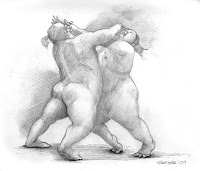
Before I let you go I want to point out the very cool drawing from a friend, Mike Franzese. Mike is in the advertising business and has a blog, Franzeseinklings, that I follow. I liked his drawings so much that I asked him for a picture that conveyed manipulation. I think you’ll agree, he did a terrific job! Keep an eye out for more from him and give his blog a follow.

Brian
Helping You Learn to Hear “Yes! “

Are You “An” Authority or “In” Authority

Okay, it’s not 5:30 PM on Monday so why the new post? Well, I received an invitation from Mike Figliuolo at thoughtLeaders, LLC, to write a guest article and I didn’t want to pass up a great opportunity.

I met Mike several months ago and we’ve become friends and colleagues. We regularly share ideas over lunch and he’s been a tremendous help to me as I’ve developed my blog. Look for some guest articles from him on Influence PEOPLE in the future. For now, click here to read Are You “An” Authority or “In” Authority.

Brian
Helping You Learn to Hear “Yes!”