Tag Archive for: authority

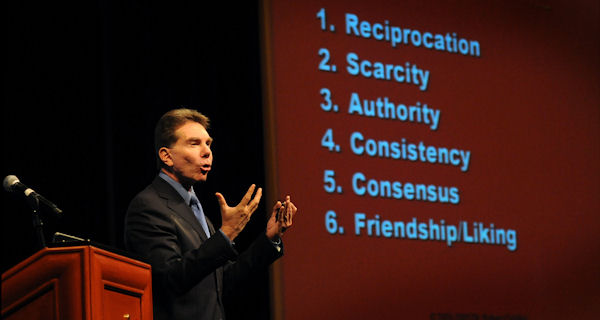
5 Tips for Persuasive Presentations

In June, I had the pleasure of giving a
keynote presentation to about 200 members of HRACO (Human Resources of Central
Ohio). It went really well and the best thing I can say is I persuaded many
people to try some of the influence tips I shared.
Often people ask me what I do to prepare for a
presentation. I’ll start by telling you what I don’t do – wing it. I always put
in lot of time, effort and practice. Here are five tips you might find helpful
next time you want to give a persuasive presentation.
1. Preparation – Vince Lombardi,
Hall of Fame coach of the Green Bay Packers, said, “Most people have the will
to win but few have the will to prepare to win.” This can’t be overstated
enough. Nobody would expect an athlete to perform with excellence without
countless hours of practice so why should you expect to give a great
presentation without plenty of practice?
When I do the Principles of Persuasion workshop
I stress this point – what you do before
the thing you do quite often makes your attempt at influence much easier. I’ll
spend at least an hour a day for weeks on end practicing my presentations. As I
do so I’m timing myself to make sure I stay within the allotted time. I work on
hand gestures, head movements at key times and voice inflection.
When I’m alone in the car I turn the radio off
and use the down time to practice. When I’m working out alone, between
exercises I practice parts of the talk. I’ll even record myself so I can hear
how it sounds.
2. Visual
Aids

– I use Power Point as a visual aid to almost all of my presentations and I’ll
have a handout for those who like to take notes. I highly recommend two books that
really influenced how I use this tool – Presentation Zen and The Presentation Secrets ofSteve Jobs.
I’ve moved away from traditional text-filled
slides, bullet points and lists. If I use words it’s usually one or two in very
large font to drive home a key point. Other that that I go almost entirely with
pictures because that’s how people think and best remember things.
I must tell you this; the first time you
present without the text and bullet points it’s a little scary because you
can’t glance at the screen for a reminder of what to say next. However, there
are several great reasons to go this route:
  • It forces you to know your material inside and
    out which makes you look more like a professional.
  • If you do miss something no one is any wiser
    because they’re not thinking, “He didn’t cover that last bullet point.”
  • It keeps the audience focused on you rather
    than the screen.
3. Questions – I ask lots of
questions. There are two reasons you want to do this. First, you can physically
engage the audience by asking for a show of hands if they agree or disagree.
The more you can physically involve people the more attention they’ll pay.
The second reason is people feel compelled to
answer questions. When you ask questions, even without asking people to do
something like raise their hands, they’ll get involved. You’ll see it with the
head nodding. Even those who don’t nod, I’ll bet they’re answering the question
in their heads so they’ve moved from passive listeners to active.
4. Introduction – A strong
introduction is key because it sets the tone for why people should listen to
you. This means you need a bio of less than 200 words so the event host can
introduce you. This leverages the principle of authority because people pay
attention to those they view as having superior knowledge or wisdom.
When I speak there are two critical
differentiators I want people to know. First, I make sure people know I’m one
of just 27 people in the world certified to train on behalf of Robert Cialdini,
the world’s most cited living social psychologist. In addition to authority this
also leverages the principle of scarcity which says people value things more
when they think they’re rare.
I also want audience members to know people in
185 countries have taken time to read my blog. That’s a great “Wow!” factor
that incorporates the principle of consensus. I want those in attendance to think, “If so many
people around the world are reading his stuff he must be pretty good.”
5. Take Away
Ideas

– I want to make sure my audience has tangible ideas for each of the principles
I talk about. It’s nice if they find the material interesting but the bottom
line is showing them how it can help them enjoy more professional success and
personal happiness. To do this I clearly state, “And here’s the application for
you,” then I share with few ways they can use the principle I just discussed in
every day situations.
Whole books are written on the subject of
presentation excellence so there’s no way to do it justice in a short blog
post. However, I hope you find these tips helpful. I know focusing on them has
helped me make great strides in giving more persuasive presentations and I’m
confident they can help you do the same.

Brian Ahearn, CMCT® 
Chief Influence Officer
influencePEOPLE 
Helping You Learn to Hear “Yes”.

Influencers from Around the World – How Executives Can Learn Influence

This month’s
Influencers from Around the World guest post comes by way of my good friend
Sean Patrick. Through the power of the internet, he sent it to me all the way
from Ireland in just milliseconds. Sean started a his own sales training
company, Sales Training Evaluation, and spends time in various parts of Europe training salespeople and
executives. Sean was in the U.S. several years ago to attend the Principles of
Persuasion workshop and there’s a good chance he’ll be here again in late
summer or early fall. If you don’t get to meet him while he’s here you can always
“meet” him on Facebook, LinkedIn and Twitter.
How
Executives Can Learn Influence
How can executives acquire meaningful persuasion
skills so they can influence outside their power brokerage?  As people like myself know all too well,
skill transfer is one of the toughest tasks that can be placed upon a learning
and development executive.  Natural
persuaders just like successful sales people who adhere to no formal sales
process, struggle to share insights into their behaviors.  They will tell you that they “just do it.”  It just flows.  Words can’t describe the cognitive processes,
emotions and beliefs that form specific actions to take place at specific
intervals during the influence process. So imagine you’re the boss of a very
large department and you need to come up with a plan to motivate more
production out of your staff.  In today’s
corporate world, working environments are highly collaborative as well as
individualistic, where multi stakeholder partnerships exist. It’s these
environments in which the skills of influence rule over old school
manipulation.
According to Dr. Robert Cialdini, today’s
executives who lack the superior communication skills of the “naturals” can
turn to science in place of sourcing the very same skills that win deals, gain
compliance and get employees to willfully change.  Executives can gain consensus and win
concessions by mastering simple basic principles that can be easily learned and
applied in a relatively short period of time.
Here are a few simple ways where influence can be
applied in everyday corporate environments:
1. Liking Informal conversations during the
workday create an ideal opportunity to discover common areas of interest,
whether it’s a sports team, hobby, or watching “Mad Men.” The important thing
is to establish the commonality early because it creates a sense of goodwill
and trustworthiness in every subsequent encounter. It’s much easier to build
support for projects when the people you’re trying to persuade are already
bonded with you.  Managers, who praise
members of their staff where relationships have been impaired, begin to
radically turn around those relationships through the simple act of
recognition.
Researchers at the University of North Carolina
writing in the Journal of Experimental
Social Psychology,
found that men acted more favorably for an individual
who flattered them even if the compliments were untrue. And in their book Interpersonal Attraction
(Addison-Wesley, 1978), Ellen Berscheid and Elaine Hatfield Walster presented
experimental data showing that positive remarks about another person’s traits,
attitude, or performance reliably generates liking in return, as well as
willing compliance.
2. Reciprocity Line managers who share staff and
resources with their peers who are fast approaching deadlines are more likely
to receive favors and help when they need it in the future. Odds will improve
even more if you say, when your colleague thanks you for the assistance,
something like, “Sure, glad to help. I know how important it is for me to count
on your help when I need it.” 
Gift giving is one of the cruder applications of
the rule of reciprocity. In its more sophisticated uses, it promises a genuine
first-mover advantage on any manager who is trying to foster positive attitudes
and productive personal relationships in the office
3. Social Proof According to one of Dr. Cialdini’s
research pieces, a group of researchers went door-to-door in Columbia, S.C.,
soliciting donations for a charity campaign and displaying a list of neighborhood
residents who had already donated to the cause. The researchers found that the
longer the donor list was, the more likely those solicited would be to donate
as well.  The people being solicited
became the subject to the power of peer pressure once they saw the names of all
their neighbors on the list.
4. Consistency People need not only to like you but
also to feel committed to what you want them to do. Good turns are one reliable
way to make people feel obligated to you. Another is to win a public commitment
from them.  Israeli researchers writing
in 1983 in the Personality and Social Psychology Bulletin recounted how they
asked half the residents of a large apartment complex to sign a petition
favoring the establishment of a recreation center for the handicapped. The
cause was good and the request was small, so almost everyone who was asked
agreed to sign. Two weeks later, on National Collection Day for the
Handicapped, all residents of the complex were approached at home and asked to
give to the cause. A little more than half of those who were not asked to sign
the petition made a contribution. But an astounding 92% of those who did sign
donated money. The residents of the apartment complex felt obligated to live up
to their commitments because those commitments were active, public, and
voluntary.
5. Authority The principle of authority asks us to
believe in the advice dispensed by experts. Since there’s good reason to take
heed to expert advice, executives should take pains to ensure that they
establish their own expertise before they attempt to exert influence.
Surprisingly often, people mistakenly assume that others recognize and
appreciate their experience. The task for managers who want to establish their
claims to expertise is somewhat more difficult. They can’t simply nail their
diplomas to the wall and wait for everyone to notice. A little subtlety is
called for.
Through liking and similarity, they can also
provide an opportunity to establish expertise. Perhaps telling an anecdote
about successfully solving a problem similar to the one that’s on the agenda at
the next meeting or maybe a recreational dinner is the time to describe years
spent mastering a complex discipline, as part of the ordinary give-and-take of
conversation.
6. Scarcity Study after study shows that items and
opportunities are seen to be more valuable as they become less available.
That’s a tremendously useful piece of information for managers.  Managers can learn from retailers how to
frame their offers not in terms of what people stand to gain but in terms of
what they stand to lose if they don’t act on the information.  According to a 1994 study in the journal Organizational Behavior and Human Decision
Processes
, potential losses figure far more heavily in managers’ decision-making
rather than potential gains. In framing their offers, salespeople and
executives should also remember that exclusive information is more persuasive
than widely available data.
The persuasive power of exclusivity can be
harnessed by any manager who comes into possession of information that’s not
widely available and that supports an idea or initiative he or she is aligned
to.  The next time that kind of
information crosses your path, gather your key stakeholders.  The information itself may seem dull, but
exclusivity will give it a special appeal. Push it out to those who need to
buy-in and inform them saying, “You just got this report today. It won’t be
distributed until next week, but I want to give you an early look at what it
shows.” Then notice the rise in interest.
Over to you
If you manage people in your job, how can you take
these examples of persuasion and use to gain compliance?
I’d love to hear about how you’ve pushed yourself
to use these principles of persuasion. 
I’d also love to hear about your wins and what you learned through the
experience.
Sean
Sources:
Influence:
Science and Practice (Allyn & Bacon, 2001)
Influence At Work www.influenceatwork.com         
HBR Business
Essentials: Power, Influence and Persuasion (HBR Press, 2005)
Social Psychology,
3rd ed. (Oxford University Press, 1985)

It Could Never Happen Today or Could It?


I got a strange birthday present this year
from my daughter Abigail; a book called Hitler Youth by Susan Campbell
Bartoletti. Abigail has been fascinated by what took place around World War II,
particularly the Holocaust, so couple that with her youth pastor recommending the
book along with my interest in psychology, and that’s how she came up with the idea.
The book details how Adolph Hitler and the
Nazis used the young German population to strengthen their cause and implement
their gruesome plans. The indoctrination of the German youth began in the early
1930s and went all the way up through the end of the war.
The children were so brainwashed between
school, the Hitler Youth organization and summer work camps that many had more
loyalty to Hitler and the state than to their own parents. Some children even
turned their parents in to Nazi authorities when they heard them say derogatory
things about Hitler or the Nazis!
For decades people have wondered how any human
being could have witnessed what was going on and not done something. Even
worse, how could anyone have willingly participated in such evil?
It’s easy for us to think the atrocities that
occurred under Hitler could never happen in this day and age because we have social
media and people would take action immediately. Sadly, that’s not the case. The
world was aware of genocide in Rwanda with the nightly news and did little to
stop it until hundred of thousands were slaughtered. More recently we only
need to look at the North Korean regime.
Five decades ago Stanley Milgram, a social
psychologist from Yale, wondered how people could have willingly participated
with the Nazis, so he set out find an answer.
Milgram conducted a series of experiments in
the early 1960s to find out how subjects would respond to an authority figure. The principle of authority tells us people defer to those with expertise and those in positions of power. As you might imagine, most people predicted the average American wouldn’t harm another person, but during a “learning experiment” Milgram found
that two-thirds of his subjects willingly administered a series of 30
progressively stronger shocks to a learning partner. The final shock was 450
volts, enough voltage to kill a person!
During the experiment no threats were used, there
was no prior history with the experimenter to consider, nor was anyone’s career
on the line. What turned these normal people into willing participants in
torture? Believe it or not, all it took was a man in a white lab coat – a
perceived authority – insisting that participants continue with the experiment.
Many protested, some to the point of near emotional breakdown, but two out of
three participants administered all 30 shocks.
Are we much different today than we were in
the early ‘60s? In a much milder form, the Milgram experiment and many other
interesting scenarios such as bullying have been replicated in recent years on the
NBC television show What Would You Do?
Various studies show most people believe
themselves to be better looking than the average person, and smarter, kinder
and, I bet, more heroic. You probably believe you are and I’ll be honest, I
believe I’m all those things too. Because of our high self-esteem we’d like to
believe we would have immediately done the right thing if we’d been in Nazi
Germany or someplace else where we witnessed something horrific. But the odds
are against us, because human nature hasn’t changed much during the past
century.
It’s become commonly documented that all too
often people don’t help one another when they see someone in need and the more
people there are around, the less any one person feels the need to help. This
is sometimes called the “bystander effect” or “diffusion of
responsibility.” If you doubt this consider, Catherine Susan “Kitty”Genovese, the woman who was stabbed to death in New York City in 1964 in full
view, or within earshot, of many people who did nothing to help her.
So what can you and I do? On a personal level,
having just read this you’re probably thinking, “I’d never do that” and that’s
a good first step. The principle of consistency tells us people want their
words and deeds to match. By telling ourselves we wouldn’t do such a thing
we’re raising our awareness that should something like that occur we’re more
likely to recognize it and take appropriate action.
Something that strengthens our resolve when it
comes to consistency is to make a public commitment. The more public we are
about our views on right and wrong, good and bad, and what we’d do, the more
likely we are to follow through on those actions.
Here’s the good news – quite often other
people know the right thing to do but are afraid to act. However, when one
courageous person takes a stand it emboldens others and before you know it you
can have a movement of good against evil. And the sooner we act, the easier it
will be to stamp out something before it seems too big, too imposing to deal
with.
Brian, CMCT®
influencepeople 
Helping You Learn to Hear “Yes”.

Influential Mad Men

I became a fan of the television series Mad Men a few years ago during the show’s fourth season on AMC. Over the holidays, thanks to Netflix, I went back and watched the first three seasons so I could fill in lots of holes on different characters.

The show revolves around a mysterious character who goes by the name of Don Draper. I say, “goes by the name of” because that’s not his real name. Part of the appeal of the series for me is that it takes place in an advertising agency back in the 1960s. That’s the decade when I was born so I remember many of the products they pitch.

Another reason for the appeal is that at its core, advertising is persuasion. Advertising is all about changing people’s behavior, trying to get them to buy the products being advertised. Throughout Mad Men, you learn that most people don’t respect Don Draper and the rest of the characters they encounter because of what they do. In the late ‘50s and early ‘60s, advertising was seen as Madison Avenue types trying to get unsuspecting people to buy things they didn’t really need or want.

There’s some truth to that last statement however, because we’re so saturated with ads today the advertising onslaught seems normal to us. In an article titled PermissionMarketing, which was written for the magazine Fast Company, William C. Taylor told readers, “This year, the average consumer will see or hear one million marketing messages – that’s almost 3,000 per day.” Here’s a scary thought – that quote is now 15 years old! If the average American consumer was exposed to a million marketing messages in 1995, how much more are we exposed to today with the explosion of the Internet and cable television? Just think about all the ads you see on Facebook, LinkedIn, Twitter and other social media sites that didn’t exist 15 years ago. It’s overwhelming!

Can you possibly take in all the information from millions of marketing messages, rationally analyze it then make the most informed choice? Nobody can, so to help navigate the tidal wave of information that comes our way we use mental shortcuts. By that, I mean when we hear certain reliable bits of information we sometimes act upon it, nearly to the exclusion of other information, so we can move on to whatever else is competing for our attention.

This is where the Robert Cialdini’s principles of influence come into the decision-making process. These principles describe psychological scenarios where it’s easier for us to say “Yes.” For example, the more you know and like someone the easier it is to say “yes” to them. In advertising we sometimes come to feel as if we know certain spokespeople in commercials. Progressive’s Flo character is a good example. The more people feel they know and like Flo the more likely they are to get a Progressive quote. This is the principle of liking.

The principle of reciprocity clearly shows you’re more likely to help someone who’s first helped you in some way or given you something. This is why you get “freebies” at the grocery store and in the mail. Those “freebies” make it more likely we’ll buy from the company that’s given those “gifts” to us.

In advertising another big way we’re influenced is through the principle of consensus. When we believe something is a best seller, that everyone else is buying the item, we become more likely to purchase it too. An example here would be touting a book that’s made the New York Times’ Best Seller list. Once we hear that single fact it legitimizes that the book is probably pretty good and worth buying. After all, can hundreds of thousands, or millions of readers all be wrong?

Spokespeople are sometimes used in advertising because they convey authority and we’re more likely to listen to so-called experts. If I tell you a certain golf ball added 20 yards to my drive would that be enough for you to buy the ball or do you think a golf pro like CoreyPavin telling people how great the new golf ball is would sell more? Most people would listen to Corey Pavin because he won the U.S. Open and has finished in the top five of the other three major golf championships during his career. This is the principle of authority in action.

Advertisers often tap into the principle of consistency to get us to buy. They tie the virtues of their product into what we’ve said or done in the past or relate the product’s attributes to our deeply held values. For example, most breadwinners want to provide for and protect their families. Advertising that shows how a particular life insurance product will allow a family to continue living in the lifestyle they’re accustomed to should the breadwinner pass away will sell more easily because it ties into the value of family protection.

And finally there’s the principle of scarcity. This principle of influence tells us people want things more when they’re becoming less available. This principle is probably most familiar to us because we see it continually when we’re hit with ads telling us “Sale Ends Sunday,” “While Supplies Last,” or “One Day Only!” This is also the reason gun sales skyrocketed after the Sandy Hook tragedy. People were afraid if they didn’t buy a gun now they might not be able to in the future.

If you take the time to watch Mad Men (season premier is April 7 on AMC) you’ll see the principles employed at every turn as they build out advertising campaigns for clients. Of course, all you need to do is pay attention to regular advertising that comes your way and you’ll see all the same principles at work. When you recognize them simply ask yourself if you’re making the best decision possible or if you’re only acting because of one piece of data at the expense of other, perhaps more relevant information. Do this and you’re sure to make better decisions over the long haul.


Brian, CMCT®
influencepeople 
Helping You Learn to Hear “Yes”.

A Call to Lay Down Your Weapons of Influence

In America there’s a debate raging and millions of people are lining up on opposite sides of the issue. The debate has to do with constitutional rights vs. public safety. You probably know I’m talking about the gun control issue that’s come to the forefront of national attention after the Sandy Hook tragedy last year. At the center of the debate is gun ownership and in particular assault weapons.

This post has to do with that debate because it’s about weapons. If you’ve read Robert Cialdini’s classic book, Influence Science and Practice, then you know it was born out of his curiosity about why he was such a “patsy” when it came to the “pitches of peddlers, fund-raisers, and operators of one sort or another.” He wrote, “I wanted to find out which psychological principles influenced the tendency to comply with a request.” Thinking of himself as someone who was taken advantage of more than he cared to admit, a few sentences later he characterized these psychological principles as “weapons of influence” because quite often they were used against defenseless people. I say defenseless because manipulators understood the principles but their targets of influence didn’t and that gave manipulators a huge advantage. Cialdini held to this viewpoint so much so that at the end of each chapter ideas are presented on how you can defend yourself against the manipulative use of these weapons of influence.

Nearly 30 years have passed since Influence first hit bookstores and times have changed when it comes to people’s views on influence and persuasion. After selling nearly 2.5 million copies, people have embraced the idea that the psychology of persuasion can be used in an ethical manner to create more win-win situations than ever before. People have embraced the concepts from Influence so much so that it was named the top sales and marketing book in The 100 Best Business Books of All Time.

Considering the change in attitude toward influence I’m writing today to ask people to banish the “weapons” terminology from their vocabulary when referring to the principles of influence.

Why now? As I scanned my Twitter feed one morning I saw a post that referred to one of the principles of influence as a weapon of influence. All of a sudden it didn’t sit well with me and as I analyzed it all the thoughts I’m sharing here came to mind. If I knew what was meant by “weapons of influence” and didn’t care for it I wondered how others might perceive the terminology.

First, the weapons terminology doesn’t conjure up positive thoughts, particularly during this time of tense, heated debate around the subject. If we truly believe small changes (i.e., using certain words at particular times in specific situations) can make a big difference – indeed that’s what influence is all about – then I argue “weapons” can’t be helping our cause when it comes to teaching people about the ethical use of influence. Consider the following:

If you didn’t know anything about influence how likely would you be to attend a workshop where you’d learn about using weapons of influence? Some people will go but I suspect many will subconsciously make an automatic decision not to consider the workshop.

How might your customer feel if they found out you were using weapons of influence on them? It’s not likely they’ll believe you’re using those weapons to defend them. Rather, I suspect they’ll feel you’re using those weapons against them in an effort to defeat them and get what you want.

We all know things can be used for good or bad. Guns in the hands of our military are good when they help defend our freedom. They’re not so good in the hands of bad guys. However, as I noted at the beginning, with the national debate raging, using weapons terminology will provoke the wrong images and emotions for too many people.

I prefer talking about ethical influence. When I teach I encourage people to look for principles that are genuinely available to the situation they find themselves in. If they look hard enough they’ll find some just waiting to be used.

Next you want to incorporate the principles into your request in a way that’s truthful. In other words, don’t tell people there’s a time limit – scarcity – if there’s not. Don’t tell people how “everyone” is using your product – consensus – when they’re not.

And finally, look for what Stephen Covey called “win-win” situations. Your product, your price, your idea, whatever you may be trying to persuade someone about will not be right for everyone. Sometimes honestly pointing that out will get you recommendations because people will trust you – authority!

In closing I ask you to join me and lay down your weapons of influence and in their place pick up the tools of ethical influence that build. I encourage you to start thinking of the principles of influence as tools that can help build relationships, overcome doubts and motivate people to action. Will it make a difference? I believe it will, because small changes can lead to big differences.

A Call to Lay Down Your Weapons of Influence

In America there’s a debate raging and millions of people are lining up on opposite sides of the issue. The debate has to do with constitutional rights vs. public safety. You probably know I’m talking about the gun control issue that’s come to the forefront of national attention after the Sandy Hook tragedy last year. At the center of the debate is gun ownership and in particular assault weapons.

This post has to do with that debate because it’s about weapons. If you’ve read Robert Cialdini’s classic book, Influence Science and Practice, then you know it was born out of his curiosity about why he was such a “patsy” when it came to the “pitches of peddlers, fund-raisers, and operators of one sort or another.” He wrote, “I wanted to find out which psychological principles influenced the tendency to comply with a request.” Thinking of himself as someone who was taken advantage of more than he cared to admit, a few sentences later he characterized these psychological principles as “weapons of influence” because quite often they were used against defenseless people. I say defenseless because manipulators understood the principles but their targets of influence didn’t and that gave manipulators a huge advantage. Cialdini held to this viewpoint so much so that at the end of each chapter ideas are presented on how you can defend yourself against the manipulative use of these weapons of influence.

Nearly 30 years have passed since Influence first hit bookstores and times have changed when it comes to people’s views on influence and persuasion. After selling nearly 2.5 million copies, people have embraced the idea that the psychology of persuasion can be used in an ethical manner to create more win-win situations than ever before. People have embraced the concepts from Influence so much so that it was named the top sales and marketing book in The 100 Best Business Books of All Time.

Considering the change in attitude toward influence I’m writing today to ask people to banish the “weapons” terminology from their vocabulary when referring to the principles of influence.

Why now? As I scanned my Twitter feed one morning I saw a post that referred to one of the principles of influence as a weapon of influence. All of a sudden it didn’t sit well with me and as I analyzed it all the thoughts I’m sharing here came to mind. If I knew what was meant by “weapons of influence” and didn’t care for it I wondered how others might perceive the terminology.

First, the weapons terminology doesn’t conjure up positive thoughts, particularly during this time of tense, heated debate around the subject. If we truly believe small changes (i.e., using certain words at particular times in specific situations) can make a big difference – indeed that’s what influence is all about – then I argue “weapons” can’t be helping our cause when it comes to teaching people about the ethical use of influence. Consider the following:

If you didn’t know anything about influence how likely would you be to attend a workshop where you’d learn about using weapons of influence? Some people will go but I suspect many will subconsciously make an automatic decision not to consider the workshop.

How might your customer feel if they found out you were using weapons of influence on them? It’s not likely they’ll believe you’re using those weapons to defend them. Rather, I suspect they’ll feel you’re using those weapons against them in an effort to defeat them and get what you want.

We all know things can be used for good or bad. Guns in the hands of our military are good when they help defend our freedom. They’re not so good in the hands of bad guys. However, as I noted at the beginning, with the national debate raging, using weapons terminology will provoke the wrong images and emotions for too many people.

I prefer talking about ethical influence. When I teach I encourage people to look for principles that are genuinely available to the situation they find themselves in. If they look hard enough they’ll find some just waiting to be used.

Next you want to incorporate the principles into your request in a way that’s truthful. In other words, don’t tell people there’s a time limit – scarcity – if there’s not. Don’t tell people how “everyone” is using your product – consensus – when they’re not.

And finally, look for what Stephen Covey called “win-win” situations. Your product, your price, your idea, whatever you may be trying to persuade someone about will not be right for everyone. Sometimes honestly pointing that out will get you recommendations because people will trust you – authority!

In closing I ask you to join me and lay down your weapons of influence and in their place pick up the tools of ethical influence that build. I encourage you to start thinking of the principles of influence as tools that can help build relationships, overcome doubts and motivate people to action. Will it make a difference? I believe it will, because small changes can lead to big differences.

Brian, CMCT®
influencepeople
Helping You Learn to Hear “Yes”.

Lance Armstrong, a Modern Day Robin Hood? Hell No!

So last week, Lance Armstrong confessed to Oprah Winfrey that he did in fact use banned substances during his career. While this might be a surprise and disappointment to the general public, it wasn’t a shock to anyone inside the sport of cycling nor was it to most athletes. Whenever we see superhuman performances like winning the Tour de France seven times, Flo Jo smashing the 100-meter dash record by a half second, or Roger Clemons pitching at a Hall of Fame level well into his 40s, we should be very leery.

As I listened to Mike and Mike on ESPN radio driving to work they brought up the point that some people have equated Lance Armstrong to a modern day Robin Hood because he helped so many, despite breaking the rules. I say, “Hell no, he isn’t a modern day Robin Hood!”
First, Robin Hood was a fictional character. We see many fictional charters we wouldn’t tolerate in real life. Arnold Schwarzenegger plays some pretty cool action heroes in his movies but would we really tolerate such characters in the real world? Of course not, and it showed when his funny quips, best left for the movies or Saturday Night Live, got him in trouble on a number of occasions while governor of California. Remember the “girlie man” quote he made about budget opponents?
Robin Hood’s motive was all about helping the poor because they were oppressed by the local government and a corrupt sheriff. If you’ve followed Lance Armstrong over the years then you know Lance’s motive was Lance, pure and simple. With his notoriety he was able to help people but it was still about Lance, from the starting line to the finish line.
I heard one commentator say Lance knew he had to do this (confess), that he had no choice. He went on to say he also realizes it’s the right thing to apologize to those people whose lives he ruined. Did you notice it was about Lance first and the people he hurt second? If the right thing had been his motive then perhaps in the absence of the overwhelming evidence he would have approached those same people and apologized for what he’d done, then confessed to the world.
People have said, “But look at all the good he did.” Can’t the same be said for Joe Paterno when it comes to Penn State and their student athletes? Joe Pa had a very positive impact on both but this line of thinking is “the ends justifies the means.” In other words, it doesn’t matter what you do as long as you can point to how you helped others. Bernie Madoff donated millions to various organizations over the years and they benefited tremendously but did that make it right in terms of how he obtained his wealth? Ask the investors who paid his tab.
If there’s a silver lining for Lance Armstrong it’s twofold. First, he has advocates who will never leave him no matter what. Those people who benefitted from the LIVESTRONG foundation are among those. And don’t forget the millions he inspired to work hard at whatever their chosen profession or sport. When it came to inspiration he was like a real-life Rocky.
The second silver lining is the forgiveness of the American people based on the recency effect. Here’s a list of people who played their cards right and, while perhaps not attaining the same level of popularity and income they had prior to their scandals they’re still doing pretty well:
  • Tiger Woods is still the crowd favorite at PGA events.
  • Martha Stewart remains an icon for most homemakers.
  • Pete Rose might just make it into the Hall of Fame during his lifetime because of the legions of fans who believe it’s the right thing to do.

So what does all of this have to do with a blog on persuasion? Here are a couple of closing thoughts.

Aristotle said, “Character may almost be called the most effective means of persuasion.” Each of these people influenced legions of us to do things because of who we thought they were. Had we known the truth many of us might have made different choices on what to do with our time, money, effort, and adoration.
When I write about persuasion my bent is ethical persuasion because none of us wants to be manipulated nor do we want to be known as manipulators.  If something is the right thing to do then we shouldn’t have to resort to manipulation to get people to do what we want.
Let me leave you with this; Frank Sinatra sang, “I did it my way” and there’s a part of the “pull yourself up by the bootstraps” American mentality that loves this.  That is, until we find out someone’s “way” is to cheat and manipulate, because in the end the ends DOESN’T justify the means. If you want to look yourself in the mirror and feel good about who you are, do the right thing.
Brian, CMCT®
influencepeople 
Helping You Learn to Hear “Yes”.

Does Your Audience Know You’re an Authority?

Earlier this year I spoke at The Ohio State University to a few dozen business coaches where I shared some insight on
Robert Cialdini’s principles of influence and their application to the coaching process.
In this short video I briefly explore the principle of authority, which tells us people look to those with superior knowledge and expertise when they’re not 100% certain about what they should do. When you want to persuade people having them know something about your expertise up front can sometimes make all the difference.

If you’re viewing this post by email click here for the video.

Are you looking for a keynote speaker, training, or consulting on how to apply scientifically proven principles of
influence to your sales, marketing, management or leadership? If so, reach out to me (BFA654@gmail.com or 614.313.1663) and we’ll talk about your specific needs.

Brian, CMCT 
influencepeople 
Helping You Learn to Hear “Yes”.

PEOPLE – What Does it Mean to Persuade?

In recent years there’s been a proliferation of books and blogs on the subject of influence and persuasion. Some are quite good but many are nothing more than a rehash of Dr. Robert Cialdini’s material.

Another problem is this; what some people call influence or persuasion is nothing more than vague advice without any basis in scientifically proven data.
If you’ve followed this blog for any length of time, you know what I share is often called “the science of influence” because findings are based on the research of social psychologists and behavior
economists.  In this series we’re working through the word PEOPLE and we now come to the second “P” which stands for Persuade. This begs the question, what does it actually mean to persuade someone?
A formal dictionary definition might read as follows, “to induce to believe by appealing to reason or understanding;
convince.” That’s okay, but I prefer Aristotle’s definition. Aristotle told the
world more than 2,000 years ago persuasion was “The art of getting someone to do something they wouldn’t ordinarily do if you didn’t ask.”
I like Aristotle’s definition because it’s nice and simple; get someone to do something they’re not currently doing. If you’re a manager and your employees make it to work on time everyday then you don’t
need to change their behavior and no persuasion is necessary. The same could be said of your child; if your child is doing his/her homework then you don’t need to persuade him or her to study.
But here’s the problem; quite often people aren’t doing what we’d like them to do and when that’s the case, we need to communicate with them in a way that hopefully leads to a change in behavior. How we communicate; i.e., persuade, can make all the difference in hearing “Yes” or “No.”
Earlier in this series I shared why influence is Powerful; because it’s rooted in science. What I share with readers isn’t just someone’s good advice because sometimes people’s “good’ advice has no bearing for you. And sometimes people succeed in spite of themselves! Imagine a
relatively healthy 85-year-old person telling you they’ve smoked two packs of
cigarettes a day for more than 60 years and tries to convince you it wouldn’t harm you. Would you want to emulate their behavior just because they’ve lived a good long life? Of course you wouldn’t. Like most people you’d probably prefer to know what decades of studies have to say about healthy eating habits and lifestyle choices.
And so it is with learning the science of
influence because it’s rooted in six decades of research by social psychologists and behavioral economists. We’re much better off following the advice of people who study this for a living vs. people who might have made it big more by chance than skill.
Having shared that, I’d change Aristotle’s definition ever so slightly by replacing “art” with “science.” Doing so makes our definition of persuasion read as follows, “The science of getting someone to do something they wouldn’t ordinarily do if you didn’t ask.” If
you’re in business you might say there are “best practices” in how to communicate if you want to get solid bottom line results.
So taking our lesson from science, here are a few examples of how you might want to alter your communication:
  • Stop making statements and start asking questions because it engages the principle of consistency. Once people give you their word they’ll do something, the odds of them following through go up significantly vs. telling them what to do.
  • Make sure people know your credentials up front. The principle of authority clearly shows that people listen to those with knowledge and expertise, but they have to know what your expertise is before you start talking.
  • Tell people what they stand to lose by not going along with your request because the principle of scarcity tells us people are more motivated by what they may lose as opposed to what they might gain.
  • Take extra time to personalize whatever you do for someone else. Reciprocity is the principle that tells us people feel obligated to give back to those who first give to them so going an extra step is usually met with a better response.

These are just a few ways to incorporate scientifically proven principles to persuade into your everyday communication. Next week we’ll examine the “L” in PEOPLE to see how persuasion can have a Lasting impact on people.

Brian, CMCT
influencepeople 
Helping You Learn to Hear “Yes”.

Influencers from Around the World – Treat Your Reputation Like Gold


The September Influencers from Around the World post comes all the way from down under, from Australia’s only Cialdini Method Certified Trainer Anthony McLean. Anthony just started a new venture called Social Influence Consulting Group. You can connect with Anthony on FacebookLinkedIn and Twitter.
Brian, CMCT
influencepeople 
Helping You Learn to Hear “Yes”.
Treat Your Reputation Like Gold!


How are with staying on top of things?  Are you across social media?  Do you hide away from it?  Well this next big change is going to drag you along whether you like it or not!


Imagine a world where:


  • You are hired based on your performance in online forums.
  • Where banks review your online reputation as well as your credit rating.
  • Where good references in making payments on time like renting a house can assist in renting a car.

In the reputation-driven world of the future, before anyone meets or does business with you, they will not only Google you but assess your online reputation through the many tools available to display this data.
And just as good reviews and referrals will drive people in your direction, negative comments will also impact you like never before.

Your online trustworthiness is your next big business commodity. The thing is, Reputation Marketing is not a thing of the future, it is here, now!
Your Reputation Data is already being expertly mined and collated for all to see.  Those with good reputations, as evidenced by likes, recommendations, endorsements, etc., will in the next six to 12 months see themselves gravitating towards page 1 on Google because they can be trusted and people like to interact with them.  Those with questionable reputations will fall
by the wayside just as it happens in the offline world.

Your digital reputation is fast becoming a guide to your trustworthiness; both in the digital and physical realms.
Wired magazine
reported in its September 2012 issue, “The value of reputation is not a new concept to the online world: think star ratings on Amazon, PowerSellers on eBay or reputation levels on games such as World of Warcraft.  The difference today
is our ability to capture data from across an array of digital services.  With every trade we make, comment we leave, person we ‘friend,’ spammer we flag or badge we earn, we leave a trail of how well we can or can’t be trusted.”
In the Principles of Persuasion Workshop, we know that when we are unsure of what we should do in a certain situation we look to a recognized Authority to guide our behaviour.  Critical to being a credible authority, however is not only our expertise but also our trustworthiness.  Therefore managing and marketing your reputation has just become far more important in persuading others because it will be tracked and easily found in the reputation centric world of the future.
In marketing now, a good online reputation will easily establish your authority, however if it is not managed well and is tarnished by negative comments, reviews, activities or statements, this will be made available for others to see and judge.
Likewise, when have no other ability to assess a person or their request we look to the behaviour of others like us to guide our decisions.  This is known as consensus or social proof.
A new study conducted by Berkley Economists Michael Anderson and Jeremy Magruder (published this month’s Economic Journal)found that across 328 restaurants in the San Francisco Bay Area, if crowd-sourced reviews moved a restaurant from a 3.0 to a 3.5 star rating, this would increase a restaurant’s chance of selling out during prime dining times from 13% to
34%.  Moving from 3.5 to 4.0 stars increased the chance of selling out during prime dining times by another 19 percentage points and these changes occur even though restaurant quality held constant.
The study reaffirmed that crowd-sourced reviews have a bigger impact when there is a lack of alternative information available by which to judge a restaurant’s quality. “If a restaurant has a Michelin star or it appears in the San Francisco Chronicle’s list of Top 100 Restaurants in the Bay Area, the Yelp star becomes irrelevant,” said Magruder.
Therefore Consensus (the opinion of others) is
trumped by Authority (proof you are
credible and trustworthy)!
IMPLICATION FOR YOU!
You need to start managing your reputation.  From reviews to referrals, to customer service, to being mindful of the comments you and/or your staff make.
Get good comments, solicit referrals, and provide mechanisms for others to praise you, but stay on top of the negative feedback.  Counter it.
Apologise where necessary.  But
ignore it at your peril!
“We are only at day one in the whole idea of global reputation,” says Brian Chesky, cofounder and CEO of the peer-to-peer marketplace Airbnb.  “By the end of the decade, a good online reputation could be the most valuable currency in your possession”.
Anthony, CMCT
Sources: