Tag Archive for: Cialdini

New Survey on Decision Making

Several years ago I asked readers to participate in a survey to give some insight into what influences decisions based on personality type. The goal was twofold: to help people understand themselves better based on their personality type and more importantly, how best to influence others when you have a handle on their personality type.

The questions in that survey were a mix of business and personal scenarios. Many people felt they answered the questions differently depending on the setting presented – work or personal – so I’ve decided to do a new survey with a focus solely on business situations.

Would you like to participate in this new survey?It’s only 11 questions so it should take no more than two to three minutes so click here and take the survey. Look for a series of blog posts beginning sometime in June where I’ll share the results.Thanks, I appreciate your willingness to help!

Brian

Brian Ahearn, CMCT®
influencePEOPLE 
Helping You Learn to Hear “Yes”.

Influencers from Around the World – 5 Tips for Influencing Business with Email

This month’s Influencers from Around the World post comes to us from theother side of the world, from Australia’s only Cialdini Method Certified Trainer, Anthony McLean. Anthony heads up the Social Influence Consulting Group. I encourage you to connect with Anthony on FacebookLinkedIn and/or Twitter.

Brian, CMCT®
influencepeople 
Helping You Learn to Hear “Yes”.


5 Tips for
Influencing Business with Email


We all know that influencing via email can be a struggle.
In multicultural countries that do business transnationally this is especially
the case. So how do we set about influencing people, especially for business,
over email?
The Science of Persuasion provides us with a number of
hints in this regard:
1. Have a Cracker
of a Headline!
The problem with too many emails is that the subject line
is cryptic and doesn’t grab the attention of the recipient.
You know what subject lines are likely to get opened and
which ones won’t.  Those that answer the
“What’s In It For Me” (WIIFM) will get a greater open rate.  For example if I say,

“Here’s your opportunity to seize an influx of resources”
or

“Hey, I have a $100 for you.”

Which one would you open?
If you need to be a little more formal provide your
subject line with the data for identification and action such as:

FOR ATTENTION: Immediate Review of Budget

FOR APPROVAL: New Contract

REMINDER: Tender Submission Due Tuesday

Using reported facts from the media or headlines from the
news shows the email is timely and perhaps includes something important that
the recipient may have missed, such as the following:

“Reserve Bank Drop Rates – What it means for your mortgage”

“Media Regulation – the unintended impact on business”

President Obama’s team tested a number of subject lines until they struck on the one that tapped into the intrinsic motivation (Consistency) of their supporters but also showed what
they stand to lose (Scarcity) – all in four words “I will be outspent.”
But remember you can’t use the same headline over and over
again.  Test to find the ones that get
the best reaction but change them regularly.
Test new headlines and avoid becoming predictable.
2. Make it
Personal
A research study between college students found that those
who started a negotiation task over email with no period of interaction, i.e.,
they got straight down to business, ended up in a stalemate 30% of the time.
Those students who were first asked to introduce themselves and provide some
personal details including their hobbies, their chosen field of study, their
hometowns and so on, only stalled 6% of the time.  The thing to note here was the negotiation
task was exactly the same.  The only
difference was the group who was more successful at reaching a resolution
personalised the interaction before getting down to business.
Therefore even though you may be writing an email to a
customer that is no excuse for it to be overly formal and boring.  Research the person, use your relationship
data and personalise the email.  This
goes for the headline and the body of the email.
Write it as if you are writing to a friend.  Don’t use templates or long messages.  Make personalised comments at the outset that
shows you have made an effort for them and it isn’t a generic email (see point
3). For example,

Hi Brian,I hope you had a great weekend.  We finally got some sunny weather and all
that did was make it harder to come back to work today.

The reason for the mail is I read an article and
immediately thought of you.  Have a look
at paragraph three; it links perfectly with your current project.

www.socialinfluenceconsultinggroup.com.au/blog

Call me once you’ve read it, as there are some nuances I
want to walk you through so it doesn’t cost you anything.

Thanks,

Anthony

Statistics on personal subject lines and messages show
that they can have twice the response rate of traditional messages.  One project was even successful in achieving
a 127% increase in open rates over their normal approach.
Finally sign the email.  A personal signature, even a digital one, has
a big impact on personalising your emails.
3. Give
In contacting your clients, think what is important to
them. What will make their lives easier? Why would they continue to open your
emails? Don’t subject them to mass email blasts. Take the time and show them
that you have made the effort to personally send them the email.
Give them content that is meaningful, customised and
expected. This effort will drive reciprocation in effort and cultivate a stronger
working relationship in the process.
Remember though, to be unexpected, don’t give all the
time.  Be selective who you share your
information with and highlight its exclusive nature when it is the case.  Give them what is truly valuable and they will
give you business and loyalty, but you need to go first though.
If you have a large database, apply the Pareto or 80/20
Rule.  For the top 20% of your database,
i.e., those who engage, buy more products, advocate your services, etc.,
personalise your approach to them and give them more.  For the other 80% a standard one-size-fits
approach may apply.  If however someone
steps up to the 20%, let them know, make them feel special and tell them you
would like to give them a more personalised service because of how important
they are to you.  Your emails will do the
rest.
4.Call to action
Your email should always have a call to action making it
clear what you want the recipient to do. Whether it is in the subject line or
in the body of the report, it must also always be in the final sentence of the
email.
Never create a call to action and then take them off in a
different tangent, as the call to action will be lost.

Hi Jill,I am really looking forward to your briefing on Thursday.

In preparation for the meeting can you please provide a
copy of the presentation for the leadership team no later than 2 p.m. on
Wednesday along with a short video synopsis explaining your take on the current
staff leave policy?

I hope your new team is performing well and really
embracing the new technology platforms we have introduced.  It is making a
big difference to other parts of the business.

T.H.E. Boss

The final comment about technology can open the door for a
conversation on that issue while the actual focus of the email was introduced
in paragraph two – the presentation on the company’s leave policy.
Always leave the reader primed to carry out the action you
have requested.  If it is asking for
business we would recommend not doing that over email because if they say “No”
it is harder for you to make a concession thereby reducing the chances they
will reciprocate and make a concession and accept your alternative.
5. Time Your
Email
Sometimes the greatest decider of your email being opened
and action taken upon it is the time of the day it is sent. The best indicator
is to review when the recipient has most frequently opened and/or replied to
emails in the past.
Research has shown the best times of day for emails being
opened are as follows:
8 a.m.
9 a.m.
3 p.m.
8 p.m.
Further we also know that emails have the greatest open
and action rate in the first hour after they are sent.  Therefore when sending important emails ensure
you send them in the hour prior to the above listed times but focus on morning
and early afternoons for most attention.
Remember these are open times for your recipient so if you
have a global database perhaps scheduling software will help you to land at
just the right time.
Please note when
opening emails at 8 p.m. you may get opened but if you are asking for
considerable action it may be held over until the following day and then in the
morning the newer emails are now sitting on top of yours perhaps rendering it
to inbox oblivion.
 
Review
Finally you must review your efforts and ensure that the
strategy employed achieved the desired results.  If it didn’t, why?  What can you improve
for next time?
Sometimes “the best email is a phone call.”
However if you need to send an email, grab their
attention, personalise it as much as appropriate but don’t overdo it.
Give only things that are meaningful and ensure the call to action is clear.We can employ all six of Dr. Cialdini‘s Principles of Persuasion in
the body of the email; however the above 5 tips for influencing business with
email will give you the structure to start and test you email success.
Anthony, CMCT®


Influential Mad Men

I became a fan of the television series Mad Men a few years ago during the show’s fourth season on AMC. Over the holidays, thanks to Netflix, I went back and watched the first three seasons so I could fill in lots of holes on different characters.

The show revolves around a mysterious character who goes by the name of Don Draper. I say, “goes by the name of” because that’s not his real name. Part of the appeal of the series for me is that it takes place in an advertising agency back in the 1960s. That’s the decade when I was born so I remember many of the products they pitch.

Another reason for the appeal is that at its core, advertising is persuasion. Advertising is all about changing people’s behavior, trying to get them to buy the products being advertised. Throughout Mad Men, you learn that most people don’t respect Don Draper and the rest of the characters they encounter because of what they do. In the late ‘50s and early ‘60s, advertising was seen as Madison Avenue types trying to get unsuspecting people to buy things they didn’t really need or want.

There’s some truth to that last statement however, because we’re so saturated with ads today the advertising onslaught seems normal to us. In an article titled PermissionMarketing, which was written for the magazine Fast Company, William C. Taylor told readers, “This year, the average consumer will see or hear one million marketing messages – that’s almost 3,000 per day.” Here’s a scary thought – that quote is now 15 years old! If the average American consumer was exposed to a million marketing messages in 1995, how much more are we exposed to today with the explosion of the Internet and cable television? Just think about all the ads you see on Facebook, LinkedIn, Twitter and other social media sites that didn’t exist 15 years ago. It’s overwhelming!

Can you possibly take in all the information from millions of marketing messages, rationally analyze it then make the most informed choice? Nobody can, so to help navigate the tidal wave of information that comes our way we use mental shortcuts. By that, I mean when we hear certain reliable bits of information we sometimes act upon it, nearly to the exclusion of other information, so we can move on to whatever else is competing for our attention.

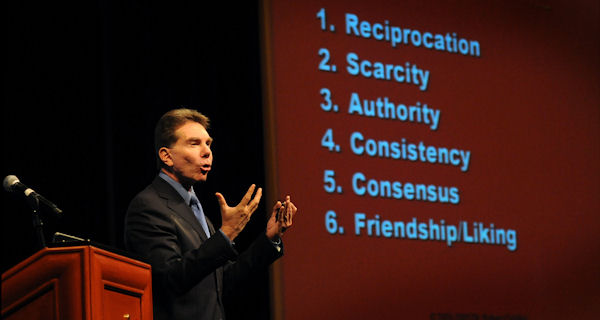
This is where the Robert Cialdini’s principles of influence come into the decision-making process. These principles describe psychological scenarios where it’s easier for us to say “Yes.” For example, the more you know and like someone the easier it is to say “yes” to them. In advertising we sometimes come to feel as if we know certain spokespeople in commercials. Progressive’s Flo character is a good example. The more people feel they know and like Flo the more likely they are to get a Progressive quote. This is the principle of liking.

The principle of reciprocity clearly shows you’re more likely to help someone who’s first helped you in some way or given you something. This is why you get “freebies” at the grocery store and in the mail. Those “freebies” make it more likely we’ll buy from the company that’s given those “gifts” to us.

In advertising another big way we’re influenced is through the principle of consensus. When we believe something is a best seller, that everyone else is buying the item, we become more likely to purchase it too. An example here would be touting a book that’s made the New York Times’ Best Seller list. Once we hear that single fact it legitimizes that the book is probably pretty good and worth buying. After all, can hundreds of thousands, or millions of readers all be wrong?

Spokespeople are sometimes used in advertising because they convey authority and we’re more likely to listen to so-called experts. If I tell you a certain golf ball added 20 yards to my drive would that be enough for you to buy the ball or do you think a golf pro like CoreyPavin telling people how great the new golf ball is would sell more? Most people would listen to Corey Pavin because he won the U.S. Open and has finished in the top five of the other three major golf championships during his career. This is the principle of authority in action.

Advertisers often tap into the principle of consistency to get us to buy. They tie the virtues of their product into what we’ve said or done in the past or relate the product’s attributes to our deeply held values. For example, most breadwinners want to provide for and protect their families. Advertising that shows how a particular life insurance product will allow a family to continue living in the lifestyle they’re accustomed to should the breadwinner pass away will sell more easily because it ties into the value of family protection.

And finally there’s the principle of scarcity. This principle of influence tells us people want things more when they’re becoming less available. This principle is probably most familiar to us because we see it continually when we’re hit with ads telling us “Sale Ends Sunday,” “While Supplies Last,” or “One Day Only!” This is also the reason gun sales skyrocketed after the Sandy Hook tragedy. People were afraid if they didn’t buy a gun now they might not be able to in the future.

If you take the time to watch Mad Men (season premier is April 7 on AMC) you’ll see the principles employed at every turn as they build out advertising campaigns for clients. Of course, all you need to do is pay attention to regular advertising that comes your way and you’ll see all the same principles at work. When you recognize them simply ask yourself if you’re making the best decision possible or if you’re only acting because of one piece of data at the expense of other, perhaps more relevant information. Do this and you’re sure to make better decisions over the long haul.


Brian, CMCT®
influencepeople 
Helping You Learn to Hear “Yes”.

A Call to Lay Down Your Weapons of Influence

In America there’s a debate raging and millions of people are lining up on opposite sides of the issue. The debate has to do with constitutional rights vs. public safety. You probably know I’m talking about the gun control issue that’s come to the forefront of national attention after the Sandy Hook tragedy last year. At the center of the debate is gun ownership and in particular assault weapons.

This post has to do with that debate because it’s about weapons. If you’ve read Robert Cialdini’s classic book, Influence Science and Practice, then you know it was born out of his curiosity about why he was such a “patsy” when it came to the “pitches of peddlers, fund-raisers, and operators of one sort or another.” He wrote, “I wanted to find out which psychological principles influenced the tendency to comply with a request.” Thinking of himself as someone who was taken advantage of more than he cared to admit, a few sentences later he characterized these psychological principles as “weapons of influence” because quite often they were used against defenseless people. I say defenseless because manipulators understood the principles but their targets of influence didn’t and that gave manipulators a huge advantage. Cialdini held to this viewpoint so much so that at the end of each chapter ideas are presented on how you can defend yourself against the manipulative use of these weapons of influence.

Nearly 30 years have passed since Influence first hit bookstores and times have changed when it comes to people’s views on influence and persuasion. After selling nearly 2.5 million copies, people have embraced the idea that the psychology of persuasion can be used in an ethical manner to create more win-win situations than ever before. People have embraced the concepts from Influence so much so that it was named the top sales and marketing book in The 100 Best Business Books of All Time.

Considering the change in attitude toward influence I’m writing today to ask people to banish the “weapons” terminology from their vocabulary when referring to the principles of influence.

Why now? As I scanned my Twitter feed one morning I saw a post that referred to one of the principles of influence as a weapon of influence. All of a sudden it didn’t sit well with me and as I analyzed it all the thoughts I’m sharing here came to mind. If I knew what was meant by “weapons of influence” and didn’t care for it I wondered how others might perceive the terminology.

First, the weapons terminology doesn’t conjure up positive thoughts, particularly during this time of tense, heated debate around the subject. If we truly believe small changes (i.e., using certain words at particular times in specific situations) can make a big difference – indeed that’s what influence is all about – then I argue “weapons” can’t be helping our cause when it comes to teaching people about the ethical use of influence. Consider the following:

If you didn’t know anything about influence how likely would you be to attend a workshop where you’d learn about using weapons of influence? Some people will go but I suspect many will subconsciously make an automatic decision not to consider the workshop.

How might your customer feel if they found out you were using weapons of influence on them? It’s not likely they’ll believe you’re using those weapons to defend them. Rather, I suspect they’ll feel you’re using those weapons against them in an effort to defeat them and get what you want.

We all know things can be used for good or bad. Guns in the hands of our military are good when they help defend our freedom. They’re not so good in the hands of bad guys. However, as I noted at the beginning, with the national debate raging, using weapons terminology will provoke the wrong images and emotions for too many people.

I prefer talking about ethical influence. When I teach I encourage people to look for principles that are genuinely available to the situation they find themselves in. If they look hard enough they’ll find some just waiting to be used.

Next you want to incorporate the principles into your request in a way that’s truthful. In other words, don’t tell people there’s a time limit – scarcity – if there’s not. Don’t tell people how “everyone” is using your product – consensus – when they’re not.

And finally, look for what Stephen Covey called “win-win” situations. Your product, your price, your idea, whatever you may be trying to persuade someone about will not be right for everyone. Sometimes honestly pointing that out will get you recommendations because people will trust you – authority!

In closing I ask you to join me and lay down your weapons of influence and in their place pick up the tools of ethical influence that build. I encourage you to start thinking of the principles of influence as tools that can help build relationships, overcome doubts and motivate people to action. Will it make a difference? I believe it will, because small changes can lead to big differences.

She Tricked Me into Marrying Her … Sort of

This week Jane and I celebrate our 25th
wedding anniversary. On March 12, 1988, we exchanged vows before friends,
family and God in the Waynesburg Presbyterian Church. I have to say, it doesn’t
seem like 25 years ago!

A funny thing happened on the way to the
alter; Jane tricked me into marrying her … sort of. Actually she employed a
principle of influence but I’m not totally sure if she knew what she was doing.
We met on our first day of work and started dating
a few weeks later. Within weeks of that, I was telling friends she might be
“the one.” Things went along smoothly until my ex-girlfriend called and that
threw me for a loop. A few months of indecision ensued and what made it extra
difficult was Jane and I still worked together and saw each other daily.
We’d stopped going out sometime in early April
and one day in late April I saw Jane in the break room and asked how she was
doing. She said she was doing fine and wouldn’t go out with me again even if I asked.
Less than two weeks later we were going out and I asked her to marry me on her
birthday.
When I used to tell the story I bragged as if
I was some kind of stud that she just couldn’t resist. While I was doing that
Jane was probably telling her friends, “All I had to tell him was I wouldn’t go
out with him again even if he asked…and he asked me to marry him!”
In case you’re not aware of what happened,
Jane used the principle of scarcity on me. This principle of persuasion tells
us people want things more when they’re less available. I bet every one of you
reading this can think of a time where you stopped going out with someone or
were considering it but when you learned they liked someone else everything
changed. All of a sudden you wanted them more than ever!

In my defense, I’d like to think part of the
reason she said “yes” was because I engaged a little reciprocity. I planned to
ask her to marry me on her birthday to throw her off my real intention. I gave
her a dozen roses at work then showed up at her apartment with another dozen
roses and a bottle of wine that evening. She thought it was all for her birthday. Next I
took her to dinner in a Silver Cloud Rolls Royce I’d rented, driver and all. On
the way home I popped the question in the back seat and gave her the ring. She
couldn’t say no after all I’d done…she owed me!

Something happened after I asked her to marry
me. All the uncertainty that plagued me for months left and it was no longer an
issue trying to decide between the ex and Jane. I can honestly say I never
looked back and wondered “what if?” Because I’d made an active, public
commitment, the principle of consistency was now at work on me.
In all truthfulness, each of us was a bungler
of persuasion and we were lucky in our application of some of the principles of
influence. We were also bunglers in marriage at such a young age but overcame
obstacles and have been in a really good place for a long time. Just as life is
easier when you understand and ethically apply persuasion, marriage is easier
when you learn and practice two things to the best of your ability.
  1. Cherish the other person because time goes by quickly (scarcity). 
  2. Put the other person’s well being above your own. When you do,
    most of the time they will respond in kind (reciprocity).

I’ll conclude with this since it’s my
anniversary. I’d like to tell all of you that Jane is incredible! The more time
passes and I watch her continue to grow and mature, the more amazed I am at
her. If God had let me put together the perfect spouse I wouldn’t have come up
with someone as wonderful as Jane. Part of the reason is I wouldn’t have been
creative enough and the other part would have been a lack of faith that there
would be someone so beautiful, kind, smart, funny and so many other amazing traits.
I’m a very blessed man!

Brian, CMCT® 
influencepeople 
Helping You Learn to Hear “Yes”.

Influencers from Around the World – Influence Yourself

This month’s Influencers from Around the World post comes from Yago de Marta. Yago has been a guest blogger at Influence PEOPLE for several years now. He’s from Spain but now spends the majority of his time in Latin America working with clients to help them speak more fluently and persuasively. To find out more about Yago visit YagoDeMarta.com or connect with him on Facebook, LinkedIn or Twitter. 

Brian, CMCT® 
influencepeople 
Helping You Learn to Hear “Yes”.

Influence Yourself

A lot of people ask themselves what they can or can’t do with influence techniques. I tell them that there are no set limits and that they can explore them in each sale or speech.
There will always be someone who will tell you what you can’t do. He will have his arguments but it doesn’t mean he has the reason. This article addresses this.
A year ago I was invited to give a speech in a very big auditorium in a city with about 1.5 million people in Latin America.  I have been in that country thousands of times but “each audience is different” and this city was “special.” When I entered in the auditorium I realized that it was too big and thought it would be difficult to fill the seats because the event hadn’t been publicized very much.
As people arrived they started taking places in the high part of the auditorium first. I was talking with the organizers (the mayor of the city and his team) and they were telling me that the people in their city were complicated and recommended I not make efforts to have them come closer. Apparently people in this city were not easy, a “tough crowd” you might say.
When almost everybody was in the hall, I was told to start my presentation and I realized that most of the people occupied the seats farthest from me. The mayor was about to introduce me to the audience and I asked him to ask people to get closer to the stage, so they’d be closer to me.
Then one of the strangest moments of my career happened. The mayor and his staff told me it was impossible to do this. He told me that he has been the mayor of this city for 20 years and that the people was too lazy to “move their asses” closer to hear me!
As you know, as you have heard and probably read a hundred times, you have to know your audience, your client. In this case, it was clear that the one that knew the audience was the mayor, not me. But, could it be limiting for my presentation?
I said to him, “Okay, no problem.  If there is no way to move them, I’ll solve it.”
The mayor introduced me, and gave me the microphone. I addressed the audience, “Good evening, it’s a great pleasure to be with all of you here today and I have something to confess to you; some minutes ago I asked your mayor if he could ask you to come closer to the stage to the front rows and fill the closest part of the auditorium. He answered me that it was impossible, that the people of this city are not likely to do that. Please, can you show him that he is mistaken?”
Suddenly, people all over the auditorium stood up and changed their seats to be closer to the stage.
That’s normal. When books talk about knowing the audience, they talk about knowing their ages, jobs, gender, but there is something easier and more powerful: you can know their motivations. You know their essence.
Maybe the mayor knew each person of his city, maybe he knew their names. But I knew why they were there.
It’s more important to believe in yourself than to believe in your audience. It’s more important to influence yourself than influence people.
You are learning and using many influence techniques and that’s what helps you accomplish whatever you want. But there is only one thing that you always have to remember – to know what people “really” want.
Yago de Marta
Speech & Media Training
www.yagodemarta.com
Méx. +52 1 (55) 59810879
Esp. +34 655 361 555
BBpin: 2A24B191
Skype: yagodemarta

Obamacare, Abortion, Gay Marriage and Christmas aren’t going away

This post is going to upset some people and

that’s okay because we’re all entitled to our opinion. What I’m going to share
is my opinion but it’s rooted in the psychology of persuasion.

Obamacare, abortion, gay marriage and
Christmas aren’t going away anytime soon. It seems as though each of these
cause intense debate because there are passionate people on both sides of each issue
– those for and those against.
Why do I believe neither Obamacare, abortion nor
gay marriage will go away? In a word; scarcity. This principle of influence
tells us people value things more when they are rare or going away. It’s the
reason we react so strongly when we think we’re going to lose something.
Think back to childhood when you got that long
awaited privilege; to eat dinner in front of the television! You begged and
begged, for what seemed to be a lifetime, to get this golden opportunity. Then
one day your mom or dad caved but assured you it was a one-time thing. And
what happened the next day? You asked again but this time heard, “No.” You
protested, “But you let me yesterday!” Arguments became commonplace and I’m
willing to bet as time went by you ate in front of the TV more and more.
Parents are usually hesitant to extend privileges
like dinner in front of the TV, staying up later on school nights or getting
candy at the store because they know its inevitable there will be arguments
down the road. Once we have something we don’t want to give it up and I believe
the same principle will dictate people not wanting to give up these “rights.”
Women have enjoyed freedom of choice for
several decades; tens of millions will
enjoy access to health care with the passage of Obamacare; and more and more
people are heading to states where they can legally marry their same sex
partner. If the government tries to take away any of these rights/freedoms I
think there would be violent protest because it all goes back to scarcity, the fear of
loss. As hard as people worked and as vocal as they may have been to gain these
rights they’ll work even harder and be more vocal in their attempts to stop any
legislation that might repeal them.
How does this apply to Christmas? Every year
in December we hear people talking about “the war on Christmas.” Let me state
emphatically, there’s no “war.” Go ask a veteran who’s seen combat if the
debate over Christmas is anything like war and they’ll set you straight. There
are however, many people who want to limit or do away with Christmas for a
variety of reasons.
I believe Christmas will be around for a long
time too because so many people want to keep it. It’s the same psychology that
applies to Obamacare, abortion and gay marriage, and it will propel people to
fight hard to keep their Christmas traditions.
Another reason I think Christmas as we know it
will survive is because the other side isn’t fighting to gain something,
they’re only seeking to prevent people from tying in Christ to Christmas and
thus making it a religious observance.
As I noted earlier, people will work much
harder to keep what they have than they will to gain the very same thing.
Studies show the average person will work about twice as hard to keep the same thing,
as they will to gain the very same thing.
How does this apply to you? Understand
whenever you seek to take something from another person or limit them in any
way it’s very likely you’ll be met with resistance because that’s human nature.
So before you extend something – eating in front of the television, a new
compensation plan, an offer to help – make sure you’re willing to deal with
some rough consequences if you decide to change your mind because whomever
you’re dealing with will feel the pull of scarcity and react accordingly.


Brian, CMCT®
influencepeople 
Helping You Learn to Hear “Yes”.

A Call to Lay Down Your Weapons of Influence

In America there’s a debate raging and millions of people are lining up on opposite sides of the issue. The debate has to do with constitutional rights vs. public safety. You probably know I’m talking about the gun control issue that’s come to the forefront of national attention after the Sandy Hook tragedy last year. At the center of the debate is gun ownership and in particular assault weapons.

This post has to do with that debate because it’s about weapons. If you’ve read Robert Cialdini’s classic book, Influence Science and Practice, then you know it was born out of his curiosity about why he was such a “patsy” when it came to the “pitches of peddlers, fund-raisers, and operators of one sort or another.” He wrote, “I wanted to find out which psychological principles influenced the tendency to comply with a request.” Thinking of himself as someone who was taken advantage of more than he cared to admit, a few sentences later he characterized these psychological principles as “weapons of influence” because quite often they were used against defenseless people. I say defenseless because manipulators understood the principles but their targets of influence didn’t and that gave manipulators a huge advantage. Cialdini held to this viewpoint so much so that at the end of each chapter ideas are presented on how you can defend yourself against the manipulative use of these weapons of influence.

Nearly 30 years have passed since Influence first hit bookstores and times have changed when it comes to people’s views on influence and persuasion. After selling nearly 2.5 million copies, people have embraced the idea that the psychology of persuasion can be used in an ethical manner to create more win-win situations than ever before. People have embraced the concepts from Influence so much so that it was named the top sales and marketing book in The 100 Best Business Books of All Time.

Considering the change in attitude toward influence I’m writing today to ask people to banish the “weapons” terminology from their vocabulary when referring to the principles of influence.

Why now? As I scanned my Twitter feed one morning I saw a post that referred to one of the principles of influence as a weapon of influence. All of a sudden it didn’t sit well with me and as I analyzed it all the thoughts I’m sharing here came to mind. If I knew what was meant by “weapons of influence” and didn’t care for it I wondered how others might perceive the terminology.

First, the weapons terminology doesn’t conjure up positive thoughts, particularly during this time of tense, heated debate around the subject. If we truly believe small changes (i.e., using certain words at particular times in specific situations) can make a big difference – indeed that’s what influence is all about – then I argue “weapons” can’t be helping our cause when it comes to teaching people about the ethical use of influence. Consider the following:

If you didn’t know anything about influence how likely would you be to attend a workshop where you’d learn about using weapons of influence? Some people will go but I suspect many will subconsciously make an automatic decision not to consider the workshop.

How might your customer feel if they found out you were using weapons of influence on them? It’s not likely they’ll believe you’re using those weapons to defend them. Rather, I suspect they’ll feel you’re using those weapons against them in an effort to defeat them and get what you want.

We all know things can be used for good or bad. Guns in the hands of our military are good when they help defend our freedom. They’re not so good in the hands of bad guys. However, as I noted at the beginning, with the national debate raging, using weapons terminology will provoke the wrong images and emotions for too many people.

I prefer talking about ethical influence. When I teach I encourage people to look for principles that are genuinely available to the situation they find themselves in. If they look hard enough they’ll find some just waiting to be used.

Next you want to incorporate the principles into your request in a way that’s truthful. In other words, don’t tell people there’s a time limit – scarcity – if there’s not. Don’t tell people how “everyone” is using your product – consensus – when they’re not.

And finally, look for what Stephen Covey called “win-win” situations. Your product, your price, your idea, whatever you may be trying to persuade someone about will not be right for everyone. Sometimes honestly pointing that out will get you recommendations because people will trust you – authority!

In closing I ask you to join me and lay down your weapons of influence and in their place pick up the tools of ethical influence that build. I encourage you to start thinking of the principles of influence as tools that can help build relationships, overcome doubts and motivate people to action. Will it make a difference? I believe it will, because small changes can lead to big differences.

Brian, CMCT®
influencepeople
Helping You Learn to Hear “Yes”.

Good Advice or Not – Expect the Worst and You’ll Never be Disappointed?


Last year I traveled a lot and this year I have even more scheduled. Fortunately I enjoy it so it’s not a burden. I knew I must have been on the road a good bit last year, though, because each time I saw co-workers or friends they’d make comments like “world traveler” or “where have you been lately?” During my travels something happened that caught my ear and I thought it would make for a good blog post.
When I travel I park at the Thrifty lot at Port Columbus. It’s really nice because I pull up, someone gets in my car then I drive right up to the terminal and they go park the car for me. When I return my car is waiting for me with the engine on, A/C or heat blasting, and the bill is prepaid. Pretty nice!
As I was driving to the terminal for one of my trips I was making small talk with the Thrifty valet and the subject turned to the weather. He made a comment about bad weather and I corrected him saying I’d heard it was supposed to be nice. He replied, “I’ll expect the worst then I won’t be disappointed if it happens and I’ll be happy if it doesn’t.”
I often talk about the contrast phenomenon which tells us how we experience something is dramatically impacted by what we experience beforehand. For example, if I know you need some money and I offer you $100 then tell you I was kidding and give you $10 you’re probably a little bummed. However, if I say I only have a dollar on me but then come up with $10, which I give you, you’re probably pretty happy. The same $10 gets two completely different responses because of what happened moments before in the expectation I created.
Essentially the valet was employing a self-defense mechanism. He didn’t want to be disappointed if the good weather failed to materialize. In his mind, by expecting the worst he wouldn’t feel so down if bad weather did come about but he also thought he’d enjoy the nice weather even more if it proved to come true.
I’m sure in his mind he felt he’d win either way. If that’s the case then why not view all situations that way? On the surface that makes some sense but what I’ve noticed with people who view events in life like that, they also tend to look for the negative in most things and that negative outlook influences many other things. Here are a few examples:

You want to win the big game badly but to keep disappointment at bay you tell yourself you probably won’t win. How likely are you to succeed? Not very likely because that sounds like a self-fulfilling prophecy for failure.

Do you think people like to be around someone who always throws a wet towel on the possibilities? No, so you might end up with very few close friends.

You see someone you’d like to meet but think, “They’d never go for someone like me.” How much nerve will you work up to go talk to that person with that thought process? Probably none.

It may be the case with things that are outside your control that it’s wise to occasionally consider the downside and be realistic about it. However, in general you’ll probably be a much happier and likable person if you choose to look on the bright side. And I’d say you’ll enjoy more opportunities with a positive attitude because there will be many things you never attempt and many more failures with a negative attitude. Teddy Roosevelt said it best when he shared with the world:
“It is not the critic who counts; not the man who points out how the strong man stumbles, or where the doer of deeds could have done them better. The credit belongs to the man who is actually in the arena, whose face is marred by dust and sweat and blood; who strives valiantly; who errs, who comes short again and again, because there is no effort without error and shortcoming; but who does actually strive to do the deeds; who knows great enthusiasms, the great devotions; who spends himself in a worthy cause; who at the best knows in the end the triumph of high achievement, and who at the worst, if he fails, at least fails while daring greatly, so that his place shall never be with those cold and timid souls who neither know victory nor defeat.”
I’ll close with this persuasion advice – stay positive my friends.
Brian, CMCT®
influencepeople 
Helping You Learn to Hear “Yes”.

Don’t take it Personal. It’s Just Business.

“Taken” is a movie that tells the story of a
young girl who goes to Europe with a friend and is kidnapped. She’s sold into
the sex slave trade but fortunately for her, and unfortunately for the bad guys,
her father, played by Liam Neeson, is a badass ex-CIA type who is used to
solving problems in a ruthless way.

I’ll never forget Jane and I watching “Taken”
in the theater just days before we were about to put Abigail on an airplane to
see her Aunt Eva in New York City. Not the most comforting feeling to know there are
sick people out there ready to prey on the innocent and unsuspecting as you’re
about to send your 13-year-old daughter on her first solo trip!
As Neeson closes in on finding his daughter,
he finds himself at the party of a very rich businessman. The businessman has a
secret; despite being a father he is running a sex slave trade where people are
paying hundreds of thousands of dollars for young women. Neeson learns that his
daughter is at this house and is about to rid the world of this thug and just
before he does so there is a brief exchange:
Bad Guy – “Please understand it was all
business. It wasn’t personal.” [Hoping to be spared]
Liam Neeson – “It was all personal to me.”
[Shoots him]
For those of us in business, while not enduring
the kind of situation Neeson found himself in, we’ve probably heard something
similar countless times from much nicer people – “Don’t take it personal, it’s
just business.”

But the reality is this; we do take it personally.
Think about how people describe themselves so often:I’m a fireman.

I’m a salesman.
I’m a nurse.
I’m a …
Much of our being is wrapped up in what we do,
“I am.” That’s only natural because from about age 20 through 65, many people
will work upwards of 100,000 hours! We spend more of our lives at work than
with our loved ones so how can we not heavily associate our identity with what
we do? If that’s the case then it’s almost impossible not to take it personally.
So how do we avoid taking it personally? By
building relationships that are so strong they can trump almost all other
reasons to do business with us. Jeffrey Gitomer, a well-known author and sales
trainer puts it this way: “All things being equal, people want to do business
with their friends. All things being not so equal, people still want to do
business with their friends.”
Gitomer’s philosophy goes to what Robert
Cialdini calls the liking principle. This principle of influence reminds us that
people prefer to say, “Yes” to those they know and like. It’s a very powerful
tool when it comes to influence.
I’m a realist and know friendship won’t trump
everything. There’s a certain price for which people will switch. How big that
difference is depends on a lot. However, I bet many of you reading this can
think of times you’ve chosen to do business with someone despite their pricing
being higher because of the friendship you have.
Here’s some proof in case you’re a skeptic. A
study was done with students from Stanford University and Northwestern. The
students were given the task of negotiating a deal. Half of the students were
told to “keep it strictly business” while the other half were encouraged to get
to know their negotiating partner; exchange pictures, emails, etc.
Did getting personal make a difference? It
most certainly did! Five times more “strictly business” students got deadlocked
in their negotiations as compared to the “get to know your partner group.” That’s
right, five times more (30% vs. 6%). Would it be beneficial for your business
if you could seal the deal significantly more than you’re currently
doing…without having to spend more money? All it takes is a bit of effort and
conversation to do these two things:
  1. Take time to find similarities with people you
    do business with. Talking about what you have in common is an easy way to bond
    with another person.
  2. Look for things about the other person you can
    genuinely compliment and then compliment them. They’ll feel good about you and
    you’ll convince yourself they’re a pretty good person in the process.
Fortunately we don’t have to try solving our
business problems like Liam Neeson had to. Give these two simple ideas a try
and you’ll build better relationships — the kind that will make, “Don’t take
it personal, it’s just business,” a thing of the past.

Brian, CMCT®
influencepeople 
Helping You Learn to Hear “Yes”.