Tag Archive for: liking

An Interesting Thing Happened on the Way to Work…

An interesting thing happened on the way to work a few weeks ago. Highways running through downtown Columbus are undergoing major reconstruction so traffic patterns have changed, lanes are restricted and many familiar exits are closed. It makes for a much more tense morning drive than normal.

As I was getting close to my exit I saw a large red truck coming up the left hand lane and it was apparent the driver was going to drive up as far as possible before cutting over to the right a couple of lanes to make the exit. I have no patience for people who continually barge ahead to save a few minutes at the expense of the rest of us who patiently and safely wait our turn. I was fairly close to the truck and my thought was, “He’s not getting in front of me.”
When it came time for him to make his move he did exactly what I thought he’d do. And what did I do? I let him in … and felt okay about it despite my initial angst. This all happened because a principle of influence suddenly made me react differently than I expected to.
The red truck had a Semper Fi sticker on the back and some other Marine stickers so it was apparent the driver served in the military at one time. I was not a Marine but my dad was, having served in Vietnam in the mid-60s. Also, my neighbor Dan, whom I’ve known since he was about three years old, is a Marine who did a tour in Afghanistan not too long ago. And to top it all off, my daughter Abigail loves the Marines because her grandpa served and Dan is like a big brother to her.
All of this ran through my mind in an instant and suddenly I found my attitude and intended behavior toward the other driver changed. It all had to do with the principle of liking. This principle tells us people prefer to say “Yes” to those they know and like. Oftentimes liking is initiated through something as simple as finding similarity with another person. While I wasn’t a Marine, as noted above, I have a special place for them in my heart. When I meet someone who is or was a Marine I always tell them I’m the son of a Marine. So you can see there’s a common bond there.
This shows us just how powerful liking is because I already shared I didn’t appreciate his driving behavior. Quite often the principles of influence override our logical thinking and change our behavior. When I explain this to people sometimes they resist the idea that something outside their conscious compelled them to do something. We want to believe we’re fully in control of our decision making and actions but in reality we’re not. Dan Ariely, author of Predictably Irrational and more recently The Honest Truth about Dishonesty, explores in detail how we’re not logical beings and he shares many experiments in his books to back up that claim.
In Robert Cialdini’s best selling book, Influence Science and Practice, he points out several studies that show the influence liking has on sales. For example, when it comes to Tupperware sales, the social bond (i.e., liking) has twice as much impact on the decision to purchase than does the actual product preference. When it comes to insurance sales Cialdini wrote, “One researcher who examined the sale records of insurance companies found that customers were more likely to buy insurance when a salesperson was like them in age, religion, politics, and cigarette-smoking habits.” In each case, Tupperware or insurance, I’m certain a good number of people buying would adamantly deny the influence of liking but it’s hard to explain away the results.
I’m not going to encourage you to put bumper stickers on your car to let the world know your likes, dislikes and associations. Instead take this simple advice; when you get ready to meet someone, do a little homework to get to know them beforehand. When you learn you have things in common make sure you raise them to the surface early in the conversation because you never know, you may spot something like I did with the Marine and that might make all the difference between them saying “Yes” instead of “No.”

Brian, CMCT
influencepeople 
Helping You Learn to Hear “Yes”.

5 Pointers to Become Listening STARS

Over the last few years I’ve conducted quite a few workshops on different sales skills. The workshops are designed to get people to practice the various skills they learn in our online training environment. One of my workshops focuses on active listening skills. In this post I’ll share five pointers from that workshop to help you become listening “STARS.”

What I’ll share are not principles of influence but they impact influence because if you’re not a good listener then your best attempts at persuasion will probably fail. Listening is
important because it helps you learn about the other person, hone in on similarities, and build on the liking principle. Listening is also vital when it comes to the principle of consistency because only when you hear someone can you tap back into their words and ethically engage consistency.

Listening is an active skill so you need to do several things if you want to excel. Unlike some skills, listening skills are all things you can do. For example, I often tell workshop attendees I can’t dunk a basketball. Never could and it’s not likely at 48 years old, standing just 5’9 tall, that I ever will. It’s a skill I don’t possess and can’t acquire no matter how hard I work at it. If someone told me my career depended on dunking a basketball I’d start looking for a new career. But not so with listening skills! Each of the five pointers I’ll share is within your capabilities if you’ll
simply make the choice to employ them.

To be listening STARS, you need to remember Stop, Tone, Ask, Restate and Scribble. We’ll take a brief look at each of these.

Stop – First thing you need to do when communicating with another person is stop everything else you’re doing so you can give them your full attention. People who think they can multi-task are fooling themselves. Scientific studies show people who try to multi-task end up taking longer to do both tasks and are more prone to errors. My own personal experiment, which I’ll share at the end of this article, verifies this.
Tone – A person’s tone of voice is important for a couple of reasons. First, it indicates mood. You can usually tell by the tone of voice whether someone is happy, sad, angry, stressed, relaxed, etc. The other reason tone is important is because it gives more meaning to the communication. For example, the sentence, “I can’t believe you did that,” can mean many different things depending on the word or words the speaker emphasizes.
Ask – Make sure you ask good questions. This helps clarify the message the other person is trying to deliver. It’s also a great way for you to find out things you think are relevant to the discussion, even if the other person doesn’t think they’re important.
Restate – It’s not enough to think you know, or think you understand what the other person said; you need to verify you’re on the same page. Restating what you think you heard, and then putting the message in your own words is a quick, easy way to make sure you fully understand the message as it was intended.
Scribble – Take notes. Remember, note taking isn’t to write a novel, it’s to capture key points and key words to jar your memory as you recall the conversation. Too often I see people take the focus off of the speaker because they get so intent on writing as much as they can but in the end they miss a lot because this is a form of multi-tasking.
Let me share this about multi-tasking. During the listening workshops I read a short, one-page story to each class. As I read I have one-third of the class just sit back and listen, another one-third takes notes, and the rest of the people are distracted as they try to connect scrambled numbers from 1 to 72 while listening to the story. After I finish I give a 10 question quiz to everyone. Having done this with nearly 200 people what I found was those who took notes got about 60% more questions correct than the distracted group who were busy connecting numbers while trying to listen. Those who just sat back and actively listened got nearly 75% more questions right than the distracted group. Wow!
Two learning points come out of this exercise. First, as mentioned above, if you take notes, be brief so it doesn’t become a distraction. Second, and more importantly, stop whatever you’re
doing and give your full attention to the person speaking. That means put away your cell phone when you’re in a meeting or conference. You can say all you want that you can do both but you will miss more of the message because odds are, you’re probably not the statistical anomaly who breaks the mold.
So let me ask this – what would it do for you if you caught 60% to 70% more of a prospect or customer’s message than your competitors? I’d imagine it would do a lot for sales and service. To wrap things up, if you want to be master persuaders then make sure you’re listening STARS. Make the choice to follow the five simple steps I’ve outlined above and you’ll be on the path to becoming a much better listener.

Brian, CMCT
influencepeople 
Helping You Learn to Hear “Yes”.

Why Selling Still Matters

It’s 5:30 a.m. and I’m already fired up! No, it’s not the three cups of Starbucks or the fact that my workout is done that has me going, it’s an article I just read, To Increase Revenue Stop Selling. The article opens with, “Creating or expanding business relationships is not about selling – it’s about establishing trust, rapport, and value creation without selling.”

I don’t disagree with the need to establish trust and rapport. When I teach persuasion workshops we focus quite a bit on two principles that address these. Robert Cialdini’s principle of authority stresses the need for trust and expertise. After all, would you want to deal with an expert you can’t trust? Of course not.

When it comes to rapport, that is facilitated by the liking principle. As Jeffery Gitomer says, “All things being equal, people want to do business with their friends. All things not being so equal, people still want to do business with their friends.” Friendship and likability are huge! We’ll see how important likability is in the upcoming election because I can’t think of a time when the more likable candidate didn’t win the presidency.

So I’m onboard with the need to be a trusted and well liked advisor but that’s not nearly enough. I’ll give a perfect example. Many years ago at my company we had a large project under way working with an outside consulting firm in an effort to stimulate more sales growth. We were highly profitable but sales lagged compared to our peer group competitors. The consultants met with our agents face-to-face, conducted phone interviews and administered an online survey. Our survey participation was off the charts and one of the consultants said, “We’ve never worked with a company where the client has had so much affection for the company. Your agents love you.” Did you catch that – affection and love?
We were a trusted advisor with excellent relationships and sales stunk. I said to one consultant, “We’re like the girl everybody likes but no one asks to the dance.” Trust and likability were not translating into sales.
I’m not sure how the author missed this point but value creation is selling. He wrote, “It’s time for companies to realize that consumers have become very savvy and very demanding.
Today’s consumer (B2B or B2C) does their homework, is well informed, and buys…they are not sold.” I have no disagreement with people hating to be sold but loving to buy. That said, however, today’s consumers are not as sophisticated as people think. Sure, they go online and “research” but you know what most of that amounts to? Price shopping.
Consider this; when telephones and the Yellow Pages were the norm, don’t you think there were people writing articles about how sophisticated consumers had become because they could call around and find out about products with ease? You bet there were!   What I’ve seen for more than 25 years in the insurance industry is people calling around to get the cheapest price the vast majority of the time. And so it is today when people “research” online. The majority are simply looking for the lowest price.
Value creation is about sharing why the price you’re asking is worth it. According to Brian Tracy, author of Advanced Selling Strategies, “Selling is the process of persuading a person that your product or service is of greater value to him than the price you’re asking for it.”
And here’s another interesting point that Steve Jobs showed us – sometimes people don’t know what they want or need. None of us had a clue about the iPod, iPhone or iPad until Jobs created them. Selling sometimes entails pointing out things the consumer might not have thought of. A good salesperson can fall back on the experience of other clients to point out features and benefits the prospective customer might not have considered.
The older I get the more I appreciate the basics. We don’t need grapefruit or Hollywood diets to lose weight, we just need to eat sensibly from the four food groups. We don’t need Madonna or Sylvester Stallone’s latest workouts to be fit; just get to the gym consistently and do some cardio work while you’re there. And we certainly don’t need the latest 10 step sales process that’s guaranteed to make sales skyrocket. Salespeople need to do the basics well – listen more than you talk, ask good questions to uncover needs, care about your client personally and professionally, know your products – how they differ from the competition and how they can help your client, understand how to ethically persuade, and don’t be afraid to ask for the sale.
Do people want to be sold? No. Do they want to work with people they trust and like? Absolutely. Can you get away without selling? Give it a try and soon you’ll be looking for a new career.
Brian, CMCT
influencepeople 
Helping You
Learn to Hear “Yes”.

Maximizer or Satisficer: Does it Make a Difference?

Remember when mom, dad, or maybe grandpa would espouse their philosophy about people, starting with something like this, “Ya know, there are two kinds of people in this world…” and then they’d give you their broad take on the human race? I’m here to add another grouping of two to the human race: maximizers and satisficers.

In the book “Welcome to Your Brain,” the
authors describe maximizers as people who “spend a lot of time worrying about differences, no matter how small. In a consumer society with choices everywhere, maximizers suffer from an inability to recognize when an alternative is good enough. Indeed, from an economic perspective, spending the additional time on maximization doesn’t make sense since your time itself has some monetary value.”
On the opposite end of the spectrum we have satisficers who are described as individuals who “look until they find something good enough, then stop. Satisficers are decisive, don’t look back, and have little regret, even about mistakes.”
So what does this have to persuasion? Plenty, because in an information overloaded society in which some experts estimate the average person sees more than 3,000 marketing messages a day we cannot possibly process all the information that comes to us through our five senses. And put on top of that the fact that so
much can change in a single day, sometimes it’s all we can do to not just cover our ears, close our eyes and start screaming.
For example; I can’t process all the features of all the smart phones and balance them with all the pricing options while weighing all the new features and options I hear might come out in the next few months. TMI – too much information! Therefore, if I’m like most people I will “satisfice.” Satisficing refers to “the act of choosing an alternative that is just sufficient to satisfy a goal.” I do it, I bet you do it and so do most other people.
Dr. Cialdini’s six principles of influence act as mental short cuts, decision triggers if you will, in an information overloaded society because they help us quickly process information in a way that allows us to make a quicker decisions that we’re satisfied with. Here are some quick examples related to buying a smart phone.
Liking – A good friend of yours owns the phone you’re considering and has nothing but good things to say. He encourages you to buy the same phone and you trust his opinion because you have the same tastes in a lot of things.
Reciprocity – When you were comparing phones and asking questions the store clerk spent a lot of time with you. You’d feel kind of bad not buying from him after he did all that for you.
Authority – You read Consumer Reports and it rated one phone you’re considering highest in three of four categories. The magazine is the most reputable, unbiased source you know.
Consensus – Everyone has the brand you’re looking at and people are raving about it. They can’t all be wrong.
Consistency – When you told the salesperson the general features you were looking for she pointed you to a phone that had almost every single one. How can you not buy it after you
said that’s what you wanted in a phone?
Scarcity – You’re shown a phone and told a newer model is coming out in a few months. Now you worry because you might not be able to get this one at the low price because everyone else will buy them up while it’s still a great deal.
As noted earlier, most people engage in satisficing but that still leaves the maximizers so how do we deal with them? Maximizers by nature are probably more analytical so my advice would be to concentrate on these principles of influence:
Authority – Let them know what the experts are saying and show them hard data because this appeals to their strength – logic.
Consistency – Get them to tell you in detail what they want. The more detail the better because if you can show them how your offering matches up then it’s only logical for the deep thinker to go with your request.
Scarcity – No one likes to lose so show them their lost dollars, time, and opportunity by not going with your recommendation relatively soon. Remind them that new features and upgrades will always come out but they’re losing the opportunity to enjoy your product in the meantime.
So whether your mom, dad, or grandpa were right about their two tier classification systems, science tells us there’s at least one other category, maximizers and satisficers. It would do you well to not only understand which category you fall into but which category those you’re trying to persuade fall into because it will make the persuasion process much easier.
Brian, CMCT 
influencepeople 
Helping You Learn to Hear
“Yes”.

A Positive Mental Attitude is an Essential Persuasion Tool

If you follow me on Facebook then you know I broke my right ankle back in March when I stepped on my wife’s boot heel the morning after our 24th anniversary celebration. When this all happened I passed out so Jane called an ambulance and I was subjected to 12 hours of tests and waiting (more waiting than tests) in the emergency room. I was there so long because doctors were concerned with my unusually low heart rate coupled with the passing out incident. I could go on and on but you get the picture; not exactly a great way to start the 25th year of marriage. Did I mention I was in a walking boot for six weeks?

On the surface that sounds like a bummer and I won’t lie, I wish it hadn’t happened. If not for the broken ankle I could have done two activities I enjoy dearly – driving my car and running. I also wouldn’t have inconvenienced some people because I needed rides to and from work. And let’s not forget all the money I would have saved.
Having taught classes on maintaining a positive mental attitude – and knowing I was going to have to teach that very same class in the walking boot – I had to practice what I preach. So how does one find the positive in all this?
Let’s start with my trip to the emergency room. When a resident asked what happened, I told her, “I did something different this morning. Normally I leave the lights off so I don’t wake up my wife but since she was already awake I turned on the light. I think I passed out when I saw her beauty so early in the morning.” She chuckled and Jane just rolled her eyes.
I didn’t get upset when a nurse mistakenly told us I was scheduled to have a pacemaker put in at noon. Jane on the other hand started to freak out thinking I was going to meet God before she did.
Knowing there would be some hefty hospital bills, Jane was feeling bad that this all started with her boot. My attitude – we can’t change it, we don’t know what we’ll be charged so why worry about it? There’s never any sense in worrying about things you have no control over so why let them get you down?

I’ve tried to have fun with it as I tell the story. People expect to hear something manly like breaking it while running or at taekwondo. Nope, nothing manly about stepping on your wife’s boot heel at four in the morning. But I usually have them laughing when I end the story with this line, “Better that she broke my ankle than my heart.”
The rides to work were fun because Cobi Dorn and Terra Boroff are such nice people and they both have a great sense of humor. They had to in order to put up with me, my ego and all the bad jokes I tell. Being the astute observer of human behavior that I am, I think they enjoyed having me  around … at least in small doses.
My spring break trip to Chicago with Abigail was more memorable in the walking boot and airport security wasn’t as big a hassle as you might think.
Perhaps my favorite pastime during all of this was watching Jane cut the grass while I drank beer sitting on the deck with my feet up. In fact, it was such a good time I made sure to preserve it with some photos and Facebook updates. Jane’s guilt has passed and she reminds during those times that she can also break my other ankle.
And one more thing – and this almost makes it all worth it – was a dinner with insurance agents that Jane came to because I needed a ride home. For those of you who have been married for any length of time you might be able to relate. When she picked me up for dinner she looked like a million bucks in a slinky black dress! It was one of those times you stare at your spouse, and even after all those years, feel the same way you did when you first met them. It was a good night!
So why am I sharing all of this in a blog on influence? The principle of liking tells us we like people who like us. There’s nothing worse than being around someone who is cranky and negative most or all of the time. A lot of people would have responded that way causing others to avoid them. I chose a different path and I hope people found it funny and entertaining. I think it make me more likable and people enjoyed being around me.
Each of you has a choice to make when seemingly bad things come your way. You can choose to look for the good or find ways to manufacture some good. If you do so you’ll probably be a little happier for it and those who are around you will benefit as well. And in the midst of it all, if you need a favor, help or have to make some other request, the odds that you’ll hear “Yes” will be dramatically better than if you do nothing but complain.

If you’re viewing this by email and want to listen to the audio version click here. If you want to leave a comment click here

Brian, CMCT 
influencepeople 
Helping You Learn to Hear
“Yes”.

Influencers from Around the World – The Communicative Feature of Your Favorite Teacher

This month’s Influencers from Around the World post comes from Yago de Marta. Yago has been a guest blogger at Influence PEOPLE for several years now. He hails from Spain where he works with clients helping them speak more fluently and persuasively. To learn more about Yago visit YagoDeMarta.com or connect with him on Facebook, LinkedIn and Twitter. 

Brian, CMCT 
influencepeople 
Helping You Learn to Hear “Yes”.

The Communicative Feature of Your Favorite Teacher

We all remember a teacher who made us love a subject in grade school, high school, or perhaps college. We all remember the teacher who helped us love literature, history, mathematics, or some other subject for which we had no passion to start.
That teacher seemed to get better performance from all of their students. He didn’t come to our home to study with us but nonetheless, he inspired us, and helped us find interest for a particular subject. In short, that teacher influenced us.
Even in the case of many poor students, most also had a
great teacher somewhere along the way. These students had no interest in school or anything related to school; they didn’t enjoy studying, but they found “something” in that one teacher that motivated them to sit down, take notes and study.
As it is a “universal” example of influence, 13 years ago I began to ask this question in my training clinics: What feature did your teachers have that made you love a subject in high school or college?
Pause to think about that for just a minute. Remember back
to your favorite teacher. See him talking to you, notice how he moved and what he did. Remember how that made you feel, how you began your relationship with that subject. Well, you’ve done it! I bet one of the features that came to mind is listed below:

A. He was explanatory

B. He made you participate

C. He knew his subject

D. He cared for you (the class)

E. He loved what he shared (the subject)

For the record, I bet most who read this article chose
option E and perhaps one of the other answers.
The point is we all know that one teacher influenced us in an ethical and positive way. We also know that the five characteristics noted above were decisive in our experience. But how are they related to the Principles of Influence?

He was explanatory – On the one hand, to be explanatory
implies a difference from the traditional teacher who was merely descriptive. So “to explain” implies effort, which implies an interest in the person – the student – to make sure he or she understands what is being shared during class. When the student understands that gives meaning to the class and that’s a comforting feeling. Thus, we find Liking. Striving to explain something involves approaching the figure of the student, and that is translated into a form of mutual identification.
Likewise, when the student feels he understands
something, some of the barriers he had about not study are demolished. In short, he is now open to learn more. This is an example of Commitment and Consistency which the teacher can draw on to further the learning.
Finally, when the teacher strives to explain the subject,
strives to approach the students, this creates an obligation to respond which taps into Reciprocity. So the more explanatory is the teacher, the better results are obtained.
He made you participate in the class – The student feels
important when he feels he is part of what’s going on. This feeling is comforting only if the teacher knows to balance the fears or nerves the student may have. However, in general terms the student will always feel positive when involved with peers. The student perceives the other’s participation and Consensus – going along with the crowd – makes him want to participate as well. This process increases the degree of student involvement with the subject so he feels more “compelled” to study after class. While making the class more horizontal, the teacher is placed on the same level as the student, a form of identification, and liking is increased.
He knows a lot – This is obviously Authority. We see that
element is very important because the above items, with the great presence of Liking, need to be balanced. In this sense, the students value the use of anecdotes and examples unknown. On the other side “to know much” is a point of reference for students. It becomes a reference image that can be pursued to improve, and it becomes an element of inspiration.
He loved what he talked about – As I noted earlier, this is the most important point of all. This is what makes all the other points possible. To love your subject means you have passion and that passion is contagious, motivating people to listen. It also makes learning more fun. It is the perfect combination of liking and authority. As others get involved because of that passion which makes it easier for those on the fringes – consensus – to join in and feel a part of what’s taking place.
We all know the influence a teacher can have because we have all felt that force. The key is that we should make people feel those same things as we meet them in our everyday life. And that can influence them to change and improve.

Yago

If you’re viewing this by email and want to leave a comment click here.

How We Deal with Information Overload

We’re in the dead of winter in Columbus, Ohio, and that means each morning as I make my way into work, it’s pitch black outside. As I drove to work recently, traffic was heavy and moving slowly so I had time to reflect. As I looked around I was struck by how much there is to see but which goes unnoticed when I’m driving closer to the speed limit.

During the drive I paid particular attention to the buildings and myriad of lights. The lights were easily distinguished from the car lights as were buildings from the trees and many other objects. Having worked for State Auto Insurance for more than 20 years, I’ve conservatively made the same drive about 4,000 times and yet, on this day, I noticed certain things for the first time.
In the midst of all this my mind wandered to persuasion and how the principles of influence work on people. Just like my brain doesn’t need to process certain input – many objects in the distance – when making the drive, neither do our minds process all the information that comes our way each day. Here’s an interesting quote that tells us just how bombarded we are:

“This year, the average consumer will see or hear 1 million marketing messages – that’s almost 3,000 per day. No human being can pay attention to 3,000 messages every day.” Fast Company – Permission Marketing by William C. Taylor

You might be thinking “Wow!” right about now, so I’ll wow you even more. That quote is now 14 years old! Imagine how much more marketing material comes your way though the proliferation of the Internet, Facebook, and smart phones. There’s no way you can process it all and that’s why Martin Lindstrom, author of Buyology, asserts that 85% of what you do every day is processed by your subconscious.
Because we cannot process all the information that comes in through our senses, our brains develop shortcuts to help us manage. The principles of influence tap into this subconscious processing quite often. While there are certainly times when they lead to mistakes and other times where manipulative people use them to take advantage of us, more often than not they lead to good decisions and that’s why we come to rely on them so heavily. Below are
some examples of the principles at work in your decision making.
1. When your neighbor gets his house painted and you think it looks nice you’re probably very willing to use the same painters. Your friendship – liking – lets you rely on their recommendation much more than those of mere acquaintances. After all, friends want to help friends.
2. Someone invites you to a party and you enjoy yourself. Even though you’ve never asked them to a movie or dinner before, you do so next time because you appreciate their hospitality. We tend to “return the favor” because that’s how reciprocity works.
3. You’re not too interested in seeing a new movie but four people in your group of six want to see it, so you go along. Consensus, what everyone else is doing, impacted your decision. You may or may not like the movie but odds are you still enjoyed yourself because you were with your friends and that was better than going to a movie alone.
4. You’re watching your regular news station – could be FOX or CNN – and hear political commentary from a news anchor quoting a prominent politician from the party you support. You’re more likely to believe the report without investigating it further because of the authority of both the news anchor and the politician.
5. Your friend asked you to help him move next Saturday because you once said, “If you ever need anything just call me.” You really wanted to watch the ballgame but you help him instead because if you didn’t you’d feel like you were backing out of your word. That’s consistency at work in you.
6. You love IKEA and hear they’re having a huge sale but it ends on Sunday. You hop in the car and make the drive to the store even though you don’t really need any new furniture. Scarcity is prompting you to do something you wouldn’t have done otherwise.
In most of these examples, critical thinking is largely bypassed. When I give a talk or lead a training session I always have people who insist they don’t fall for any of this. I just smile because I know those are typically the people who respond to persuasion attempts the most and their strong reaction is a way to convince themselves they don’t, because it makes them feel as if they’ve lost some freedom of choice and have been duped. But they also miss the point that most of the time people are not trying to take advantage of them. There’s nothing wrong with going to the movie most people want to see or inviting a couple out to dinner because they first invited you to a party. As I noted earlier, the principles of influence generally guide us into good behavior and that’s why we continue to use them “on automatic pilot” so often.If you’re viewing this by email and want to listen to the audio version click here. If you want to leave a comment click here.

Brian, CMCT
influencepeople 
Helping You
Learn to Hear “Yes”.

“There is nothing either good or bad, but thinking makes it so.”

It was in Hamlet that William Shakespeare penned the famous line, “There is nothing either good or bad, but thinking makes it so.” I came across this quote while doing some research for a training class I’ll be leading on attitude but the more I thought about that simple sentence the more I thought about how persuasion differs from manipulation. Some people are uncomfortable with the psychology of persuasion because they think using that knowledge gives them an unfair advantage over others.

It’s true that understanding how people’s minds work and knowing more effective ways to get someone to say “Yes” gives you an advantage. However, I don’t see that being any different than good looking people having a leg up when it comes to modeling, math whizzes doing better in fields like accounting, or people with great voices having a better chance at a singing career.
In each case those people possess something most others do not but we don’t consider it an unfair advantage. To be sure, if a good looking person uses their looks to take advantage of you or if the math genius knowingly confuses you with numbers to get the best deal then we’d say those people were not acting in a fair manner.
Richard
Shell and Mario Moussa, authors of The Art of WOO, have a wonderful quote that goes to the heart of the matter so to speak. They wrote, “An earnest and sincere lover buys flowers and candy for the object of his affections. So does the cad who succeeds to take advantage of another’s heart. But when the cad succeeds, we don’t blame the flowers and candy. We rightly question his character.”
Flowers and candy are neither good nor bad because, as Shakespeare rightly pointed out, we are the ones who ascribe meaning to them. Flowers can be wonderful when a man gives them to a woman when he asks her to marry him. They can also signify profound sadness when displayed at a funeral. Candy might not be so good if
you’re on a diet but it’s usually received with great joy by little kids on Halloween.
So
what does this have to do with understanding the psychology of persuasion? The six principles of influence as defined by Dr. Cialdini are neither good nor bad. They simply describe how people respond to one another and each can be used in positive ways or each can be used to take advantage of another person. Let’s take a brief look at each principle to see how this can happen.
Reciprocity tells us people feel obligated to return the favor when someone first does something for them. This is a great principle to know if you helped a friend move and need help down the road because your friend will be very likely to want to return the favor and help you. Of course there are always people who give you things or do things for you just so you’ll feel obligated to help them in some way.
Liking is the natural inclination to enjoy working with or being around people we like. Finding ways to like other people and get them to like you makes life much easier. Don’t you enjoy working with people you like? Sure you do. And I bet you want to like your neighbors and hope they like you. Deceitful people will tap into this principle by flattering you just to get you to do what they want.
Consensus is the tendency for us to go along with the crowd. Much of the time this is the right thing to do because “there’s safety in numbers” and “everybody can’t be wrong.” A dishonest person might try to sway you by telling you how “everyone” is doing something because they understand you’ll feel a psychological pull to go along with the crowd.
Authority is all about our reliance on people we view as experts. When you don’t have time to do a lot of research it’s a big time saver to defer to an expert. For example, most people don’t want to do their own taxes so they hire an accountant. On the flip side, there are people who prey upon this by creating a false impression of authority just so you’ll trust them.
Consistency is all about people doing what they say they’ll do or doing what you’ve done in the past. That’s very good because we can rely on people to continue in a consistent manner when we engage them. Of course, the manipulator seeing that can dupe the unsuspecting person by referring to something they said just to take advantage of this principle.
Scarcity comes into play when people’s actions are impacted by the thought of something becoming less available. Quite often this is good because we don’t miss out on opportunities that might go away. However,
this can be used against us when untrustworthy types create a false sense of urgency to get us to act in the moment rather than giving us time to consider all options.
As you can see, each of the six principles has an upside. In fact, I’d say the upsides are huge because they typically help us make good decisions faster. After all, if they didn’t lead to good decisions most of the time we’d quickly figure that out and stop responding to the cues. But just as flowers and candy aren’t
always good, the principles can be used in manipulative ways by some people who are only looking to get their way no matter the cost to the other, unsuspecting person. Just like the honest and sincere lover and the cad, it comes down to the motive of the person wielding the principles. I trust that you as a reader have come to see my focus is on the ethical use so win-win situations are created. Even if you don’t see yourself as the influencing type, understanding the principles will also help you protect yourself from the cad.

Brian, CMCT
influencepeople 
Helping You Learn to Hear “Yes”.

Do We Need Term Limits for a Better America?

In November many Americans went to the polls to vote on various issues. In less than a year we’ll go back to vote in the Presidential election so the rhetoric will heat up with each passing month until November 2012. Knowing this I thought it would be a good time to look at a political issue – term limits – through the lens of influence.

Precedence was set with American presidents when George
Washington declined to run for a third term and based on his actions no president ran for a third term in office until Franklin Roosevelt did so in 1944. The unusual circumstance of a world war in two major theatres was a big reason for FDR’s decision. However, not long afterwards the American people passed the 22 Amendment which limited a United States president to a maximum of two terms in office.
For some reason Americans have not done the same thing when it comes to term limits for congressman and senators. While some states enacted laws to limit the terms of their particular representatives in Washington in an effort to move away from “career politicians” the U.S. Supreme court overturned those laws saying states could not limit the term of national offices.
I’m not going to argue if term limits are good or bad. Like just about anything in life there are positives and negatives to each side of the argument. What is concerning is whether or not the best people get elected and whether or not we’re getting fresh political ideas simply because of how voters make decisions.
I remember my pastor saying, “People will remain the same until the pain of being the same is greater than the perceived pain of change.” That’s akin to, “If it ain’t broke don’t fix it.” Americans saw voter revolts in 1994 when republicans swept into power in the house and senate and again in 2010 because of our economic woes. Both times there was so much dissatisfaction with the status quo that people kicked out many incumbents. My question is, why do we have to wait for things to get so bad before we act? “If it ain’t broke, don’t fix it,” sounds good until you consider Steve Jobs and his iPhone. We didn’t need the iPhone because nothing was broken but we’re better off for it. Perhaps we could have the same fresh ideas and change in Washington if we routinely had new people in office.
Politicians are famous for saying things like, “We have term limits because voters can always vote someone out of office if they want to,” and, “Why do we need to restrict voter freedom?” Of course both arguments could be used against term limits for the president and yet as a country we thought it was good to limit the terms for the highest office in the land. I suspect career politicians are thinking first and foremost about self-preservation, not the good of the country.
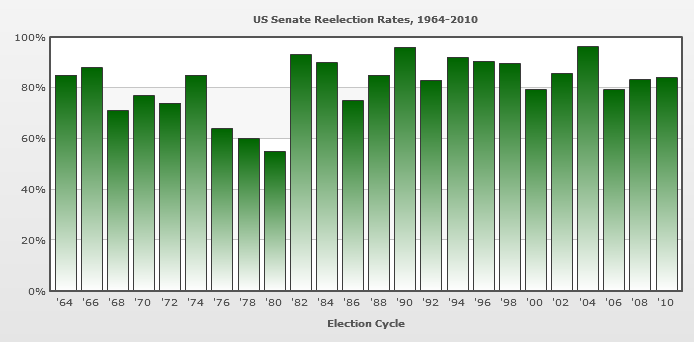
But I digress and you’re wondering how influence ties into this. It will come as no surprise to readers when I state the obvious; nearly every sitting politician wins re-election the vast majority of the time. In fact, it’s staggering how often they win. Take a look at the charts below showing reelection rates for U.S. congressman and senators from the Center for Responsive Politics.


Are incumbents winning so often because they’re the best candidates? Hardly. It’s simply a function of familiarity. People go to the polls and tend to vote for the person they’re most familiar with and the farther you go down in terms of elected offices the worse it is because quite often people vote for the incumbent simply because they know nothing about the other person running. When you’ve seen or heard about your congressman for the past four years or your senator for the last six years that’s a lot of familiarity for a challenger to overcome.
On this subject, in his book Influence Science and Practice, Dr. Cialdini wrote, “Often we don’t realize that our attitude toward something has been influenced by the number of times we have been exposed to it in the past.” And it’s not just how often we hear a name it’s how much we see the face. Sitting politicians are routinely seen in the news and that helps unless their face is connected to a scandal. I can tell you from firsthand experience that I get much better response to my emails when I include my picture at the bottom of the email because familiarity helps.
While there many other things that come into play during an election we can’t underestimate the importance of simply being more familiar with one candidate vs. another. It’s the way we’re wired.
To be sure we – the typical American voter – are partly to blame because we’re notoriously disengaged when it comes to knowing the candidates, their positions, and understanding the issues. If anyone didn’t need term limits it would be presidents because I’d venture to guess we know presidential candidates better and understand the presidential issues more because of how much they’re in the media vs. lower offices and more localized issues.
In a sense terms limits save us from ourselves and how our decision making might be working against us. My boss likes to say, “If you always do what you’ve always done, you’ll always get what you’ve always got.” In other words, how can we expect anything different from Washington when we keep electing the same people for the most part? Yes, we can make a concerted effort to become more informed voters but with less than 60% of people of voting age voting in every presidential election since 1968 do we really think that will happen? I certainly don’t. Sometimes we need laws to protect ourselves from ourselves and I’d say term limits would be one such law.
Brian, CMCT
influencepeople 
Helping You Learn to Hear “Yes”.

Influencers from Around the World – My Favourite Principles of Influence Used by Online Marketers

This month our Influencers from Around the World guest post comes all the way from Ireland courtesy of Sean Patrick. Sean owns his own sales training company, Sean Patrick Training, and writes a blog, Professional Persuader. We met through Facebook several years ago because of Dr. Cialdini and we’ve maintained regular contact ever since. I know you’ll enjoy what Sean has to say this week.


My Favourite Principles of Influence Used by Online Marketers
The following is a list of my all time favourite principles of influence used by online marketers and how I see them used; the good, the bad and the ugly.
1.     Authority
Marketers use this principle to create a sense or feeling of how the potential customer is in safe hands because they make the prospect feel as though they’ve found someone who has or can demonstrate ability, credibility and proof of concept by knowing the exact pain, dissatisfaction and problem that the prospect is currently feeling. It’s a demonstration of experience by telling a story of how the knowledge to overcome the problem or dissatisfaction came about, the journey of anguish and frustration followed by one “Eureka” moment that just blew the problem apart and facilitated a solution.
Solutions imply success and this is where testimonials come in handy. The marketer will supply oodles of proud and happy customer testimonials which make the prospect’s imagination itch with anticipation. Unfortunately all too often the testimonials are nothing more than cronies and affiliates who have an interest in the product’s success by earning commissions on each sale.
The real heavyweight to this principle is when the marketer offers a cast-iron guarantee or assurance as to the efficacy of the product that the prospect will only ever experience success. This deflects any come back to the marketer by implying that it’s the customer’s problem if they don’t experience the same results as all the other customers.
The last piece of the authority principle that the marketer needs to employ is by bringing in the heavy-weight celebrities, famous affiliates or mentioning some major event they sponsor.  The principle of authority when used credibly creates and confirms expertise, but when done in an egotistical manner it implies “Guru Status.” There is a world of difference between the two and self-appointed gurus are best avoided.
2.   Scarcity (Fake Urgency)
When done properly and all other conditions are met this is the one principle to send a would-be buyer over the edge. It makes them buy, especially when potential customers are spoon-fed the notion that what they are pondering is about to be taken away from them due to two things:
a. Limited stock or supply, or
b. Time limited price offer
Scarcity is often perceived as the one to watch out for because it’s been used over and again, but if all the other principles are used effectively then scarcity becomes the trigger that’s easily pulled. The easiest way this is done on the web is by stating right from the start that what is about to be sold is scarce either because of limited supply or because the guy in the stock room messed up and priced all the labels incorrectly, stupidly at a much lower price so therefore the marketer can’t afford to sell the product at the launch price for an extended period.
The reality is that scarcity is quite often fake and the sense of urgency is false; just a ploy. The majority of products sold on the web are information products so how can something produced digitally be of limited supply? The same rule applies with price simply because no one sells anything at a loss; unless it’s a liquidation sale where all stock is liquidated at low prices in order to pay the exorbitant fees of the liquidator. This why a time limited price offer can be extended and often is when the guy in the stockroom screws up again and finds a ton of stock that was hidden under a polythene cover.
In my opinion scarcity is really powerful when people travel and they see something that is scarce back home but is abundant in the region they are travelling through. But the conundrum is either to buy there and then or to go on the web and buy via direct mail when they get back home. Generally, the window of opportunity is narrow for both seller and buyer and most of the time the tourist will succumb and purchase on the spot.
3.   Reciprocity (Concession)
The principle of reciprocity has been killed to death by marketers on the web. The usual tricks follow the pattern of exchanging an email address in return for some pointless or semi-useful report, whitepaper or mp3 that contains only self promoting messages rather than ready-to-use-instantly-valuable information.
A new wave of reciprocity is to receive an invitation from a marketer to a live web-conference where you can learn X and Y and achieve Z for free. It’s like a 3 for 2 offer. This tactic achieves both receiving the identities and email addresses of prospects that sit at the beginning of the sales cycle and during the lead nurturing process the marketer can choose to offer more freebies of varying scales to the prospect with the aim of qualifying the prospect further. The principle of reciprocity states that I’m more compelled to do something for you because you gave me something first that was both personal and timely.
Prospects will begin to find the marketer as a source of authority through a repetitive experience of this principle.
4.   Contrast
Perceptual contrast is one of the sneakiest tricks that a marketer can play out in the online world. The same tricks that a mentalist employs are played out online all the time.
This principle plays stage to how a menu of prices can confuse and distract and leave the customer financially worse off. Just the like the 3 for 2’s you see in the shops a similar price structure ensures that the marketer is maximizing every dollar from every customer. But the pricing structure can be a lot more complicated if bonus materials and legacy products are offered at supposedly discounted prices.
Just like price, how problems are solved can be distorted very easily by using this principle. Questions a lot of people don’t ask themselves before buying include:
a. What will this product really do?
b. How much time do I need to invest in order to get a return?
c. How does the product really work?
More often than not the obvious gets blurred by the use of other principles melding together that creates dissonance in the prospects mind. This in turn creates a contrasting perception of where they are and where they’ll be in the future but at the same time seeing their potential future self in the present because they’ve convinced themselves to buy the marketers product and now feel a part of a tribe of successful like-minded people. They trust wholeheartedly the marketer to be their sole authority over their problem.
5.    Liking
I like you because you appear to be similar to me because of experience, status, color, race, sexuality, football team, or our stamp collection.  ; )
Liking is powerful because it brings about a sense of trust that is long lasting. We all want to be a part of the same crew, tribe, team and corporation or we like people who value our sense of freedom and independence and therefore feel camaraderie. This tactic is very popular with online marketers who launch membership sites that take in monthly fees or marketers who create pre-launch events that bring together the entire pool of prospects who suffer the same dissatisfactions and allow them to network, mingle and produce fellowships by way of interacting in web-chat facilities, forums and social media sites.  It also goes hand in hand with the social proof principle that facilitates the need to purchase even more because people who we came into friending are buying, and those who bought before had huge successes and you know what they were pretty cool people too and I like them!
Hopefully your eyes are open a little wider now and you can spot legitimate use of certain principles of influence vs. illegitimate use.
Cheers,
Sean

To read about Influential Negotiations on Sean’s site click here.