Don’t Live in “Scare City” this Christmas

Yes, it’s mid October and I’m already writing about Christmas. Ho, Ho, Ho, the only surprise might be that I’ve not written about it sooner. I’m not sure what stores are like where you live but around Columbus, Ohio mega-malls are big business and very soon you’ll see Christmas on display. What this means in many cases are great deals to lure shoppers into the stores early. In the retail war the initial battle is to win your attention. “Battle” is not too strong a word because according to Dawn Hudson, Senior VP Marketing at Pepsi, “The average American receives more than 3,000 marketing messages a day!”
So how can a marketer help a retailer stand out from the crowd? A favorite tactic of marketers is to utilize the principle of scarcity to motivate you to get off the couch and visit the store. Scarcity is the term we use to describe the psychological response where people tend to place more value on things when they believe those things are rare or dwindling. If you’re wondering why this is used any more than other methods that’s because it works primarily on the subconscious level. In his book Influence Science and Practice Robert Cialdini describes our almost automatic response as a “click whir” phenomenon.
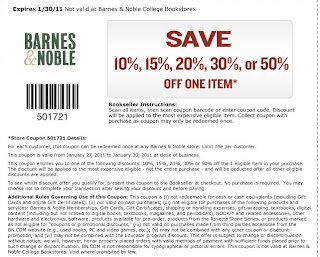
A while ago a friend at work who sat in on my influence training stopped by to give me an advertisement that caught his eye. He was aware of the influence approach Bed, Bath and Beyond took in this mailer his wife received.

The 20% coupon isn’t much different than most retailers. What was different with this one was the call to action: The Sooner You Use it the More it’s Worth! By using the coupon right away you save 20%, but if you wait it’s only worth 10% later. I think that approach is creative for a couple of reasons.

First, the ad incorporates the compare and contrast phenomenon. Most things only have value, or make sense in relation to other things. For example, if I offer you $20 you’re probably pretty happy. But, I’m willing to bet if I offer you $10, then change my mind and give you $20 instead, you’re much happier than having been offered $20 straight up. Why? Simple, now my offer is twice as much as you originally thought you were going to get. If you don’t believe me try it with a few people sometime and see how they react.

The second element of the ad that works well is how it incorporates scarcity. If you don’t use the mailer now it’s only worth half as much later. On the back of the mailer you would have seen the recipient had four full weeks to save 20% on one item, then four more weeks to save 10% on a single item. Something about that seems more motivating to me than a straight up use it or lose it approach.

Pay attention as the Christmas ad bombardment begins. Not only will you see scarcity applied, you’ll see consensus too. After all, if everyone is buying a certain gift you’re kids will probably want that same item too. But if you don’t hurry you might just miss that golden opportunity so get it soon for your kid’s sake! Seriously, there may be great deals and some items might truly be limited but with your eyes open to how retailers are trying to motivate you at least you can pause, think and make the best decision, instead of an impulsive one.
Brian, CMCT
influencepeople
Helping You Learn to Hear “Yes”.

The Trappings of Success

Ever heard of Marc Dreier? Probably not because he was overshadowed by someone I’m willing to bet you have heard of, Bernie Madoff. What a great name – Madoff – because he made off with everyone’s money! Madoff captured headlines about the same time Marc Dreier was being apprehended because Madoff’s billion dollar Ponzi scheme finally blew up. Marc Dreier was involved in his own fraudulent activity, to the tune of $700 million! No small potatoes but not quite the billion dollars Madoff was bilking people out of so Dreier flew “under the radar,” so to speak.

As I watched the 60 Minutes rerun in which Dreier was interviewed something he said caught my attention. When Steve Croft asked about his $18 million yacht, $10.5 million condo and other expensive possessions, Drier said, “Having the trappings of success was an important part of the plan.” The plan he was referring to was getting people to invest in his bogus business deals. When you’re courting millionaires you better look the part yourself if you want their confidence and their money.

All this leads to an important principle of influence – authority. This principle tells us people look to those they view as more knowledgeable than themselves, experts if you will, when they’re not sure what to do. The question is; how do you establish your authority get people to view you as an expert?Dreier was absolutely right when he talked about the trappings of success being necessary. You might be amazed at the difference they can make. And what are these trappings? Let’s look at a few, starting with appearance.Dress for success is more than just a slogan. Believe it or not something simple like a suit can make a big difference because a suit conveys authority. In his book Influence Science and Practice, Robert Cialdini details a study that proves this point as three and a half times more people follow a man in a suit when he crosses the traffic against the light than they followed a man in slacks and a t-shirt. Speaking of dress; wearing a uniform can make all the difference depending on the situation. For example, John Doe telling you to do something might not cause you to act. However, police officer John Doe giving the same instructions in his uniform, would probably elicit action from people.Jewelry, as long as it’s not flaunted in an over the top way, makes a positive difference too. When someone is seen with an expensive designer pen, wearing a Rolex watch or having gold rings, an air of wealthy is conveyed, and wealth usually comes from success.While these can also be false signs of success, too often they’re overlooked by people when they could really help. This comes to mind because not long ago we walked by Radio Shack and I commented about a salesman who’d helped us. Jane said the young guy was nice and helpful but he ought to invest in getting his shirts and pants pressed. Most times we’ve seen him he looks kind of messy and disheveled. A few simple adjustments to his appearance would make a very positive impression and give confidence to potential customers.Like it or not, it’s a fact that people do judge a book by its cover and every person you meet for the first time is assessing you. Sometimes it’s a very conscious act but most of the time it registers in the subconscious. I’m willing to guess there have been times when you met people and instantly liked or disliked them. If you were asked why you might not know the reasons but if you took the time to dissect the situation and your interaction with the person I’m sure you’d piece together all those things your subconscious registered in seconds.So here’s your takeaway – next time you go into a situation where you know you need to be persuasive, give thought to your audience and the environment you’ll be in. Make sure you have the trappings of authority in addition to a persuasive presentation and the odds of hearing “Yes” will increase significantly.Brian
influencepeople
Helping You Learn to Hear “Yes”.

“People forget what you say, but they remember how you made them feel”

Many of you reading have seen Sean Patrick’s name before because he’s written several posts for my Influencers from Around the World series. I asked Sean to write another post to generate interest because he’s in America this week. He’s visiting Columbus, to attend the Principles of Persuasion workshop I’m leading.If you’d like to meet Sean, stop by The Pub at Polaris at 6 p.m. on Friday October 8. In the meantime get to know a little about him by visiting his website, Sean Patrick Training, blog, Professional Persuader or just look him up on Facebook, LinkedIn or Twitter.
“People forget what you say, but they remember how you made them feel”
Warren BeattyPersuasion is defined by many as the ability to move a person or a group from one level of thought or abstraction to a level the person performing the persuasion wants to move them to. Aristotle, often regarded as the founding father of persuasion, devised a simple equation of how persuasion can be both defined and performed with the outcome of moving a person or a group from point A to point B.The process of persuasion, according to Aristotle, needed three elements in order for the movement of abstraction to happen. When these three elements are blended together, this then represents a potent mix of persuasive behavior. And what are the three elements?Pathos – Emotional appeal Ethos – Ethical, character and reputation Logos – Logical
Pathos relates purely to the emotions felt by the audience. As Aristotle put it, persuasion may come through the hearers when the speech stirs their emotions. In other words it is essential to appeal to the emotions felt by your listeners in order to be persuasive. You need EMPATHY.
Ethos related to the speaker and his or her character as revealed through the communication. For the message to be believable there has to be a source of credibility which is something that exists in the minds of the listeners. So it’s the trustworthiness that the speaker has in the eyes of the audience. It relates to the person and refers to the sincerity that exudes from the individual.
Logos refers to the actual words used by the speaker. Choice of words and use of stories, quotations and facts are important in moving the audiences over to your point of view.
I think it’s a great idea to take a look at ourselves and the way we present ourselves to the world. Do we use all three of these elements? Notice how other people present and broadcast their thoughts and ideas. More importantly look for those around you who use all three of these elements and model their behavior. Look at these people as a benchmark for your own communication style. It’ll be worth the effort.
When we look around today, pathos and logos mean nothing when a politician speaks. For example, do we believe the politicians when they tell us that our young men and women need to leave for some distant shore and potentially give up their lives for the good of the country? How about when tax increases are said to be necessary because the banks need more liquidity? Conversely this same rule applies to every other aspect of our lives and notably our personal relationships.
Aristotle’s pathos defines empathy toward the people we share our lives with either directly or indirectly. Showing empathy is a way of providing proof that we both “understand and know how it feels.” And showing this ability to perceive the true feelings of other people that you deal with is at the heart of every successful relationship.
Empathy is the ability to identify and understand the other person’s feelings, ideas and situation. It’s listening with your heart as well as your head; i.e., the ability to read emotions in others. Many people who train in the art of persuasion today, or even people who are professional persuaders prefer to use the term “connection” where empathy is concerned. Empathy is based largely on trust and before this can happen we move to ethos – source credibility or proving sincerity towards an individual or group.
This is essential if any form of persuasion is going to take place in today’s world where people have become increasingly suspicious and have developed a hardened sense of skepticism towards advertising and politics specifically. Sincerity is what allows us to attain a level of trust between people and without this process every other element in Aristotle’s model of persuasion is nullified.
Some people will emit trustworthiness more easily than others and this has been validated by the research of Dr. Robert Cialdini, as illustrated in his persuasion principle known as “Commitment and Consistency.” This is where we grow accustomed to a person because his/her actions are consistent with how we expect him/her to perform, which in turn allows us to trust this person and grow to like them. In essence the more supportive you are, the more a person will allow their true inner feelings, thoughts, desires and fears to surface. And this is a two-way street;the more we are deemed to be trustworthy towards another person the deeper and more personal will be the feelings, thoughts and desires that the person shares with you.
In NLP this is known as “going there first,” specifically within a therapeutic sense, whereby the practitioner will demonstrate empathy and sincerity by going into a genuine state so the client can then follow along and open up to a much deeper level. This same principle applies to every aspect of our lives; it is how we are wired as humans.
These core qualities have recently been highlighted as being “emotionally intelligent.” Having empathy and sincerity are the two things alone which will make you stand out as a persuasion artist even more so than brushing up on technique or presentation of your communication style. If you cannot get to the core of this principle nothing else will ever work. Our interpersonal skill is our ability to understand and act out with other people how they feel, their likes and dislikes and their motivations. The person with this ability can almost predict how others will act and is therefore able to interact with them effectively and be very persuasive. When we look around us we notice how politicians, sales people, hypnotherapists and people who outwardly social animals have this innate sense of developed intelligence.
Sean
Again, if you’d like to meet Sean stop by and see us Friday evening at The Pub at Polaris. Until then, cheers!Brian
influencepeople
Helping You Learn to Hear “Yes”

The Matthew Effect

Not too long ago, I reread The Art of WOO by G. Richard Shell and Mario Moussa. The book focuses on using strategic persuasion to sell your ideas. I particularly like how the authors use real people and real-world examples of both success and failure when analyzing persuasion techniques. The Art of WOO is one of the few books—alongside Robert Cialdini’s Influence: Science and Practice and Yes! 50 Scientifically Proven Ways to Be Persuasive—that I regularly recommend when people ask about good books on influence and persuasion.

In the chapter on “Closing the Sale: Commitments and Politics,” the authors describe something known as the Matthew Effect. Having read through the Bible many times, this reference caught my eye. In the Gospel of Matthew, Jesus—while teaching on the kingdom of heaven—was asked by His disciples why He taught in parables. His reply:

“For whoever has, to him more shall be given, and he will have an abundance; but whoever does not have, even what he has shall be taken away from him.” (Matthew 13:12 NASV)

Social scientists don’t use the Matthew Effect exactly as Jesus did, but rather to describe a phenomenon where people receive more credit or success based on their past achievements. In other words, reputation matters because it builds momentum. This idea closely ties into the principle of influence known as authority.

The principle of authority reflects the reality that people value the advice of experts more than that of the average person. “Average Joe” and “Johnny Expert” might both say the exact same thing and be 100% correct, but more people will believe Johnny Expert. Is that fair? Maybe not—but it makes sense. Experts are generally right more often than non-experts, which is why we place more trust in them.

If you had to bet money, whose advice would you follow: a doctor or a nurse? A general or a foot soldier? A Harvard professor or a high school teacher? I’d place my money on the doctor, the general, and the professor—and I bet most of you would too. While they aren’t always right, they’ve attained their positions through years of training, experience, and being correct more often than not. That’s why they’re viewed as experts.

I covered this in more detail last March in a post titled “Is Expert Advice Always Worth the Price?” In that article, I encouraged people to pay attention because sometimes the advice isn’t worth the asking price.

Now, let’s explore how you can take advantage of the Matthew Effect.

We all know reputation matters—it can help or hinder you. That’s not news. What is new is how much attention it’s gotten in recent years. In today’s business world, the conversation has shifted from “reputation” to personal branding. Just as companies create brands to evoke positive impressions and emotions, individuals are now encouraged to brand themselves.

I wrote a piece on Personal Branding back in July 2009. Just like a great product doesn’t always translate into great sales, sometimes good, hard work goes unrecognized. Personal branding can help change that.

At work, every email I send includes the tagline:
“When it needs to be done well!”
My voicemail starts with:
“Do you need something done well? Then you’ve come to the right place!”

These are small, intentional ways I encourage people to associate me with getting things done right. Of course, a slogan alone isn’t enough—you have to back it up with performance, or your brand will suffer.

Another thing you can do is work to achieve expert status. In my field—insurance—continuing education is essential. As you pass exams, you can earn professional designations. For instance, the CPCU (Chartered Property Casualty Underwriter) is a well-respected credential that usually takes about five years of study to complete.

Sometimes, the fact that people don’t know what a designation means can actually work in your favor. When someone asks me what CMCT stands for (Cialdini Method Certified Trainer), I get to explain—and mention that only about two dozen people in the world hold that title. Sharing how rare it is incorporates scarcity, adding even more weight to my brand.

Finally, being able to tell people that readers from about 140 countries have visited my blog adds credibility and reinforces authority.

So, my question for you this week is simple:
What can you do to start leveraging the Matthew Effect?

What are the things about you that—if people knew—could enhance your credibility and give your ideas more weight? Brainstorm. Talk with coworkers and trusted peers. Make a list. Then start narrowing it down and thinking of creative ways to highlight those personal selling points.

Doing so could make the difference between being heard or ignored, between getting promoted or passed over. Life may happen to us, but how we respond is entirely within our control.

All but one of Jesus’ disciples chose to stick it out with Him. They were exposed to truths others were not—and now they live on for eternity. The Matthew Effect may not be that dramatic for you, but if you learn how to leverage it, it could significantly impact your career.


Brian
influencepeople
Helping You Learn to Hear “Yes”.

An Exercise in Awareness

Click on the picture below to watch a short YouTube video
then we’ll continue on.

If you’re like most people you were probably floored by all that went on in the video that you missed! I know I was first time I watched it. The video is a great exercise in awareness and focus.

I have to confess, I’m not always the most aware guy and this occasionally bites me in my marriage. Many years ago I went to a “gallery hop” art show with my wife. Not exactly my cup of tea but I was trying to be the dutiful husband and act interested. When I saw a painting style I recognized (Monet) I said to Jane, “We have a painting by that guy don’t we?” She said, “We have that painting.” Surprised I replied, “Really?” Jane proceeded to tell me the painting was at the top of the stairs in our house…and had been there about three years! Ooops! Better keep my mouth closed next time.One of my favorite questions to ask when training is this, “Has anyone bought a new car in the past couple of years?” As you would expect there are usually several people who raise their hand. Then I pick someone for a simple follow up question, “What kind of car did you get?”Let’s suppose they say, “I bought a Ford Mustang.” Next I’ll ask, “After you bought the car, did you notice more Mustangs on the road in the days and weeks following your purchase?” You know the answer to that question, a resounding yes. I’ve never had someone tell me they didn’t notice their new car on the road more after getting it.What do you suppose changed? Could it be that there just happened to be a rush on Mustangs at that moment in time? Of course not! The only thing that changed was the buyers’ awareness of that type of car. I use that simple truth to get them to realize they get what they look for.How does this tie into influence? In two basic ways. First, your lack of awareness when it comes to the principles of influence means you’re missing opportunities that could help you hear that one word we all long for when making requests of other people – “Yes!”The more you come to understand the principles of reciprocity, liking, consensus, authority, consistency, and scarcity the more you’ll become aware of all the opportunities to ethically use them when interacting with people. With enough practice you’ll even find yourself using them almost without thinking.The second way awareness ties into influence is protection. That’s right, protection. Let’s face it, there are lots of people out there who understand this stuff but may not be constrained by ethics. I bet every one of you reading this can think of a time where a salesman manipulated you to buy something. Or maybe unethical influence was used on you by someone who took advantage of you in a relationship. What do you think about politicians and manipulation?My point is this; there are many people out there whose livelihood depends on getting you and others like you to say yes. It’s a sad fact that many more than we’d like to admit will do whatever they can to move ahead. Your understanding of the principles of influence is a first line of defense from being taken advantage of.I hope this was an enlightening little experiment for you; an “ah ha” moment perhaps. If you continue to read Influence PEOPLE I guarantee your eyes will be open to new possibilities and you’ll be more aware when it comes to those who seek to take advantage of you. Brian
influencepeople
Helping You Learn to Hear “Yes”

Explaining the Spread of Urban Legends

Did you know syringes have been found in the ball pits at McDonalds? I knew I should have taken the kids to Burger King…except that Burger King guy on those commercials is really creepy!
URGENT PRAYER REQUEST: for a friend of a friend of a friend…Kayala Scott’s 22-month old son shot himself in the chest with a nail gun…I guess that means no more family outings to Home Depot or Lowes.Mr. Rogers was a Marine sharpshooter with numerous kills in Vietnam! No wonder it was a beautiful day in his neighborhood…everyone was scared to death of him!I hope you know none of the above is true. They’re all urban legends; stories that spread spontaneously in various forms. While they’re almost always false far too many people believe them to be true and that’s part of the reason why they live on.You might be reading this with some embarrassment because you’ve passed on one or more of these stories in days gone by to others via email. I’ll make you feel a little better and ‘fess up that I forwarded some of these types of email in the early days of the Internet. I’d like to take a moment to explain some of the psychology about why these stories live on.
First, consider who typically sends these to you – someone you know. If your best friend, neighbor or a relative sends you and email with this kind of news the principle of liking is engaged. We tend to trust those we know and like so when a friend sends you a story, no matter how far out is sounds, most people immediately give them the benefit of the doubt and believe there’s some truth to it. And when a friend asks you to pray and pass along a well meaning email to others the liking principle compels many people to help the cause.It doesn’t take too many forwarded emails to keep it going either. If you get an email and pass it along to a couple dozen friends and only four pass it to another couple dozen and four of those people forward it…by the time that goes through seven iterations it could be passed along to more than 16,000 people!Seeing all those names on an email triggers another psychological principle of influence — consensus. Sometimes known as social proof, consensus tells us people look to others for cues on how to act in certain situations. When you see all those email addresses because the email has been forwarded multiple times it’s natural to assume there’s some validity to what’s being shared. All those names prompt people to continue the behavior.I’m sure many of you reading this are thinking to yourself, “I don’t pass that stuff along anymore.” Good for you but it’s undeniable that others still do and, as I shared earlier, if just four people out of two dozen keep it going it can spread faster than the flu virus through your office or your kid’s school.How can you slow down these kinds of unwanted emails? It’s pretty simple actually. Visit a site to see if what you just got has any validity. Here are just a few sites that can help you. Once you get to a site just do a search on some key words from the email.
Snopes.com UrbanLegends.com Scambusters.org If you find out it’s a hoax hit the Reply All button and politely let your friend know what they shared isn’t true and give the website where you found out. Let them know you got drawn into something similar before and don’t want to see them make the same mistake.A word of caution: whatever you do, don’t lay the person to waste! Once when I passed along a well meaning email about a prayer need someone fired back at me in a pretty harsh way. There’s no place for that, particularly when the email was well intended. Approach the person as you’d like to be approached and as Dale Carnegie encouraged, allow the other person to save face. Do that and you’ll slow the spread of unwanted email and preserve a friendship.Brian
influencepeople
Helping You Learn to Hear “Yes”.

Influencers from Around the World – Influence in Italian Gas Stations

In Italy our highways are called Autostrade and with a very capillary network they cover almost our entire “boot-shaped” peninsula, enabling us to travel from the North of the country down to Sicily in a fast and easy way. Along these roads are many gas stations owned by a company called Autogrill which builds restaurants and drugstores close to the gas stations in order to offer travelers the chance to have coffee, a meal or to buy something along the way. In these shops the principles of influence are used massively and they always attract my attention.

When people stop in one of these places, aside from their need for gas, they enter the building mainly for two reasons: either they need to go to the toilet or they want something to eat or drink. The shop entrance is situated very close to the bar desk and to the toilet entrance. Once these two needs are fulfilled (a cash register is located close to the bar so customers can easily pay) people only want to go back to their cars as fast as possible and to resume their journey. The most logical thing would therefore be to exit from the same door they used to enter the store. However, that would deprive the store owner of a great opportunity – to possibly sell something extra to somebody who is already a customer and who has probably no other explicit need at that point.For this reason, in order to gain the exit, you are forced to take a very long walk within the store, where you are exposed to every sort of product imaginable. This “detour” is created within the store by adding cardboard walls in strategic positions, creating one of those lines which are often seen at airports for passport controls or baggage check-in, filing many people into narrow spaces. On the two sides of the narrow way, customers are exposed to regional foods from every part of Italy, toys, books, fine bottles of wines, and many other consumer products. Most of these products, regardless from the season, are offered with a “50% discount off full price” or with the formula such as “buy one get the second one free.” Both of these of course trigger the reflex to the principle of scarcity.Now, the theory is this; if asked almost nobody among those who take this forced walk would admit to have the original intention to buy a piece of seasoned Parma Ham, a box of “tortellini” home made in Bologna or any other of the goods they are exposed to. However, the fact is, most people end up actually buying something and paying for it at a second cash register which happens to be strategically positioned before the real exit. We can learn two things:1) The products are exposed in a very appealing way. People can smell the fresh food, touch the fabric of goods (because of the narrow space they are almost invited to do so) or open the books to have a look inside. In essence, a need is created by mere exposure. The lesson for you and I is this – by presenting our product in an appealing way, we can create a need where there wasn’t one in the first place.2) The store owner knows if you present these products to a very large number of people
, statistically some will end up buying. Their products are presented, with no alternative, to EVERY single customer because, unless they walk with their eyes closed, they are forced to endure the seemingly endless array of products. We can apply the same principle by doing whatever is necessary to expose our product or service to the highest number of qualified to buyers.So now you are warned, when you come to Italy and need to refill your tank, be ready to make some unscheduled purchases in one of those stores or accept the challenge to resist the impulses driven by the persuasion principles!Marco

I’m sure Marco would enjoy hearing from you so feel free to leave a comment below.
Brian
influencepeople
Helping You Learn to Hear “Yes”.

One Small Step for a Supervisor, One Giant Leap for the Company

Many of you reading this have probably heard Neil Armstrong’s famous words when he stepped on the moon, “One small step for man, one giant leap for mankind.” Several weeks ago at work I saw one small step for a supervisor and possibly one giant leap for our company.

If you’re in a position of leadership then you know you have to rely on others to accomplish your objectives. Increasingly we have to rely on others for their expertise because there’s simply too much to know and understand as man’s collective intelligence increases exponentially.

Quite often the seemingly little things are what end up making the difference. My boss likes to say, “Most companies don’t make million dollar mistakes, they make a million one dollar mistakes.” Not printing on both sides of the paper, not making the choice to email files rather than printing them, and wasting small amounts of money here and there can add up to millions of dollars over the long haul. When it comes to influence, small changes can make big differences too.Several weeks ago a coworker named Jim emailed a number of people asking us to make a technical change to some websites we were responsible for. For various reasons there was a delay getting this taken care of immediately so I knew Jim was anxious to wrap it up when he contacted us a second time. When I got around to doing my part, I hit Reply All and emailed back, “Done. That was easy.” I know many of you detest people who hit Reply All but allow me to explain why I did this.

Jim’s a good guy who is as nice as they come and always helpful to me. Despite his good qualities I know when an IT guy asks non-IT folks to do something the non-IT people tend to drag their feet. Usually they do so because what they’re being asked to do is not a high priority for them and they might be unsure about exactly what to do. I hit the Reply All button to help Jim.

Jim replied directly to me to say thanks. I called him and asked if everyone had done their part and he said no, there was still one person he was waiting on. He said the email was probably buried in Joe’s inbox. I told Jim I had replied to everyone so he could take advantage of consensus, the principle of influence that tells us people look to many others, or similar others, when deciding what to do. This principle is sometimes called social proof. When talking to our kids we call it peer pressure and for students in college it might be known as beer pressure on the weekends.

You see, I had a hunch if someone who’d not done their part saw most others had completed their work they’d feel the pull of the group and do so as well. My advice to Jim was to reply back to my email, including all of us, to say thanks to all those who had done their part. He took the advice and here’s what he wrote:
“Thanks again! I have heard from everyone but Joe. Joe, do you know when you can complete this update? I would like to wrap up this project by the end of the day.” Within seven minutes Joe replied to let us all know he could be numbered among those who’d completed the task! This may not be a big deal to you but it sure was for Jim because that’s one more item he can put to bed allowing him to move on to the next task. And I bet if it was you, you’d be pretty happy too.

Will this be the difference between growth or no growth for my company? Nope. The
difference between profit or unprofitability? Nope. But, imagine every supervisor and manager taking this subtle approach every day, five days a week, 52 weeks a year. That’s a lot of days cut off of projects; and more projects completed giving time for new initiatives to begin.

And this might be the best news for you business owners or those in charge of budgets – it cost nothing! All this took was an understanding of the principles of influence, eyes open to opportunities (they’re everywhere!) and a little creative application to a very routine way of communicating.

So here’s my challenge for readers this week; look at what you do and pause for just a moment to consider how you might ethically employ the power of the crowd, consensus, to move people to do what needs to be done. A few days here, a few days there, and it’s one more project off your list for the week which could add up to good things for you and your company. Brian
influencepeople
Helping You Learn to Hear “Yes”.

I was so mad I could have spit!

Not too long ago, I was so mad I could’ve spit! I really lost my cool, and that actually bothered me more than the situation that got me so upset in the first place. They say real wisdom is learning from others’ mistakes, so hopefully, you’ll be a little wiser having read this.

Let’s back up to the situation and start from there. It was really no big deal—a dead car battery in Jane’s SUV. Fortunately, it was parked at the house and not somewhere on the road. I tried to jump it but had no luck. AAA came out and got the car started, but as soon as we turned it off, it was totally dead again. They started the car one more time, and we let it run for quite some time to charge the battery a little.

Trying to be the dutiful husband, I told Jane I’d drive her car to Advance Auto Parts to get a new battery installed while she worked on dinner. As I drove away from the house, I had one thought in mind—don’t stall the car because I won’t be able to start it again.

Like most men, I thought I knew where I was going, but I ended up at the NAPA store, not Advance Auto Parts. That wouldn’t have been so bad except NAPA was closed. So much for my memory and my assurance to Jane that I knew where I was going! When I realized my dilemma, I called Jane because we’d looked up the store phone number online, so I knew she could easily pull it up and tell me where to go. As she was telling me, I started backing out of the NAPA lot and stalled the car! To make matters worse, it started to thunder and lightning.

So, there I am, having done exactly what I tried not to do—stall the car! Because the battery was dead, there was no air conditioning, and I knew I’d have to wait an hour or so before AAA would come. Great!

While all of this was happening, and curses were flying out of my mouth, Jane was still on the phone. I wasn’t mildly upset; I was totally pissed off. I used to have a really bad temper, and it’s gotten much better over the years, but every now and then it still raises its ugly head. While it’s usually directed at myself for making some kind of mistake, it’s not pretty to be around. It’s a part of me that I really, really dislike.

I usually start my day with this phrase: “This is the day the Lord has made, so I will be glad and rejoice in it. Today will be a good day because I will approach everything with a positive attitude, and I’ll learn from every situation.” Well, my attitude wasn’t so positive there in the NAPA parking lot, but I’m learning from it, and, as I said in the opening, I hope you do too.

Here was my big mistake—I focused on what I didn’t want to happen, which was stalling the car. I can’t remember the last time I stalled the car, but as I left the house, “don’t stall” was front and center on my mind. I should know better because I teach about this in sales courses.

Have you ever seen the television show Frasier? If you have, then maybe you recall the episode where Frasier and Niles tried to learn to ride bikes. Frasier struggled because every time he didn’t want to run into something, he kept his eye on it, thinking that would help him avoid the obstacle, but as you might guess, he’d always run into whatever he kept his eye on! He focused on what he didn’t want to do, and that’s what he ended up doing. Frasier’s dilemma is a picture of what occurs in our brains when we think “don’t…”

You see, the brain doesn’t process the “don’t” in a statement, but it does picture the object. For example, if I tell you, “Don’t think about elephants,” you will think about elephants, at least momentarily. Crazy as it sounds, the more you try not to think about elephants, the more you usually do.

To prove my point, I often ask golfers in my training sessions, “What do you think when you come to a hole with water?” The typical response is, “Don’t go in the water.” When I ask what happens most of the time, people laugh and acknowledge they often end up in the water. Why does that happen? Because the water is what they’re focused on, even though it’s prefaced with “don’t.”

So, what’s a person to do? Very simple: you need to focus on what you want to happen. For me, that would be easy on the golf course, but unfortunately, in the scenario I found myself in, I was blind to my own teaching. In a way, I was like the accountant who forgets to balance his checkbook, the investment guy who’s not saving enough for his own retirement, or the doctor who “occasionally” overeats. I failed to take my own good advice.

I think a couple of good things will come from this. First, because the situation was so emotional for me, I’ll probably catch myself before I make the same mistake again. The other good outcome might be you remembering my story next time you have to make a decision, and your choices are “what to do” or “what to not do.” Take it from me, focus on what you want and leave it at that. Doing so might just save you a big headache and a lot of time.

Brian Ahearn
influencePEOPLE
Helping You Hear “Yes”.

You’re Getting Sleepy, Very Sleepy…

I had lunch recently for the second time with a real live hypnotist, Bill Gladwell. Neither of us could quite remember how we met on Facebook but we did and Bill was kind enough to reach out to me to have lunch. You might be wondering if he hypnotized me; I don’t think so but I did pick up the tab the first time we met. In my defense, I’d planned to do that ahead of time because he made a 30-minute drive to meet me in downtown Columbus.

I’m really glad we hooked up because Bill is a neat guy with fascinating story. As we talked I was interested to learn a little about hypnosis and what he does with his understanding of psychology. I was surprised at how much crossover there was between what he does and the influence training I do.Here’s an example where influence and hypnosis are very similar. Bill talked a lot about creating the right environment for hypnosis and in one of his videos he explained how we go into hypnotic states all the time without realizing it. If you want a familiar scenario consider this; have you ever drove to work, got there then realized you didn’t remember much, if anything about the drive? You were on “autopilot” and mindlessly made your way into work. It’s similar to the “click whir” phenomenon Dr. Robert Cialdini talks about in the opening of Influence Science and Practice.As I’ve mentioned numerous times in this blog, it’s not what you do in the moment of persuasion that’s most important, it’s what you do before that moment. In other words, how you set the stage or create the environment to give you the best chance to persuade is what’s usually most important in the persuasion process.
Play along with me here and be honest; if a total stranger asked you for your phone number and/or email would you give that information to them? I’m willing to bet everyone one of you read that and thought, “No way.” I know that’s what I’d say if you asked me that question. My conversation with Bill helped me realize that’s not necessarily true because the environment can change your response completely. Let me explain.When I was out shopping for my mom’s birthday I went to Bath & Body Works because you can’t really go wrong there shopping for the ladies in your life. After being helped and gathering up several items I waited patiently in line to pay. When it was my turn I was told if I spent a little more I’d actually save money because of a promotion they were having so I grabbed one more small item. The young lady behind the counter proceeded to ring up my order then politely asked, “My I have your phone number?” I mindlessly blurted out the number then gave up my email when asked for that.You and I both know stores don’t need that information to finalize the sale. If I’d given incorrect number or email they’d never know the difference. If I’d have said, “I prefer not to give out that information,” they would not have pushed the issue or denied making the sale. The real point is I didn’t do either and I bet the vast majority of you comply just like I did. We can’t pass off our actions because of authority because what authority does a young lady in her mid-20s have over the customer? I’d say very little to none.
It’s the environment that impacts our behavior along with social proof (a.k.a. consensus). We see and hear other customers giving up that information as we stand in line so it’s natural for us to follow along and do the same when it’s finally our turn to pay and we’re asked the same questions.If you’re like me then you don’t want unwanted text messages or more junk email so next time you find yourself getting sleepy, very sleepy and are about to go into that mindless trance WAKE UP! Quickly ask yourself if what you’re being asked to do is what you really want to do. If you find yourself wrestling with that question then the answer is probably no and you should politely decline to do whatever is being asked. It could save you more than dealing with unwanted texts or email depending on what’s someone is trying to get you to do.Brian
influencepeople
Helping You Learn to Hear “Yes”.